
Trump's Blatantly Unconstitutional Attempt To Punish His Congressional Critics Hits 2 Roadblocks
A grand jury and a federal judge rejected the president’s vendetta against legislators who produced a video about the duty to refuse unlawful military orders.
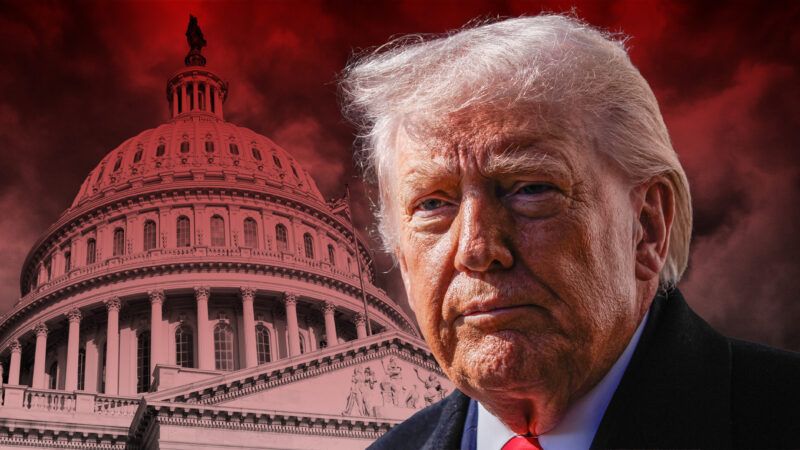
In 2013, several Republican senators questioned President Barack Obama's use of drones to kill suspected terrorists. The lawmakers, who included Sens. Rand Paul (R–Ky.), Ted Cruz (R–Texas), Mike Lee (R–Utah), and Marco Rubio (R–Fla.), were especially troubled by the possibility that drones might be deployed against American citizens on U.S. soil, which they argued would be clearly unlawful in the absence of an imminent threat.
How would Republicans have reacted if Obama, assisted by a Justice Department eager to do his bidding, threatened to arrest and jail those critics? That is how President Donald Trump has responded to Democratic legislators who worry about his potentially illegal use of military power.
Trump's attempt to punish his congressional critics ran into two roadblocks last week. A grand jury rejected a proposed indictment against six legislators who produced a video reminding U.S. military personnel of their duty to "refuse illegal orders," and a federal judge explained why any such prosecution would be blatantly unconstitutional.
The November 18 video did not identify any specific "illegal orders." But it is not hard to imagine how the issue might arise in the context of Trump's domestic military deployments or his murderous campaign against suspected cocaine smugglers.
Trump said the two senators and four representatives who produced the video "should be ARRESTED AND PUT ON TRIAL." But he had trouble explaining what crime they supposedly had committed by reiterating the well-established principle that members of the armed forces "have a duty to disobey" orders that are "manifestly illegal."
Trump called the legislators "TRAITORS" who had engaged in "SEDITIOUS BEHAVIOR." But nothing they did came close to meeting the elements of treason or seditious conspiracy.
If the Justice Department was determined to deliver on Trump's threat, as it clearly was, it needed a different option. Jeanine Pirro, the Trump-appointed U.S. attorney for the District of Columbia, reportedly settled on a statute that applies to someone who "causes or attempts to cause insubordination, disloyalty, mutiny, or refusal of duty by any member of the military or naval forces of the United States."
That offense is a felony punishable by up to 10 years in prison. But it requires an "intent to interfere with, impair, or influence the loyalty, morale, or discipline of the military or naval forces of the United States." And the Uniform Code of Military Justice defines insubordination as willfully disobeying "a lawful order," while the video explicitly addressed "illegal orders."
Grand juries, which hear only the government's side of a case, almost always approve charges recommended by federal prosecutors. But in this case, a grand jury in Washington, D.C., declined to cooperate with Trump's vendetta.
Two days later, U.S. District Judge Richard Leon, a George W. Bush appointee, ruled that the video was "unquestionably protected" by the First Amendment. Leon was responding to a lawsuit by Sen. Mark Kelly (D–Ariz.), a retired Navy captain whom Defense Secretary Pete Hegseth had censured for the video and other public comments that offended him.
Hegseth, who equated criticism of him with "conduct prejudicial to good order and discipline," sought to punish Kelly, a member of the Senate Armed Services Committee, by reducing his retirement rank and pension. He warned that the senator could face "criminal prosecution or further administrative action" if he continued to say things Hegseth did not like.
Leon issued a preliminary injunction barring Hegseth from following through on those threats while the case is pending. Although that decision was limited to Kelly, its logic also condemns any further attempts to treat the video as a crime.
"Under any reading of the law," Leon noted, Kelly's statements "constitute 'speech on matters of public concern' and are therefore 'entitled to special protection.'" Like the Republican senators who criticized Obama's military policies, Kelly and his Democratic colleagues indisputably have a right, as Americans and as legislators charged with overseeing the Pentagon, to speak their minds, even when it irks the president.
© Copyright 2026 by Creators Syndicate Inc.