
A Consumer Fraud Complaint About 'Boneless Wings' Won't Fly, a Federal Judge Rules
Aimen Halim sued Buffalo Wild Wings, saying he was tricked into buying chicken breast nuggets when he thought he was getting deboned wings.
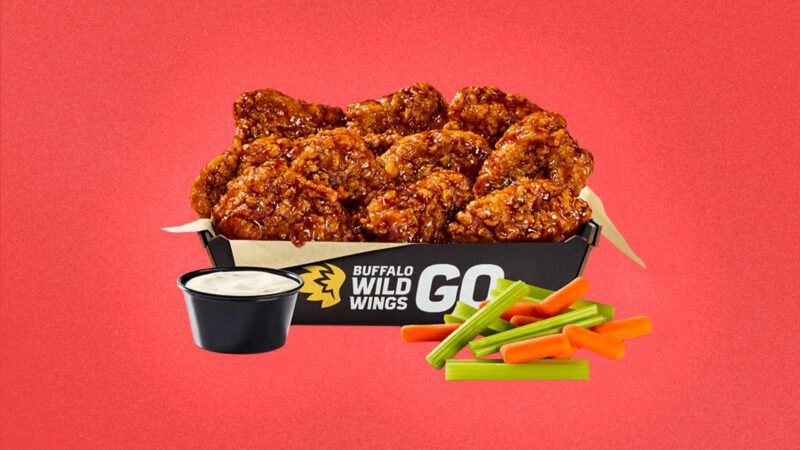
Back in January 2023, Aimen Halim bought an order of "boneless wings" at a Buffalo Wild Wings (BWW) outlet in Mount Prospect, Illinois. At the time, he claims, he assumed the product was composed of deboned chicken wing meat. But to his horror, he discovered that it was in fact made from chicken breast meat. That revelation resulted in a federal lawsuit that Halim filed against the chicken chain two months later, alleging breach of express warranty, common law fraud, and unjust enrichment.
When he dismissed that lawsuit on Tuesday, U.S. District Judge John J. Tharp Jr. did not question Halim's claim of confusion about the nature of boneless wings. But even if Halim honestly thought he was getting a deboned version of BWW's "traditional" wings, Tharp says in his 10-page opinion, "his complaint has no meat on its bones," because "Halim does not plausibly allege that reasonable consumers are deceived by boneless wings."
That conclusion jibes with BWW's cheeky response to Halim's claims. "It's true," the company tweeted a few days after the lawsuit was filed. "Our boneless wings are all white meat chicken. Our hamburgers contain no ham. Our buffalo wings are 0% buffalo."
BWW describes its boneless wings as "juicy all-white chicken." But as The New York Times notes, it is not clear "whether chicken wings are light or dark meat." While "wings are technically white meat," their "fat levels" are similar to those of "legs and thighs."
Even without that clue, Halim's avowed expectation of what he would get when he ordered boneless wings is hard to credit. Halim "says he expected to receive 'wings that were deboned (i.e., comprised entirely of chicken wing meat),'" Tharp notes. "It's unclear what, exactly, Halim expected such wing fillets to look like, or how he thought they would be made, and the complaint does not allege that the 'boneless wings' actually resembled traditional chicken wings (whether the drumettes, the flats, or both). It's also unclear when or how Halim learned that BWW's boneless wings aren't really made from wing meat."
BWW said "a reasonable consumer would not be misled by the term 'boneless wings' because context clues make clear that the nuggets cannot be made of wing meat," Tharp writes. But Halim argued that "the term 'boneless wings' is 'literally false' because the products are not wings."
Tharp thinks that's "debatable." In context, BWW said, "wing" refers to a style of cooking rather than a particular body part. Tharp notes that "words can have multiple meanings." The term "buffalo wing," for example, "refers to the type of sauce on the wing, rather than indicating it is made of buffalo meat." Similarly, "chicken fingers" do not consist of amputated digits. But even if "the term 'boneless wings' is 'literally false,'" Tharp says, that does not necessarily mean it is deceptive.
Since "boneless wings are presented as an alternative to traditional wings," Halim argued, "reasonable consumers would think boneless wings are made from wing meat." But as BWW pointed out, that argument also would apply to the chain's cauliflower "wings," which it likewise offers as an alternative to traditional wings. "If Halim is right, reasonable consumers should think that cauliflower wings are made (at least in part) from wing meat," Tharp writes. "They don't, though."
Halim conceded that point, saying "'cauliflower wing' is clearly a fanciful name because cauliflowers do not have wings." But "'boneless wing' is also clearly a fanciful name, because chickens do have wings, and those wings have bones," Tharp says. "A reasonable consumer would not think that BWW's boneless wings were truly deboned chicken wings, reconstituted into some sort of Franken-wing."
Tharp also notes that BWW's "boneless wings" cost less than its "traditional" wings. "Common sense tells consumers that a product made out of the same ingredients, but requiring more time and work to create, would cost more," he writes. "Moreover, boneless wings are not new; even putting aside the news articles that report that 'boneless wings' have been around since before the turn of the century, Halim's complaint alleges BWW has sold them since 2003. Boneless wings are not a niche product for which a consumer would need to do extensive research to figure out the truth. Instead, 'boneless wings' is a common term that has existed for over two decades."
Halim, in short, "did not 'drum' up enough factual allegations to state a claim," Tharp says. "He does not plausibly allege that reasonable consumers are fooled by BWW's use of the term 'boneless wings.'"
Halim is represented by Treehouse Law, a Los Angeles outfit that bills itself as the country's "premier consumer class action firm." In addition to its beef against boneless wings, the firm has claimed, among other things, that consumers mistakenly think Truffettes de France Truffles are made in France; that Starbucks customers do not realize that its "sprouted grain" bagels are "made primarily with traditional, non-sprouted grains"; and that "100% Biodegradable" WaterWipes "will not completely decompose within a reasonable time period after customary disposal" because they "are customarily thrown in the trash, which means the Wipes ultimately end up in landfills or incinerators."
The consumer injuries described by Treehouse Law may seem trifling. In Halim's case, for instance, his lawyers said he "would have paid less" for BWW's boneless wings if he had known they were "not actually chicken wings" or perhaps "would not have purchased them at all." At the time, the BWW outlet in Mount Prospect was charging $13.49 for an order of 10 boneless wings. But when you multiply that cost, or some fraction of it, by all the similar purchases at the country's 500 or so BWW outlets, you are talking about real money.
If Tharp had approved the nationwide class action that Halim's lawyers proposed, they would have stood to earn a tidy sum for their efforts. But those profits hinged on persuading Tharp that Halim's avowed confusion was not just sincere but also reasonable.
Tharp gave Halim a month to file an amended complaint. But he says "it is difficult to imagine that Halim can provide additional facts about his experience that would demonstrate that BWW is committing a deceptive act by calling its nuggets 'boneless wings.'"