
Trump Backpedals From Portraying Alex Pretti As a 'Domestic Terrorist' and 'Would-Be Assassin'
Although the president initially reinforced that plainly inaccurate narrative, his subsequent comments cast doubt on the initial justification for shooting the Minneapolis protester.
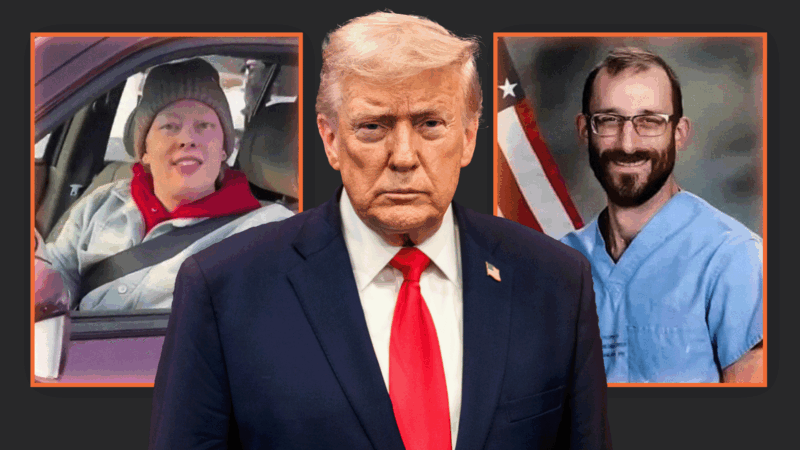
After Immigration and Customs Enforcement (ICE) agent Jonathan Ross fatally shot Minneapolis protester Renee Good on January 7, President Donald Trump claimed she "violently, willfully, and viciously ran over the ICE Officer, who seems to have shot her in self defense." Trump added that "it is hard to believe he is alive" after that purported vehicular assault. A week later, the president retreated from that characterization. Although "her actions were pretty tough," he told CBS News, "I would bet you that she, under normal circumstances, was a very solid, wonderful person."
Something similar happened after U.S. Border Patrol agents fatally shot another Minneapolis protester, Alex Pretti, on Saturday morning. Various Trump administration officials immediately described Pretti as "a domestic terrorist" and "would-be assassin" who was "brandishing" a gun, who "was there to perpetuate violence," who "attacked those officers," who "tried to assassinate federal law enforcement," and who "wanted to do maximum damage and massacre law enforcement." Although Trump initially reinforced that framing, his subsequent comments suggested the circumstances of Pretti's death were not as clear as those officials implied.
In both cases, video evidence contradicted the government's version of events. Since millions of Americans have seen footage of the Good and Pretti shootings, which does not support the claim that either was bent on murder, Trump had to choose between sticking with a clearly false narrative, asking Americans to disbelieve their lying eyes, and back-pedaling from that blatantly inaccurate story. Although respect for reality has never been one of Trump's strong suits, he seems to have taken the latter course.
In a Truth Social post on Saturday afternoon, Trump echoed Secretary of Homeland Security Kristi Noem, Border Patrol Commander Gregory Bovino, and White House Deputy Chief of Staff Stephen Miller, all of whom asserted that Pretti intended to kill the agents who killed him. "This is the gunman's gun," Trump wrote above a photograph of the 9-mm Sig Sauer pistol that Pretti was legally carrying. The handgun was "loaded" and "ready to go," Trump said, faulting "the local Police" for failing to "protect" the Border Patrol agents.
The implication of murderous intent was complicated by videos of the incident showing that Pretti never unholstered his gun, which the agents did not discover until after they tackled him. The footage also indicated that one of the agents had disarmed Pretti by the time the shooting started.
In a Truth Social post on Sunday afternoon, Trump took a notably different tack, blaming state and local Democrats for creating "chaos" by refusing to cooperate with his immigration crackdown. "Tragically," Trump wrote, "two American Citizens have lost their lives as a result."
White House Press Secretary Karoline Leavitt was singing the same tune. "Nobody, including President Trump, wants to see people get shot or hurt," she told CBS News. "That's exactly why [Minnesota] Governor [Tim] Walz and [Minneapolis] Mayor [Jacob] Frey need to allow local police to work with federal law enforcement to remove illegal alien criminals, murderers, and pedophiles from Minnesota."
Secretary of Veterans Affairs Doug Collins, whose department employed Pretti as an intensive care nurse in Minneapolis, echoed that message in an X post on Sunday afternoon. "As President Trump has said, nobody wants to see chaos and death in American cities, and we send our condolences to the Pretti family," he wrote. "Such tragedies are unfortunately happening in Minnesota because of state and local officials' refusal to cooperate with the federal government to enforce the law and deport dangerous illegal criminals."
As Trump, Leavitt, and Collins tell it, criticism from Democrats such as Walz and Frey has encouraged protests against immigration enforcement, which in turn have created the circumstances in which ICE and Border Patrol agents feel compelled to use force against protesters. Whatever you make of that argument, the language used by Trump and Collins is telling. If Good and Pretti were in fact bent on murdering immigration agents, it would be strange to describe their deaths as "tragedies," as opposed to the obviously justified consequences of violent aggression. When police or bystanders interrupt a mass shooting by killing the gunman, for example, politicians do not view that use of deadly force as a tragedy.
That label suggests Good and Pretti died in complicated circumstances that may have involved errors or misunderstandings. That does not necessarily mean the shootings were legally unjustified. It is possible that Ross and the Border Patrol agents reasonably perceived potentially deadly threats at the moment they fired their weapons, even if that perception seems mistaken in retrospect (although it both cases the rounds fired after the initial shot seem especially hard to justify). But that is a far cry from the snap judgments that federal officials, including Trump, made immediately after the shootings, which portrayed Good and Pretti—U.S. citizens with no criminal records or known histories of violence—as malicious and murderous.
In an interview with The Wall Street Journal on Sunday, Trump notably declined to say whether he thought the agents who shot Pretti had acted appropriately in the circumstances. "We're reviewing everything and will come out with a determination," he said.
Trump nevertheless suggested there was something inherently suspect about Pretti's decision to exercise his constitutional right to bear arms. "I don't like any shooting," he said. "But I don't like it when somebody goes into a protest and he's got a very powerful, fully loaded gun with two magazines loaded up with bullets also. That doesn't play good either."
Trump seems to think that anyone who brings a gun to a protest is asking for trouble, a position that is hard to reconcile with his avowed commitment to "protecting Second Amendment rights." Nor is that the only reason to doubt that the review he promises will satisfactorily address the questions that any fair-minded person would have after watching footage of the Pretti shooting. That review is being conducted by the Department of Homeland Security, the head of which has already prejudged the outcome.