
The Rip Is a Just-OK Miami Cop Thriller That's Really About Netflix
Matt Damon and Ben Affleck play Florida police officers who stumble into a giant cash stash.
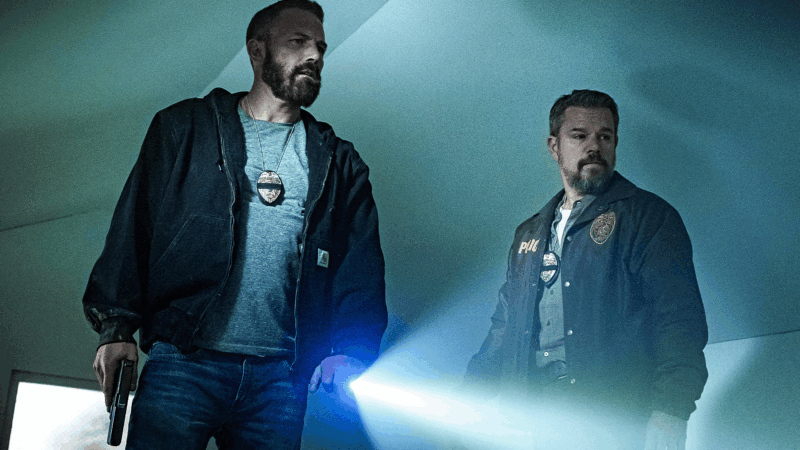
Looked at one way, The Rip is just a story about corrupt Florida cops. Loosely—very loosely—based on the true story of some Miami police officers who found a giant stash of drug money in a suburban house, The Rip takes that setup and spins it into a twisty yarn about betrayal and self-dealing, as a cop unit sniffs out likely traitors in their midst. Released by Netflix and starring Matt Damon and Ben Affleck as the unit's rivalrous alphas, it's another one of Netflix's particular brand of high-end, star-fronted, TV movie of the week, in which big-name stars are given big paydays to skip theaters and go directly to streaming.
As a tough-guy vehicle for Damon and Affleck to chew scenery and bump chests, it's competent enough, if vaguely underwhelming in the way that Netflix originals tend to be. But as a metaphor for the changing state of the movie business in the streaming era, it's surprisingly adept.
As the movie begins, Affleck and Damon—it doesn't matter what their character names are—are in the midst of an official inquest into the killing of a Miami police detective. There's a complicated backstory about various specialized units that have been broken up and defunded, and the hard feelings that have resulted. And there's a generalized suspicion in the department that some cops have gone rogue, perhaps even forming informal takedown squads designed to illegally seize drug money for themselves.
As veteran officers, Affleck and Damon have chips on their shoulders about the timid, bureaucratic state of policing and their own careers. "I hate being a cop," Damon sighs in the police department bathroom. They're a couple of middle-aged professionals looking at a business that is changing underneath them.
Inevitably, a tip leads them to a "rip," a cartel stash house that supposedly has six figures worth of dirty cash hidden away. But the stash turns out to be much, much larger: some $20 million. And the only people who know about it are them and the other cops in their crew.
That's the kind of bankroll that can drive even good cops to go bad. It's also the kind of money that makes for serious external danger. Not only do they have to worry about criminals coming to claim their cash, but they also have to make sure they get the police procedure precisely right, so as not to arouse the suspicions of internal investigators already on high alert. That means laboriously counting the money on site, while danger looms outside.
As the count proceeds, Damon and Affleck square off. Is there a traitor in their midst? Is one of them working with the cartels? Is one of them trying to make off with the money?
It's just tense and moody and macho enough to keep watching, but the answers are less interesting than the questions themselves, and the film never rises above the basics of its bad-cop premise. The real-life events the film is based on weren't nearly as twisty or corrupt, so it's disappointing to see those added narrative elements play out with such a shrug.
The Rip isn't really interested in police culture or procedure. It's better understood as a movie about Hollywood, and how the foundations of the business as it used to exist are collapsing. Theaters are struggling. Studios are merging. Even successful middle-aged professionals—like, one suspects, Matt Damon and Ben Affleck—have become somewhat sour about their industry. And the only way to succeed is to score a big payday with a streaming service like this film's backer and platform host, Netflix.
When the Boston pals broke into the business in their early 20s with the Oscar-winning Good Will Hunting, the movie business was markedly different from what it is today. A modestly budgeted original drama could gross $225 million at the box office and make its 20-something screenwriters stars. That's nearly impossible to imagine today, and it surely has an effect on their feelings toward the industry.
So it's not surprising that the most entertaining aspect of The Rip is not the movie but the press tour, in which Affleck and Damon have grumbled about the use of artificial intelligence in screenwriting and explained that because Netflix knows that so many viewers are watching movies while scrolling their phones, screenplays have to be written to repeatedly emphasize basic plot mechanics, almost as if characters are narrating their actions on screen for inattentive viewers.
Yet there's still serious money in streaming, even if the product is often mediocre. And when top box office stars lend their faces to streaming features, the big paydays tend to be around…$20 million. That's in the neighborhood of what Damon and Affleck's Boston contemporary, Mark Wahlberg, now regularly commands for a direct-to-streaming picture. Wahlberg is streaming's most successful leading man; for him, every film is a big rip. Why shouldn't Affleck and Damon get in on the action too?