
ICE Agents Flouted DHS Policies That Could Have Prevented Renee Good's Death
DHS tells officers to use "de-escalation tactics," employ "a verbal warning" instead of force when feasible, and avoid "placing themselves in positions" that trigger the use of deadly force.
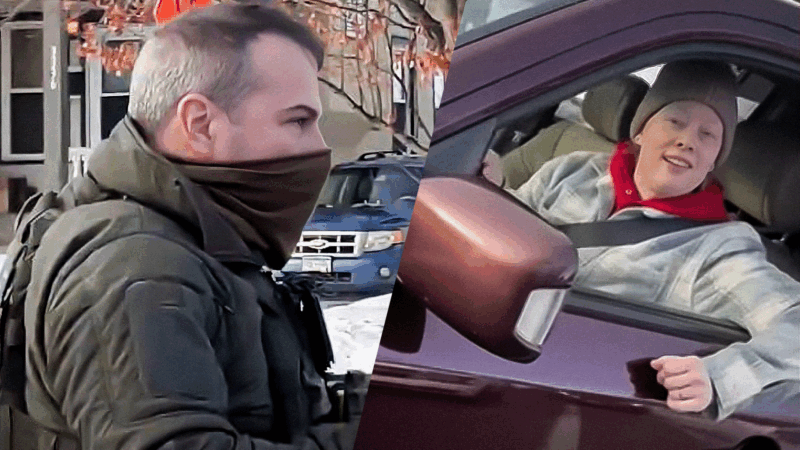
When Immigration and Customs Enforcement (ICE) agent Jonathan Ross approached Renee Good's Honda Pilot at 9:35 a.m. on Wednesday, January 7, his cellphone video of the encounter shows, she was smiling at him. "That's fine, dude," Good assured Ross from the driver's seat, apparently referring to the fact that he was recording her. "I'm not mad at you." Within two minutes, Ross had fatally shot Good. "Fucking bitch," he said as the unguided SUV careened down the street before crashing into a parked car.
The controversy over that shooting has focused mainly on the question of whether it was legally justified, which depends on whether Ross reasonably believed, given "the totality of the circumstances," that the use of deadly force was necessary to protect himself, his colleagues, or the general public from the threat Good allegedly posed as she began to drive away. But the swift escalation from a calm interaction to lethal gunfire also raises questions about how Ross and the other ICE agents at the scene handled the encounter before he killed Good—in particular, whether they followed policies and practices aimed at avoiding such outcomes.
The Department of Homeland Security (DHS), which includes ICE, emphasizes that its employees "may use force only when no reasonably effective, safe, and feasible alternative appears to exist and may use only the level of force that is objectively reasonable in light of the facts and circumstances confronting [the officer] at the time force is applied." Because "respect for human life" is a guiding principle, the DHS policy says, officers should be "proficient in a variety of techniques that could aid them in appropriately resolving an encounter," including "de-escalation tactics." De-escalation, DHS explains, is "the use of communication or other techniques during an encounter to stabilize, slow, or reduce the intensity of a potentially violent situation without using physical force, or with a reduction in force."
There is little evidence that Ross or his colleagues took that guidance to heart. The problem they initially confronted was not complicated: Good had positioned her car sideways on Portland Avenue, partly blocking the one-way street and forcing motorists to drive around her. "We stopped to support our neighbors," Good's wife later told Minnesota Public Radio. "We had whistles. They [the ICE agents] had guns."
The orange whistles to which she referred, one of which can be seen around her neck in Ross' video, are a favorite tool of anti-ICE protesters in Minneapolis, who blow them when they see ICE agents in action. Antonio M. Romanucci, a lawyer for Good's family, told The New York Times that Good and her wife had just dropped Good's son off at school and were driving home when they saw ICE agents and decided to stop.
"That was something that was happening very close to where they live," Romanucci said. "And just like anybody else who lives in the neighborhood, if there's activity in the neighborhood, they're going to be asking what's going on." Although Romanucci declined to comment on Good's prior activism, her wife's whistle, her wife's comments in Ross' video, and a message that Good shared with parents at her son's school indicate that the couple, who moved to Minneapolis last March, had been involved in anti-ICE protests for a while.
Good stopped near several unmarked ICE vehicles and had been there a few minutes when ICE agents first approached her. A witness reported that one of the agents initially told Good to drive away, which would have been a straightforward and peaceful way to resolve the situation. But another agent took a more aggressive approach. "Get out of the car," he told Good. "Get out of the car. Get out of the fucking car. Get out of the car."
Immediately after those rapid-fire commands, bystander video shows, that agent grabbed the handle of the front driver's side door and reached into the car. At that point, the car backed up a bit and then started moving forward, the front wheels turned to the right—away from the ICE agents. "Drive, baby, drive," said Good's wife, who was standing outside the car. Ross, who initially was standing near the SUV's left headlight but quickly moved out of its path, responded by firing three shots into the car, one through the lower left corner of the windshield and two through the front driver's side window.
According to DHS Secretary Kristi Noem, President Donald Trump, and Vice President J.D. Vance, all of those shots were fired in self-defense. Whether or not you agree, it is easy to imagine an alternative scenario in which Good would still be alive. If the agents had simply allowed her to leave, which would have addressed the problem that provoked their intervention, the threat that Ross perceived never would have arisen. Instead, the ICE agents seemed determined to forcibly remove Good from the car and arrest her, which presumably was the outcome that Good tried to avoid by driving away.
"When feasible, prior to the application of force, [officers] must attempt to identify themselves and issue a verbal warning to comply with [their] instructions," the DHS policy says. In this case, the ICE agent who grabbed Good's car did not identify himself. And while he did issue commands that might qualify as "a verbal warning," he immediately resorted to the use of force without giving Good a reasonable chance to comply.
In these circumstances, it was surely unwise for Good to react the way she did. And if her car "clipped" Ross (as the New York Post describes it) before he got out of the way, her recklessness demonstrably endangered him. But whether you view his reaction as justified self-defense or angry retaliation, all of this could have been avoided if the ICE agents had kept their cool.
It also could have been avoided if Ross had not carelessly positioned himself in front of Good's car, which was contrary to DHS policy as well as standard police training. DHS warns that officers should "avoid intentionally and unreasonably placing themselves in positions in which they have no alternative to using deadly force."
That is not just good practical advice. It can figure in the legal analysis of whether a particular use of force was consistent with the Fourth Amendment.
Last year in Barnes v. Felix, the Supreme Court emphasized that a court assessing the use of deadly force "must consider all the relevant circumstances, including facts and events leading up to the climactic moment." That case involved a Texas police officer who stopped a car for suspected toll violations. After endangering himself by jumping on the car as it began to move again, he addressed the resulting hazard by shooting the driver dead. The justices unanimously rejected the Fourth Amendment test applied by the U.S. Court of Appeals for the 5th Circuit, which focused on "the moment of the threat" to the officer without considering how he ended up in that situation.
The Supreme Court did not decide whether the officer's reckless behavior made his use of deadly force unconstitutional, instead instructing the 5th Circuit to reconsider that question under the proper Fourth Amendment test. But even if Ross' carelessness does not defeat his self-defense claim, the fact that he fired at least two shots when he was no longer in the path of Good's car complicates the analysis. So does the fact that shooting Good did not stop the car but instead increased the danger it posed by killing the person who was controlling it.
In general, DHS says, officers "may use deadly force only when necessary, that is when the [officer] has a reasonable belief that the subject of such force poses an imminent threat of death or serious bodily injury to the [officer] or to another person." And in situations like the one that Ross faced, officers "are prohibited from discharging firearms at the operator of a moving vehicle, vessel, aircraft, or other conveyance unless the use of deadly force against the operator is justified under the standards articulated elsewhere in this policy." They "must take into consideration the hazards that may be posed to law enforcement and innocent bystanders by an out-of-control conveyance" before "using deadly force under these circumstances."
Based on the evidence so far, there is reason to doubt that Ross followed these rules. But however you assess his decision to fire his weapon, it seems clear that his conduct prior to the shooting, coupled with his colleague's hot-headedness, led to a fatal outcome that easily could have been avoided.