
The Trump Administration Says It's Illegal To Record Videos of ICE. Here's What the Law Says.
"Violence is anything that threatens them and their safety, so it is doxing them, it's videotaping them where they're at when they're out on operations," Homeland Security Secretary Kristi Noem said.
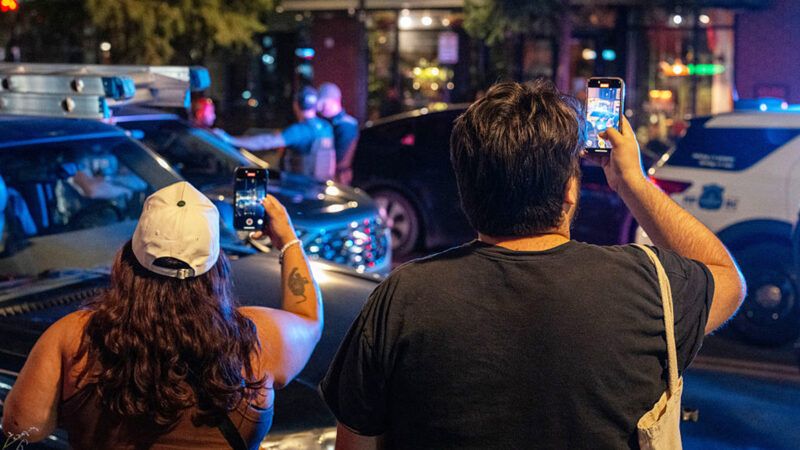
The Trump administration believes you don't have the right to record Immigration and Customs Enforcement (ICE) officers in public. This stance is both factually wrong and an attempt to chill free speech by conflating it with violence.
At a July 2025 press conference in Tampa, Florida, Department of Homeland Security (DHS) Secretary Kristi Noem said, "Violence is anything that threatens them and their safety, so it is doxing them, it's videotaping them where they're at when they're out on operations, encouraging other people to come and to throw things, rocks, bottles."
In September 2025, DHS Assistant Secretary for Public Affairs Tricia McLaughlin called "videotaping ICE law enforcement and posting photos and videos of them online" a form of doxing. She added, "We will prosecute those who illegally harass ICE agents to the fullest extent of the law."
These aren't idle threats. The Trump administration strong-armed Apple into removing an app from its mobile store that tracked ICE activity and threatened criminal investigations into its creators.
The most aggressive application of this policy has come in Chicago under "Operation Midway Blitz," where ICE officers have relentlessly targeted protesters, reporters, and clergy engaged in protected First Amendment activity.
In October, a group of journalists and protesters filed a lawsuit alleging "a pattern of extreme brutality in a concerted and ongoing effort to silence the press and civilians."
In court filings, the plaintiffs stated that federal officials' own testimony illustrated their point. For example, when ICE field director Russell Hott was asked if he agreed "that it's unconstitutional to arrest people for being opposed to Midway Blitz," he answered "No."
"Similarly, [U.S. Customs and Border Protection Commissioner Greg] Bovino testified that he has instructed his officers to arrest protesters who make hyperbolic comments in the heat of political demonstrations, even though such statements—which do not constitute true threats—are protected speech," the motion argued. (Hott and Bovino's depositions were filed under seal, and those comments were later redacted in a corrected filing by the lawsuit plaintiffs, but not before others took screenshots of them.)
Based on voluminous evidence that feds in Chicago ignored her previous orders to curb their use of force, U.S. District Court Judge Sara Ellis issued a preliminary injunction against DHS in early November 2025, saying the government's conduct "shocked the conscience."
Ellis found much of the officials' testimony not credible. Bovino, for instance, testified that he never used force against a protester he was filmed tackling, and in another instance, Ellis said, he lied about being hit with a rock before firing tear gas at demonstrators. Nor did evidence support the government's claims that federal officers issued warnings before firing less-than-lethal projectiles at those protesters.
"Describing rapid response networks and neighborhood moms as professional agitators shows just how out of touch these agents are, and how extreme their views are," said Ellis.
The Trump administration responded by calling Ellis an "activist judge," but it is squarely wrong when it comes to recording and protesting the police. Cato Institute senior fellow Walter Olson points out that, "While the Supreme Court itself hasn't yet faced the issue squarely, the seven federal circuits that have done so…all agree that the First Amendment protects the right to record police performing their duties in public."
Likewise, federal circuits have upheld the right to use vulgar language to oppose police without fear of retaliation, and to warn others of nearby police checkpoints or speed traps.
As Olson writes, the administration's "attempt to alter reality by establishing new legal facts on the ground" ultimately serves as a green light for informal repression. "If the agents come to believe that they have blanket immunity [for] whatever they do, or that citizens have no right to record them, they are more likely to take aggressive informal action, such as grabbing phones or taking news reporters into custody on charges of obstruction (perhaps later quietly dropped)."
It's not hard to find examples of this rotten agency culture in practice. In late October 2025, ICE officers broke out the window of a U.S. citizen's car and detained her for seven hours after she followed and photographed their unmarked vehicles. DHS accused her of reckless driving, attempting to block in officers with her car, and resisting arrest—all claims that she and her lawyer deny. Prosecutors did not charge the woman with a crime.
Recording government agents is one of the few tools citizens have to hold state power accountable. Any attempt to redefine observation as "violence" is not only unconstitutional—it's authoritarian gaslighting. When a government fears cameras more than crimes, it isn't protecting the rule of law. It's protecting itself.