
Ayn Rand Denounced the FCC's 'Public Interest' Censorship More Than 60 Years Ago
In her 1962 essay "Have Gun, Will Nudge," Rand foresaw how government officials would seek to silence people they don't like.
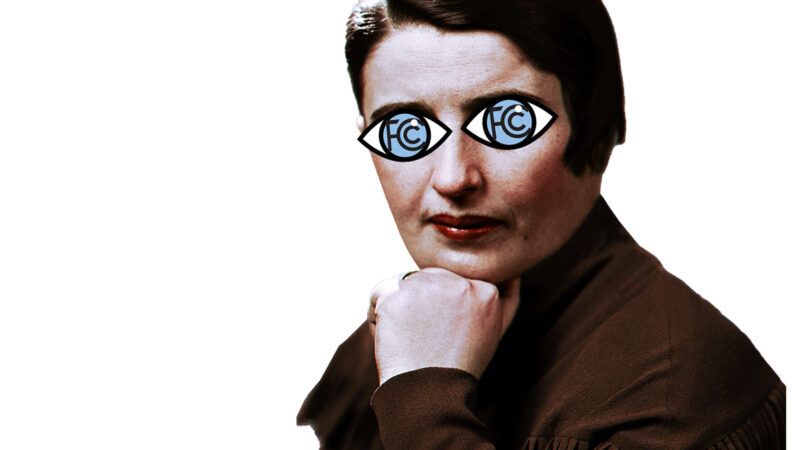
After Jimmy Kimmel delivered a misinformed monologue about the assassination of Charlie Kirk, Federal Communications Commission (FCC) Chair Brendan Carr pressured broadcast channels to take the comedian off the air. Carr faced immediate pushback: Republican Sens. Rand Paul of Kentucky, Ted Cruz of Texas, and Dave McCormick of Pennsylvania all chastised Carr for trying to use his position to steer private companies' editorial decisions—a serious breach of free speech principles.
Carr is not without his defenders, however. Nathan Leamer, tech policy writer and onetime adviser to former FCC Chair Ajit Pai, asserts that Carr's actions fall squarely within his duty to promote the "public interest" on television, as defined by the Communications Act of 1934. He also assails libertarians in particular for not caring about how the FCC works, and he suggests that such skeptics are incorrectly or selectively railing against the public interest standard in the Kimmel case.
But fans of the free market have been warning that broad interpretations of the public interest standard will empower the FCC to engage in censorship for over 60 years. Just read Ayn Rand.
In 1962, Rand penned a prophetic warning about the public interest standard, which then–FCC Chair Newton N. Minow was citing to justify pressuring television companies to create more educational programming. Minow famously railed against a supposedly "vast wasteland" of shoddy television shows, and he claimed that the FCC's charter empowered him to push for editorial changes to the medium that would align with his view of the public interest.
"You must provide a wider range of choices, more diversity, more alternatives," said Minow in his well-remembered 1961 speech. "It is not enough to cater to the nation's whims; you must also serve the nation's needs."
Minow repeatedly claimed that he was not in favor of government censorship and was not trying to tell broadcasters what they could and could not say. Rather, he charged them to make nebulous and ill-defined improvements to the product that he believed would be better appreciated by the American public—i.e., the public interest.
In her March 1962 essay "Have Gun, Will Nudge," Rand argued that this was censorship by another name. "It is true, as Mr. Minow assures us, that he does not propose to establish censorship; what he proposes is much worse," she wrote. Unlike explicit bans on speech, Rand warned, the modern method of censorship "neither forbids nor permits anything; it never defines or specifies; it merely delivers men's lives, fortunes, careers, ambitions into the arbitrary power of a bureaucrat who can reward or punish at whim."
This strong-arming, she argued, spares the bureaucrat from rules or standards and instead "places upon the victims the burden of discovering how to please him, with a fluid unknowable as their only guide."
She even imagined how such influence could play out in practice. "A federal commissioner may never utter a single word for or against any program. But what do you suppose will happen," Rand asked, "if and when, with or without his knowledge, a third-assistant or a second cousin or just a nameless friend from Washington whispers to a television executive that the commissioner does not like producer X or does not approve of writer Y or takes a great interest in the career of starlet Z or is anxious to advance the cause of the United Nations?"
The title of the essay was inspired by Rand's contention that a man who holds a gun to your head and demands your wallet is surely deploying impermissible force rather than mere encouragement. When the FCC chair proclaims that a private company can "do this the easy way or the hard way," he is providing a similar kind of nudge.
"What makes it possible to bring a free country down to such a level?" Rand asked. "If you doubt the connection between altruism and statism, I suggest that you count how many times—in the current articles, speeches, debates and hearings—there appeared the magic formula which makes all such outrages possible: 'The Public Interest.'"