Reason.com - Free Minds and Free Markets
Reason logo Reason logo
  • Latest
  • Magazine
    • Current Issue
    • Archives
    • Subscribe
    • Crossword
  • Video
    • Reason TV
    • The Reason Roundtable
    • Just Asking Questions
    • Free Media
    • The Reason Interview
  • Podcasts
    • All Shows
    • The Reason Roundtable
    • The Reason Interview With Nick Gillespie
    • The Soho Forum Debates
    • Just Asking Questions
  • Volokh
  • Newsletters
  • Donate
    • Donate Online
    • Donate Crypto
    • Ways To Give To Reason Foundation
    • Torchbearer Society
    • Planned Giving
  • Subscribe
    • Reason Plus Subscription
    • Gift Subscriptions
    • Print Subscription
    • Subscriber Support

Login Form

Create new account
Forgot password

Congress

How Congress Keeps Its Sexual Harassment Hush Money Secret

Documents from a $27,000 harassment settlement from Rep. John Conyers' office show how Congress keeps its tax-funded settlements secret.
C.J. Ciaramella | 11.21.2017 12:18 PM

Share on FacebookShare on XShare on RedditShare by emailPrint friendly versionCopy page URL Add Reason to Google
Media Contact & Reprint Requests
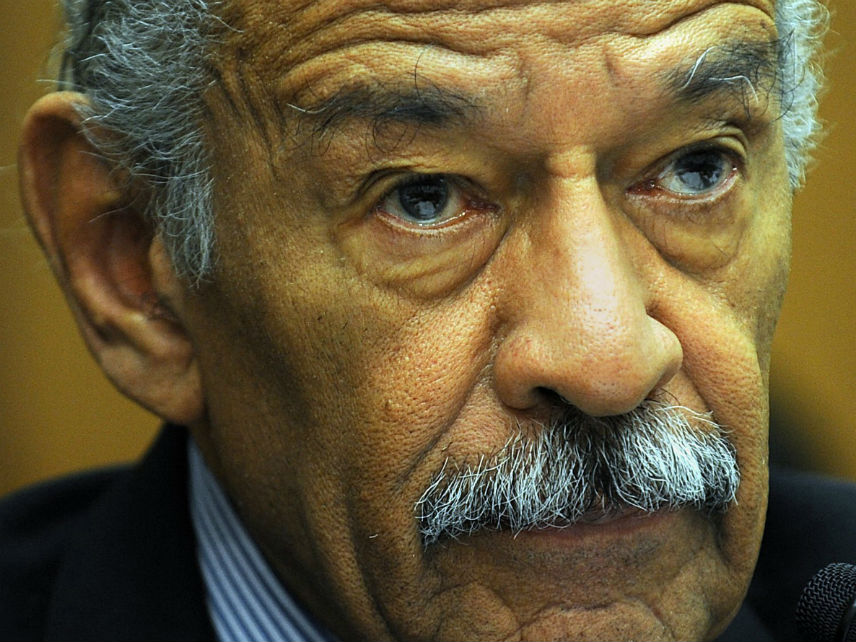
Rep. John Conyers (D-Mich.) // Astrid Riecken/TNS/Newscom

BuzzFeed reported Tuesday night that the office of Rep. John Conyers (D-Mich.) paid $27,000 to settle a previously undisclosed sexual harassment complaint against the lawmaker. The story is notable not just for the allegations against a powerful member of Congress, but for shedding light on the highly opaque process through which the House of Representatives handles such settlements—and keeps them concealed.

Amid the cascade of sexual harassment allegations ignited by The New York Times' exposé of Harvey Weinstein, Rep. Jackie Speier (D-Calif.) told MSNBC earlier this month that the House had paid out millions of dollars over the last decade to settle sexual harassment claims.

Under public pressure, the Office of Compliance, which acts as the House's rough simulacrum of a human resources department, released documents showing it had paid out $17 million since 1997 to settle a variety of workplace claims, including sexual harassment.

The details of those settlements, including their nature, are confidential. Claimants are required to sign a nondisclosure agreement to begin the lengthy mediation process.

Last week Speier introduced legislation that would prohibit Congress from requiring nondisclosure agreements in such situations and would require regular reporting of settlements.

"In 1995, Congress created the Office of Congressional Compliance to protect itself from being exposed, and it has been remarkably successful," Speier said in a statement. "Twenty years later, 260 settlements and more than $15 million have permanently silenced victims of all types of workplace discrimination. Zero tolerance is meaningless unless it is backed up with enforcement and accountability."

"It's clear that our country is at an inflection point with respect to the behavior of powerful men across our society," says Alex Howard, deputy director of the Sunlight Foundation, a group that works for government transparency. "Congress itself is neither excluded nor sacrosanct from that reckoning, but continued secrecy will hinder public understanding of how our representatives conduct themselves in office. Ethical standards that include training, oversight, and public disclosure of all past settlements online as open data are in the public interest, and we hope that Congress does so."

It's important to understand just how secretive the current House process for settling harassment claims is.

In most regular cases, lawsuit settlement by the federal government go through the Treasury Department's Judgement Fund, which has an online, searchable database of payouts, filterable by agency and date.
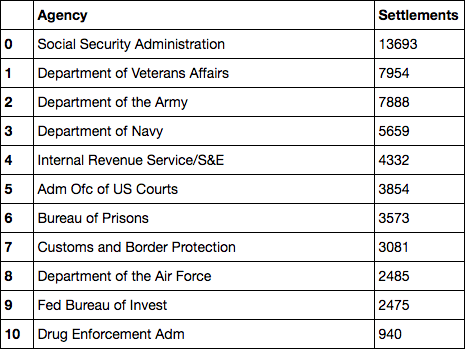
Top federal agencies by number of settlements since 2007 // Reason

For example, the Department of Veterans Affairs has settled nearly 8,000 lawsuits between 2007 and 2016, according to records from the Judgement Fund database—most of them, unsurprisingly, for medical malpractice. It is the federal agency with the second highest number of settlement payouts, behind the Social Security Administration, which has about 13,000.

But the House harassment payments described by Speier don't appear in that database. Nor do they appear in the disbursement disclosures the House is regularly required to file.

Because of the provisions of the ironically named Congressional Accountability Act, settlement payment come from a special Treasury fund that the Office of Compliance draws from as necessary. The offices responsible for the payouts, and the reasons for the settlements, are kept strictly confidential.

In Conyers' case, his office didn't even go through that process, according to the documents obtained by BuzzFeed:

[O]ne of Conyers' former employees was offered a settlement, in exchange for her silence, that would be paid out of Conyers' taxpayer-funded office budget. His office would "rehire" the woman as a "temporary employee" despite her being directed not to come into the office or do any actual work, according to the document. The complainant would receive a total payment of $27,111.75 over the three months, after which point she would be removed from the payroll, according to the document.

Because of the nondisclosure agreement and the use of regular office payroll to obscure the payout, there was practically no way for the public to know it was bankrolling Conyers' settlement.

Former House Speaker John Boehner and current House Minority Leader Rep. Nancy Pelosi (D-Calif.) have both issued statements saying they were unaware of the Conyers payments. That's no surprise. Congress created a perfect black box of secrecy, designed to shield its members from scrutiny, give senior leadership plausible deniability, and avoid any of the regular reporting that other federal settlements are subject to.

And it's all paid for by you.

Start your day with Reason. Get a daily brief of the most important stories and trends every weekday morning when you subscribe to Reason Roundup.

This field is for validation purposes and should be left unchanged.

NEXT: You Don't Have to Listen to the Government to Eat the Foods You Like.

C.J. Ciaramella is a reporter at Reason.

CongressTransparencyHarassment
Share on FacebookShare on XShare on RedditShare by emailPrint friendly versionCopy page URL Add Reason to Google
Media Contact & Reprint Requests

Show Comments (60)

Latest

Americans Need More and Better 'Third Places.' User Fees Can Help.

C. Jarrett Dieterle and Shawn Regan | 12.13.2025 7:00 AM

Nepal's Socialist Government Banned Social Media, So Activists Plotted a Revolution—on Discord.

Matthew Petti | From the January 2026 issue

The Feds' 'Worst of the Worst' Database Is Stuffed with Nonviolent Offenders. Who Exactly Is ICE Arresting?

Autumn Billings | 12.12.2025 6:00 PM

Donald Trump Tries To Override State AI Regulations via Executive Order

Jack Nicastro | 12.12.2025 5:38 PM

2 Grand Juries Have Rejected the Grudge-Driven Case Against Trump Foe Letitia James

Jacob Sullum | 12.12.2025 4:00 PM

Recommended

  • About
  • Browse Topics
  • Events
  • Staff
  • Jobs
  • Donate
  • Advertise
  • Subscribe
  • Contact
  • Media
  • Shop
  • Amazon
Reason Facebook@reason on XReason InstagramReason TikTokReason YoutubeApple PodcastsReason on FlipboardReason RSS Add Reason to Google

© 2025 Reason Foundation | Accessibility | Privacy Policy | Terms Of Use

This site is protected by reCAPTCHA and the Google Privacy Policy and Terms of Service apply.

r

I WANT FREE MINDS AND FREE MARKETS!

Help Reason push back with more of the fact-based reporting we do best. Your support means more reporters, more investigations, and more coverage.

Make a donation today! No thanks
r

I WANT TO FUND FREE MINDS AND FREE MARKETS

Every dollar I give helps to fund more journalists, more videos, and more amazing stories that celebrate liberty.

Yes! I want to put my money where your mouth is! Not interested
r

SUPPORT HONEST JOURNALISM

So much of the media tries telling you what to think. Support journalism that helps you to think for yourself.

I’ll donate to Reason right now! No thanks
r

PUSH BACK

Push back against misleading media lies and bad ideas. Support Reason’s journalism today.

My donation today will help Reason push back! Not today
r

HELP KEEP MEDIA FREE & FEARLESS

Back journalism committed to transparency, independence, and intellectual honesty.

Yes, I’ll donate to Reason today! No thanks
r

STAND FOR FREE MINDS

Support journalism that challenges central planning, big government overreach, and creeping socialism.

Yes, I’ll support Reason today! No thanks
r

PUSH BACK AGAINST SOCIALIST IDEAS

Support journalism that exposes bad economics, failed policies, and threats to open markets.

Yes, I’ll donate to Reason today! No thanks
r

FIGHT BAD IDEAS WITH FACTS

Back independent media that examines the real-world consequences of socialist policies.

Yes, I’ll donate to Reason today! No thanks
r

BAD ECONOMIC IDEAS ARE EVERYWHERE. LET’S FIGHT BACK.

Support journalism that challenges government overreach with rational analysis and clear reasoning.

Yes, I’ll donate to Reason today! No thanks
r

JOIN THE FIGHT FOR FREEDOM

Support journalism that challenges centralized power and defends individual liberty.

Yes, I’ll donate to Reason today! No thanks
r

BACK JOURNALISM THAT PUSHES BACK AGAINST SOCIALISM

Your support helps expose the real-world costs of socialist policy proposals—and highlight better alternatives.

Yes, I’ll donate to Reason today! No thanks
r

FIGHT BACK AGAINST BAD ECONOMICS.

Donate today to fuel reporting that exposes the real costs of heavy-handed government.

Yes, I’ll donate to Reason today! No thanks