

Reason.com - Free Minds and Free Markets
Reason logo Reason logo
  • Latest
  • Magazine
    • Current Issue
    • Archives
    • Subscribe
    • Crossword
  • Video
    • Reason TV
    • The Reason Roundtable
    • Just Asking Questions
    • Free Media
    • The Reason Interview
  • Podcasts
    • All Shows
    • The Reason Roundtable
    • The Reason Interview With Nick Gillespie
    • The Soho Forum Debates
    • Just Asking Questions
  • Volokh
  • Newsletters
  • Donate
    • Donate Online
    • Donate Crypto
    • Ways To Give To Reason Foundation
    • Torchbearer Society
    • Planned Giving
  • Subscribe
    • Reason Plus Subscription
    • Gift Subscriptions
    • Print Subscription
    • Subscriber Support

Login Form

Create new account
Forgot password
Reason logo

Reason's Annual Webathon is underway! Donate today to see your name here.

Reason is supported by:
Karl Seamon

Donate

Net Neutrality

The Fear-Based Campaign to Control the Net

A transparent attempt to establish government control over the rare place where freedom is still highly regarded.

Veronique de Rugy | 5.4.2017 12:30 AM

Share on FacebookShare on XShare on RedditShare by emailPrint friendly versionCopy page URL Add Reason to Google
Media Contact & Reprint Requests

Public fear is an ally of big government. When fear sets in among the populace—often with encouragement from self-interested politicians—the result is usually an expansion of governmental power and a loss of individual rights.
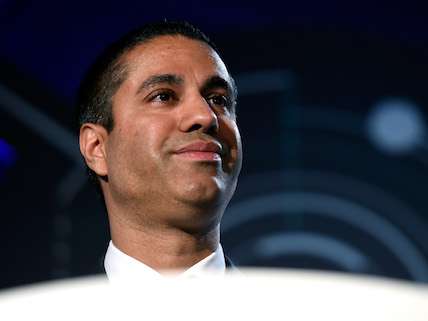
Ajit
David Becker / ZUMA Press / Splash News/Newscom

Politicians typically stoke fear by exaggerating some perceived threat or by inventing one out of whole cloth. They then declare that government alone can provide the answer. Take the demonization of a recent move led by Sen. Jeff Flake, R-Ariz., and Rep. Marsha Blackburn, R-Tenn., to undo last-minute Obama-era rules from the Federal Communications Commission regulating online privacy.

The rules exempted powerful data-hogs, such as Facebook and Google, while subjecting other service providers to new and confusing rules with the potential to strangle innovation, all thanks to one agency's unauthorized power grab. Companies such as Verizon and Comcast were suddenly required to secure your consent before selling or sharing your browsing history, app usage and other private information with advertisers and other companies.

That sounds sensible, but it actually represents an abrupt departure from decades of established practice under competing regulatory regimes. Indeed, ever since the advent of the internet, the default position was that consumers had to opt out of the program if they didn't want their information sold or shared. The practice was unsurprisingly successful, considering the billions of dollars and attention that tech companies invest in data security to protect consumer privacy.

Yet according to media coverage and the response from liberal advocacy groups, heroic FCC rules protected consumers from a serious threat (in spite of evidence that such a threat didn't actually exist), and now internet freedom advocates have maliciously re-exposed Americans' private information and placed them at the mercy of greedy internet service providers.

Media outlets were filled with sentences like this one, from a March 29 New York Times op-ed by former FCC Chairman Tom Wheeler: "The Senate already approved the bill, on a party-line vote, last week, which means that in the coming days President Trump will be able to sign legislation that will strike a significant blow against online privacy protection." This was from the prominent tech website Ars Technica on the same day: "Internet privacy advocates are mourning the death of online privacy rules, but yesterday's House vote to eliminate the consumer protections was celebrated by (internet service providers), advertisers, and Federal Communications Commission Chairman Ajit Pai."

This would be funny if the level of deception weren't so significant. First, the mourning period should be quite short, because the FCC's rule had yet to even take effect when it was rescinded. Its reversal, hence, is nothing more than an assurance that the FCC will continue "to preserve the vibrant and competitive free market that presently exists for the Internet … unfettered by Federal or State regulation," as Congress put it in the Telecommunications Act of 1996.

Furthermore, before the FCC seized regulatory control by reclassifying broadband providers as public utilities in February 2015, the Federal Trade Commission exercised jurisdiction over the internet. And for a government agency, it was reasonably hands-off.

When it came to privacy, the FTC took an outcomes-based approach that focused on what data were held and the impact of potential misuse. The approach preferred by the FCC, regulating based on who holds the data, opens the door for political favoritism to take precedence over consumer interests.

Unfortunately, as the internet has taken on an ever more central role in our personal and economic lives, the temptation to seize control apparently became too much for the FCC. The political left is invested in the narrative of internet service providers as privacy-violating boogeymen—and the FCC as a heroic digital guardian—not because there is any evidence to support the position but as a means to exercise more control.

With Pai's recent announcement that he intends to stop regulating the internet like a utility and return to the system that began under the Clinton administration—which allowed the internet to become what it is today—we can expect a repeat of the fear-based narrative.

Consumers and voters should see this rhetoric for what it is—a transparent attempt to establish government control over the rare place where freedom is still highly regarded.

COPYRIGHT 2017 CREATORS.COM

Start your day with Reason. Get a daily brief of the most important stories and trends every weekday morning when you subscribe to Reason Roundup.

This field is for validation purposes and should be left unchanged.

NEXT: Here Are the Cuts to Make Tax Reform Work

Veronique de Rugy is a contributing editor at Reason. She is a senior research fellow at the Mercatus Center at George Mason University.

Net Neutrality
Share on FacebookShare on XShare on RedditShare by emailPrint friendly versionCopy page URL Add Reason to Google
Media Contact & Reprint Requests

Show Comments (38)

Webathon 2025: Dec. 2 - Dec. 9 Thanks to 319 donors, we've reached $83,070 of our $400,000 goal!

Reason Webathon 2023

All Donations NOW Being Matched! Donate Now

Latest

Support Reason To Keep Your Favorite Podcast Going. Every Dollar You Give Is Matched!!

Peter Suderman | 12.4.2025 8:00 AM

SCOTUS Tackles Illegal File Sharing, Internet Music Piracy, and Copyright Law

Damon Root | 12.4.2025 7:00 AM

The History of This Word Reflects the Rise of Anti-Immigrant Politics

Jay Stooksberry | From the January 2026 issue

Brickbat: Hanging Judge

Charles Oliver | 12.4.2025 4:00 AM

The Horseshoe of Doom: Populists Left and Right Say America Is Failing. The Facts Don't.

Veronique de Rugy | 12.4.2025 1:45 AM

Recommended

  • About
  • Browse Topics
  • Events
  • Staff
  • Jobs
  • Donate
  • Advertise
  • Subscribe
  • Contact
  • Media
  • Shop
  • Amazon
Reason Facebook@reason on XReason InstagramReason TikTokReason YoutubeApple PodcastsReason on FlipboardReason RSS Add Reason to Google

© 2025 Reason Foundation | Accessibility | Privacy Policy | Terms Of Use

This site is protected by reCAPTCHA and the Google Privacy Policy and Terms of Service apply.

r

HELP EXPAND REASON’S JOURNALISM

Reason is an independent, audience-supported media organization. Your investment helps us reach millions of people every month.

Yes, I’ll invest in Reason’s growth! No thanks
r

I WANT TO FUND FREE MINDS AND FREE MARKETS

Every dollar I give helps to fund more journalists, more videos, and more amazing stories that celebrate liberty.

Yes! I want to put my money where your mouth is! Not interested
r

SUPPORT HONEST JOURNALISM

So much of the media tries telling you what to think. Support journalism that helps you to think for yourself.

I’ll donate to Reason right now! No thanks
r

PUSH BACK

Push back against misleading media lies and bad ideas. Support Reason’s journalism today.

My donation today will help Reason push back! Not today
r

HELP KEEP MEDIA FREE & FEARLESS

Back journalism committed to transparency, independence, and intellectual honesty.

Yes, I’ll donate to Reason today! No thanks
r

STAND FOR FREE MINDS

Support journalism that challenges central planning, big government overreach, and creeping socialism.

Yes, I’ll support Reason today! No thanks
r

PUSH BACK AGAINST SOCIALIST IDEAS

Support journalism that exposes bad economics, failed policies, and threats to open markets.

Yes, I’ll donate to Reason today! No thanks
r

FIGHT BAD IDEAS WITH FACTS

Back independent media that examines the real-world consequences of socialist policies.

Yes, I’ll donate to Reason today! No thanks
r

BAD ECONOMIC IDEAS ARE EVERYWHERE. LET’S FIGHT BACK.

Support journalism that challenges government overreach with rational analysis and clear reasoning.

Yes, I’ll donate to Reason today! No thanks
r

JOIN THE FIGHT FOR FREEDOM

Support journalism that challenges centralized power and defends individual liberty.

Yes, I’ll donate to Reason today! No thanks
r

BACK JOURNALISM THAT PUSHES BACK AGAINST SOCIALISM

Your support helps expose the real-world costs of socialist policy proposals—and highlight better alternatives.

Yes, I’ll donate to Reason today! No thanks
r

STAND FOR FREEDOM

Your donation supports the journalism that questions big-government promises and exposes failed ideas.

Yes, I’ll donate to Reason today! No thanks
r

FIGHT BACK AGAINST BAD ECONOMICS.

Donate today to fuel reporting that exposes the real costs of heavy-handed government.

Yes, I’ll donate to Reason today! No thanks


