Ronald Bailey | January 6, 2009
Don't answer too hastily, but have you ever wondered what you would have done if you grew up in Nazi Germany? Of course, we all hope that we would have had the moral strength to stand against that monstrous regime, but can we be so sure? After all, times were tough and both important politicians and leading intellectuals supported Nazi theories and policies. And then there were the ordinary Germans, friendly neighbors like Karl and Lötte down the street. They had joined the Party and were sending little Wolfgang and Gretchen to healthful Party-sponsored summer camps. Being a Nazi was normal for many Germans. Would things have been any different for you or me if we had been unfortunate enough to grow up at that time and in that place?
The most horrific feature of Nazi and Communist regimes, of course, was their industrial-scale savagery. The Nazis managed to murder six million Jews and 22 million other Europeans. The Soviet Communists exterminated 62 million and the Chinese Communists killed 35 million. While these murders were ordered by vicious dictators, they were actually carried out by ordinary people like Karl and Lötte. Which brings us to the famous obedience studies conducted by Yale University psychologist Stanley Milgram.
In 1961, Milgram did research involving ordinary residents of New Haven, Connecticut, who participated in an experiment that ostensibly aimed at determining the effect of punishment on learning. Along with the experimenter, the situation involved two subjects, one a "teacher" and the other a "learner." The learner was a confederate of the experimenters, so the teacher was the only actual participant. In the experiment, the learner was supposed to memorize a list of word associations. The learner was strapped down to a chair with an electrode attached to his wrist. To encourage learning, the teacher was to pull switches that would supposedly increase electric shocks from 15-volts up to 450-volts in 15 volt increments. Before the experiment began, both the teacher and the learner were given 45-volt shocks. In addition, the switchers were labeled with warnings such as Slight Shock, Moderate Shock, and so forth, all the way up to Danger: Severe Shock. The final two switches were marked XXX.
As the experiment proceeded, the learner (experimental confederate) would keep making wrong answers. The teacher (experimental subject) would then be instructed by the expermenter to progressively pull the switch for ever higher levels of shock. The learner would begin to make noises expressing pain at 75-volts increasing in loudness until 150-volts, at which point he would urgently demand to be released, complaining of heart palpitations. His complaints would grow louder until 300-volts were reached. At 330-volts the learner fell silent. If the teacher showed signs of wanting to discontinue, the experimenter offered a series of prompts:
The appalling results of these obedience experiments was that 65 percent of participants eventually pulled all of the switches, ultimately reaching the 450-volt level. But perhaps modern Americans would be less susceptible to the demands of authority. After all, the intervening years have seen the rise of the civil rights, peace, and gay rights movements, right? Not necessarily. Last month, Santa Clara University psychologist Jerry Burger reported the results of replicating Milgram's experiment. He excluded people who had heard of the original experiments and found that the average rate of obedience remained the same at around 65 percent. In addition, there was no difference between men and women.
In 1965, Milgram wrote, "With numbing regularity good people were seen to knuckle under the demands of authority and perform actions that were callous and severe. Men who are in everyday life responsible and decent were seduced by the trappings of authority, by the control of their perceptions, and by the uncritical acceptance of the experimenter's definition of the situation, into performing harsh acts." In 1979, Milgram's judgement was more severe: "If a system of death camps were set up in the United States of the sort we had seen in Nazi Germany, one would be able to find sufficient personnel for those camps in any medium-sized American town."
But can it really happen here? It's a giant step from a Yale psychology lab to Auschwitz and the Gulag. What Milgram showed was that ordinary people are deferential to authority figures in laboratory settings. The exact nature of the authority wielded by experimenters is controversial, but it seems based on both perceived legitimacy and expertise. It doesn't take too much imagination to think that even more people would have gone all the way to 450-volts if the experimenter had the power to punish disobedience. Leaders of governments, militaries, religions, corporations, universities, and gangs all arguably exercise these types of authority. Hierarchy is a universal feature of human societies.
As obedience experiments show, Americans are not really any better at resisting the claims of authority than other people, yet there was no Gulag and no Auschwitz here. True, there was the immense moral evil of slavery, the destruction of Native Americans, Woodrow Wilson's imprisonment of thousands of dissidents, Franklin Roosevelt's internment of Japanese Americans, and more recently, the Abu Ghraib cruelties. Leaders at all levels can persuade some Americans to participate in immoral activities. However, the arc of American history has been toward correcting old evils and the commissioning of fewer atrocities over time. Why? Because our institutions of freedom have maintained and expanded the norms that limit the powers wielded by authorities.
For example, a free press is able to criticize practices like slavery and racial discrimination and help establish new norms. If Bill and Joanne down the street send their kids Joe and Kathy to an ethnically mixed school, in other words, it must be OK. In addition, American governmental powers are fragmented and in competition with one another. As another Milgram experiment showed, if two experimenters disagreed about continuing the experiment, the majority of participants sided with the one who argued for stopping it. In other words, when people could refer to an authority figure who agreed with their moral views, they were much more likely to act on them. Similarly, dividing up governmental power increases the chances that some authorities will act ethically and thus inspire people to act on the dictates of their consciences.
Milgram didn't really explore why it was that Germans created death camps while Americans did not. The answer is liberty. In 1974, Milgram more generously noted, "It is not so much the kind of person a man is as the kind of situation in which he finds himself that determines how he will act." Americans have not escaped the natural human tendency to defer to authority. Instead, we have had the good fortune to find ourselves in the situation where our social institutions have traditionally limited what authorities can get away with. The institutions of liberty are what enable people to act on what Lincoln called, "the better angels of our nature."
Ronald Bailey is reason's science correspondent. His book Liberation Biology: The Scientific and Moral Case for the Biotech Revolution is now available from Prometheus Books.

Help Reason celebrate its next 40 years. Donate Now!
Try Reason's award-winning print edition today! Your first issue is FREE if you are not completely satisfied.
For those keeping score at home, Bailey mentions religion only once, and then only to recognize that the religious leaders, like other leaders, exercise "authority".
Is that picture Tom Cruise in Valkyrie? Oh the irony - it oozes, Ron, it oozes...
Writing as a libertarian, your rejection of individual responsibility in the determination of personal action is disturbing. It is not institutions that have won us the liberty we enjoy today, but the constant endeavors of good men.
Writing as a libertarian, Robby Lee's point would be clearer without a dangling participle.
Not to help initiate a religion debate, but the Germans were no
less religious than we. The Nazi core may have rejected much or all
of Christianity, but I doubt that was even remotely the case with
the general population.
I think America's love of liberty and of individuality go hand in
hand. However, the poison is in us, too, which is why we have to be
ever vigilant about ceding too much power to government.
It is not institutions that have won us the liberty we enjoy
today, but the constant endeavors of good men.
In many cases the good man is irrelevant without the institution
(as ideologically painful as that may or may not be). And the
institution, obviously, is useless if it is filled with
malefactors.
Not to help initiate a religion debate, but the Germans were no less religious than we. The Nazi core may have rejected much or all of Christianity, but I doubt that was even remotely the case with the general population.
Granted, although the religion of those Germans was inarguably much
more theologically "moderate" than the American fundamentalism of
today that is so frequently criticized.
In many cases the good man is irrelevant without the institution (as ideologically painful as that may or may not be). And the institution, obviously, is useless if it is filled with malefactors.
Granted, but good institutions are formed and preserved by good
(wo)men if and when they are formed and preserved at all.
Religion the great dictator. Yawn.
Religion has been the main and often only opposition to the state.
I grew up learning of persecuted Christians, and the imperatives
are freedom. It was a religious book, Kingdoms in Conflict, that
put me directly on the path to libertarianism.
The religion as bad man is a straw man.
There are millions of people in the U.S. who are dumb and
gullible enough to do almost anything BHO would ask them to do. Our
"intelligentsa" might even purge themselves, if they thought BHO
wanted it.
And, there are hundreds of tools who'd smash personal liberty in
the quest of personal liberty.
Don't forget that there's something in American culture that makes it impervious to dogmatic drivel of the sort peddled by market fundamentlaist so-called "libertarians" and their marxist cousins.
I think better people--more virtuous, educated, logical, etc.--would lead to a better society, but a fundamental assumption in the Constitution is that even the angels amongst us can't be trusted with too much power. The wisdom of this viewpoint is what has given us a very stable republic (historically speaking). The unwisdom of allowing that philosophy to slowly lapse is what will be our undoing. Design the system to limit the damage of people in power and trust people in society to manage their own affairs well enough, and we may make it another 230 years.
I've got all sorts of problems with the popular mindset
regarding Naziism and it's relative horrors. Not just the
Godwin-esque phenomenon of referring to your opponents as Nazis or
facists, but the presupposition that it was uniquely evil over the
course of human history. In some ways the belief that Naziism is
specially unique isn't much different than the odd belief that
Germany in WWI was more evil than (say) the British or French or
Russians of the time period. In retrospect, it's hard to see the
British Empire of 1914 as morally superior to the Kaiser's
Germany.
By comparison, the 1930's Nazi party wasn't really uniquely more
horrible than other political movements of the time period,
including those in the US and other parts of Europe. It was a
variation on a number of common themes. Racism, nationalism,
progressivism, socialism. Mix and match these things and you can
come up with a lot of familiar faces. Eugenics was practiced and
advocated by many progressives of the era. Racism was endemic. The
Nazis were not unique in that era, no more than they were uniquely
politically repressive (see the Soviets), or more blindly patriotic
than others. (The Brits had that whole God and Country thing down
pat.) Anti-semitism wasn't a purely German phenomenon either.
The only thing about Naziism that makes it different is Hitler's
personal obsessive focus on the Jews. Which is a product of the
particular individual who was in charge. Take that out - replace
Hitler with some other leader, and you get something that's only
equally as bad as all the other horrific philosophies that
dominated the continent at the time.
HM: That's why I mentioned communists and islamists, too. In fact, the propensity to go along with authority is part of human nature and has been pervasive in history. What changes that dynamic is the creation of battling institutions that jealously guard their prerogatives and, as I argue, enable people to act on other aspects of their nature, e.g., the propensity to cooperate.
Religion has been the main and often only opposition to the
state.
Tell it to our local fellators of political power, the
institutionalized church. Seriously, with all the preachers running
around playing kingmaker, making endorsements and extolling the
"godly virtues" of this or that politician, I find the claim that
in America religion stands in opposition to the state as
*laughable*.
In truth, I enjoyed Rev. Wright getting the spotlight because, like
what he says or not (and I couldn't really give a shit about the
motivations behind the words), but his mouth was not wrapped around
any politician's genitals, for certain.
The only thing about Naziism that makes it different is
Hitler's personal obsessive focus on the Jews.
Yup.
If ya gonna pick a fight wit' da jooz,
Ya bettah not looz.
Cuz we write da books,
Ya shnooks.
There's really no difficerence between worshipping freedom and worshipping authority. You're all dogmatic fumdamentalists.
While Religion can oppose state violence, it can go hand in hand
with it.
One only need to look at the religious wars in Europe as the
Catholic church ceased to be catholic (as in universal ;) ).
The massacres of the Hugenauts, the persecution of Catholics in
England was egged on by religious scholars who happily argued that
the violence was God's work.
And
that continues into modern times.
In Valkyrie II, the not-quite-dead-yet Stauff kills Hitler in a sword fight. Turns out that Hitler is his father, too. And his brother. His father. His brother. His father and his brother.
I've always had a problem with the conclusions made from these studies. After all the one giving the shocks knows it's an experiment and that the other party is also a volunteer. An average person would assume that the scientists are not going to do anything that would cause real harm to the shockee. What really disturbs me is that the average person doesn't know a 450 volt shock would kill someone and therefore don't figure out it's all a ruse. This experiment doesn't show a deference to authority it shows people are stupid.
This experiment doesn't show a deference to authority it shows
people are stupid.
They're also given to writing run-on sentences.
This experiment doesn't show a deference. To authority, it shows people are stupid.
This experiment?
Doesn't. Show a deference
to authority? It shows.
People?
Are stupid.
this experiment does
n't
show a deFerence
toauthority
it
shows
peopleareSTUPID
In 1961, obedience experiments conducted by Yale's Stanley Milgram famously revealed that Americans were no better at resisting the claims of authority than other people.
They never met me. That probably explains my stellar career track
and high salary...
The expert interrogators in Iraq said that the # 1 motivation
for guys was Gitmo; more people joined the opposition ranks because
of that than anything else.
In spite of the fact that many of the Gitmo prisoners were innocent
bystanders, the whole thing was unconstitutional, etc. the Country
more or less acquiesed. That is part of the obedience equation too,
passively going along with the lawless dictates of Cheney and
Bush.
I think they still sell "I'd rather be waterboarding" tee-shirts on
Drudge.
"He (John Gill) drew the wrong conclusion from history. The problem with the Nazis wasn't simply that their leaders were evil, psychotic men. They were, but the main problem, I think, was the leader principle."
To author:
Since tiny-ee people are stupid,
Defer, as how i'm this expert.
Doesn't show?
.
There's really no difficerence between worshipping freedom
and worshipping authority.
Or worshipping justice and worshipping the devil. Or worshipping
peace and worshipping war!
It's all just worship!
I expect that obedience to authority is a psycho-adaptation to tribal hierarchy.
Off topic, but how much credence can be given to psychological research performed on college students for small amounts of money?
They kicked me out of that shock therapy experiment.
I dialed it up to 450 on the second question because I grew
impatient with the subject making mistakes.
There was no real electricity, so the actor didn't know how high it
was. I really got kicked off the experiment when I went into the
actors room and started physically hitting him when he made
mistakes.
Wow.
What a terrible little essay.
Poorly argued, poorly written, poorly thought out...just
terrible.
And Ron gets paid to write.
Wow.
From the article:
"In 1979, Milgram's judgement was more severe: 'If a system of
death camps were set up in the United States of the sort we had
seen in Nazi Germany, one would be able to find sufficient
personnel for those camps in any medium-sized American
town.'"
To rephrase it slightly: "When a system of death camps was set up
in the United States, under the euphemism of 'reproductive health
clinics,' the clinics were able to find sufficient personnel for
those camps in any medium-sized American town."
(From the article) The experimenters persuade the subjects to
continue:
"Please continue"
Never mind the abortion of innocent children - just ignore
it.
"The experiment requires that you continue"
The Constitution requires that a 'right to choose abortion' be
recognized by the law.
"It is absoulutely essential that you continue"
If abortion becomes illegal, the evil right-wing fundamentalists
will take over!
"You have no other choice, you must go on"
Roe v. Wade is stare decisis. You cannot question it if you're a
loyal American.
The rise of Naziism is inversely proportional to the fall of our
economy.
Start practicing holding your arm out straight.
Huey Long would have been our first Hitler had he not got
shot.
He wanted to out-Nazi FDR.
Capt. Kirk,
If the leader principle was bad in Nazi Germany, why is it good on
board the Enterprise?
The benevolent dictator is a great system. As long as you have smart, benevolent dictators. Without them, things get kinda unpleasant pretty fast.
Mad Max | January 6, 2009, 8:57pm | #
What. On. Earth are you talking about? Seriously, what was that mad
ramble? Last I checked, anti-abortion/pro-life folks numbered about
45% of the population; hence, this sentence particularly: "Roe v.
Wade is stare decisis; you cannot question it if you're a loyal
American." is farcical idiocy.
Heck, I'm pro-fetus recycling and I think that Roe v. Wade was a
bad decision.
"islamists"
Yes, now all can see Bailey as the Zionist neocon that he really
is.
, American governmental powers are fragmented and in
competition with one another.
Well, they're supposed to be, but the congress did a hell
of a lot of shirking over the last couple of decades.
-jcr
I'm pro-fetus recycling and I think that Roe v. Wade was a bad decision
What would have been a good decision? No dog in this fight, just
interested in those who combine your two positions.
By comparison, the 1930's Nazi party wasn't really uniquely
more horrible than other political movements of the time period,
including those in the US and other parts of Europe.
By the 1930s, they were already murdering people they considered
mentally defective.
-jcr
Religion has been the main and often only opposition to the
state.
Occasionally, but usually because the church is competing for
power. The role of the Catholic church in the Solidarity uprising
that toppled the Polish commies is rather overshadowed by their
complicity in Hitler and Mussolini's dictatorships, IMHO.
-jcr
What would have been a good decision? No dog in this fight,
just interested in those who combine your two positions.
Well, there are a few things in play. First, in order of
preference...
1. Constitutional Privacy Amendment
2. Some other legislative solution
...
99. Court arrogating authority to create rights out of whole
cloth
IMO, Griswold and Roe did soooo much damage to the potential for a
favorable legislative, constitutional, or jurisprudential schema in
the area of general privacy, that it plain just pisses me off. It's
like the issue of race obscuring the deeper issues of poverty; you
never get to talk about why some people are poor because you get
stuck talking about the race stuff. Same thing with abortion and
privacy.
Not to mention the decisions were poorly reasoned and reeked of
arbitrary capriciousness.
Now, as a *practical* matter, ideological preferences aside, I am
glad that someone acted when they did so that we would not have any
longer the legacy of back-alley coat-hanger abortions and women
trapped in cycles of pregnancy and poverty that they did not wish
to be in.
By the 1930s, they were already murdering people they
considered mentally defective.
I believe our resident neocon was referring to the party and not
the burocratic system.
Religion has been the main and often only opposition to the
state.
Occasionally, but usually because the church is competing for
power.
Uh, yeah, but if I understand what's going on, that's pretty much
always the case. I mean "liberty" as we pine for it, is had when
everybody is competing for power but nobody is able to really get
too much of it.
You know, freedom is something like a perpetual case of blue balls.
Or something.
"What really disturbs me is that the average person doesn't know
a 450 volt shock would kill someone and therefore don't figure out
it's all a ruse. This experiment doesn't show a deference to
authority it shows people are stupid."
Um, I'm pretty sure that rubbing your feet on the carpet and
shocking someone clocks in at a cool 30,000 volts or some such.
Volts are potential, you only need enough voltage to make it
through you to the ground. Its the amperage that kills you.
Now I get it. The Nazis were the same kind of people who berate you for leaving out a comma. That's why he killed all the Jews. Hebrew has no punctuation. It drove him mad. MAD I SAY!
What do you call Godwinizing when Mad Max takes a discussion
about Nazis and introduces abortion into the mix? UnGodwinizing?
AntiGodwinizing? Reverse Godwininian threadbating?
CB
So why hasn't the U.S. had its own Gulag or
Auschwitz?
Well, the U.S. has had concentration camps; those it placed Native
Americans and Filipinos in. I don't know if one wants to call these
gulags, but they were certainly horrendous affronts to individual
liberty.
The presence presents of
grammar nazis in this discussion is delicious irony.
"Um, I'm pretty sure that rubbing your feet on the carpet and
shocking someone clocks in at a cool 30,000 volts or some such.
Volts are potential, you only need enough voltage to make it
through you to the ground. Its the amperage that kills you."
not only that, it matters where the voltage is applied: ie. across
the chest, arm to leg, or just locally - maybe two spots on the
hand. I know a guy who used to test if outlets were live using his
fingers, using his thumb and forefinger. The electricity takes the
shortest path, through just the finger and thumb. He could tell
110v from 220v from the sting, but it wasn't dangerous. most home
electrocutions happen when a guy uses both hands on a outlet and
the juice goes across his chest and heart.
"If the leader principle was bad in Nazi Germany, why is it good
on board the Enterprise?"
Because the script writers know the ending.
The only reason we still have any liberty in this country is due to the inherently inefficient nature of our form of government.
@domoarrigato
Ok, i'm gonna try that thumb and forefinger thing at home... if I
die I shall haunt you forever.
The whole premise of this article is on shaky ground, as these
experiments on obedience to authority have effectively nothing to
do with the vicious savagery of the Nazi regime.
It's been well-documented that there was essentially no pressure to
be directly involved in the killing operations, and indeed any
soldiers who requested reassignment were readily granted that
request, even if it was just because they were city boys who got
queasy at the sight of blood and brains as opposed to any kind of
moral principle. The Einsatzgruppen were volunteer squads.
There was ample opportunity for German soldiers and civilians to
protest courses of action they found objectionable and back down
the authorities, such as during the killing of their mentally and
physically disabled family members, or upon receiving orders to
remind the troops that they are not to loot & pillage, orders
which "besmirched the honor" of German soldiers.
Likewise, a theory of social or authoritarian coercion cannot
explain the zeal and vigor with which so many of the killers
pursued and carried out their duties: ghetto liquidators were
meticulous and thorough, even though they could have simply
refrained from applying stethoscopes to walls and ceilings in their
search for Jews to murder. A German soldier could simply have shot
a Jewish child, rather than snatching her off her feet by her hair
and then shooting her, but he didn't. And even as the German army
was falling apart at the seams at the end of the war, there was a
frenzied effort to continue killing Jews at all costs - even at the
cost of military effectiveness.
The Nazi brutality stemmed not from coercion of unwilling
participants, but the societal cultivation of willing participants
over the course of decades, and centuries, worth of incitement -
the same kind of incitement you're seeing today in leftist cities
outside Israeli consulates.
You don't have to be "psychotic" to be "evil." The orderliness and
efficiency of the Nazi's mass murder flies in the face of any
contention that it was conducted in any but the most rational,
practical, intelligent manner possible by those who orchestrated
it.
Calling them "psychotic" is a cop-out.
"Wow.
What a terrible little essay.
Poorly argued, poorly written, poorly thought out...just
terrible.
And Ron gets paid to write.
Wow."
Wow, what a terrible, smug little comment. No reasons or support;
just pure, undiluted snideness. You must be incredibly insecure.
Wow.
No discussion of the scapegoat du jour in America: Hispanic immigrants. Any American fascism would start and end there. Plus religion would have to be a key player, as has been mentioned in this thread.
Ron, great article, but it begs the question. Why did we create the 'battling institutions' and competing centers of authority, where other societies did not? To me, that is proof positive of our skeptical, refusing nature.
So Kirk was, in fact, a Nazi. And, instead of Jews, he had it in for red-shirted crewmen.
Michael Pelletier | January 7, 2009, 8:44am | #
This wouldn't happen to be Michael Pelletier formally student at
URI, would it?
BTW, I was with you right up until here:
"The Nazi brutality stemmed not from coercion of unwilling
participants, but the societal cultivation of willing participants
over the course of decades, and centuries, worth of incitement -
the same kind of incitement you're seeing today in leftist cities
outside Israeli consulates."
Especially the last part. Huh?
Hi Matt: Yes, I agree that I did "beg" the question of how the
"battling" institutions were created. There are word limits to web
articles that I already generally violate.
To some extent, I think that we (the Anglophone world) were the
beneficiaries of a series of fortunate accidents of history, e.g.,
Henry VIIIth leaving Roman Catholicism, the fragmentation of
European states allowing for the movement of capital and
intellectuals freely encouraging rulers to grudgingly loosen bonds
to encourage them to emigrate, and so forth. Basically, this set
off a Hayekian evolutionary spiral in which freer societies began
to outcompete less free societies. Nevertheless, leaders almost
always argue that with more authority they can solve all our
problems. The threat of backsliding toward traditional
authoritarian centralized regimes will always be with us.
@LMNOP
""The Nazi brutality stemmed not from coercion of unwilling
participants, but the societal cultivation of willing participants
over the course of decades, and centuries, worth of incitement -
the same kind of incitement you're seeing today in leftist cities
outside Israeli consulates.""
I actually found that to be the most compelling part of his post.
Agitators love a mob they can whip into a frenzy. It's like a force
of nature. All they need to do is single out a common foe.
Though I would like to add that the mob can be as much a force of
liberty (see the American Revolution) as a force of authority (see
the Cultural Revolution).
I actually found that to be the most compelling part of his
post. Agitators love a mob they can whip into a frenzy. It's like a
force of nature. All they need to do is single out a common
foe.
Oh I get that. What I was questioning was the reference to "decades
and centuries" of cultivation, and also the reference to "leftist
cities". Those are the pieces that don't seem to fit, either
through non sequitor or simply because I'm not getting the
references.
@LMNOP
You don't think that unemployed people in a left-leaning city would
be a ready source of cannon fodder for political agitators?
You have seen riots on TV haven't you, or bothered to read a
history book?
You don't think that unemployed people in a left-leaning
city would be a ready source of cannon fodder for political
agitators?
Sure. It's the specific context that seems a little off. Being
anti-Israeli, so far as I can tell, is neither a left nor a right
position. For that matter, unemployed and/or desperate people in
any city, whether left or right, are ripe to be tools of a
demagogue.
Like I said, it's the "leftist cities" (and, BTW, just WTF is a
"leftist city"?) that threw me, as well as the assertion that these
mobs have been carefully cultivated for many years, rather than
being fairly spontaneous eruptions against the scapegoat du
jour.
Well, I guess it depends on your definition of leftist
then.
If you use the term left to mean those who want to impose rules on
others for the greater good, then all cities are leftist.
If you use leftist to mean fiscally challenged and socially
liberal, that applies to most cities (but not all).
The Nazi brutality stemmed not from coercion of unwilling
participants, but the societal cultivation of willing participants
over the course of decades, and centuries, worth of
incitement...
Maybe. Though if you recall how fragmented Germany was through most
of history, it might raise the question of just what you mean by
this.
The details of this study are debatable, I'll grant that. But I'd
still venture the argument that the basic premise in Ron's article
is correct.
In any nation, some fraction of the population is probably going to
be willing to do horrible things. Given the right circumstances, I
suspect that you could find volunteers here in the US just they
found them in Germany.
Being anti-Israeli, so far as I can tell, is neither a left
nor a right position.
It sure looks like a very left leaning position to me.
The religious right likes Israel. And the calls for Israel to "stop
doing what you're doing" (like for example right now in Gaza)
always-always come with left-leaning foreign policy tones
mixed into them.
Although I agree, the notion of a "leftist city" is a a little
odd.
"If a system of death camps were set up in the United States of
the sort we had seen in Nazi Germany, one would be able to find
sufficient personnel for those camps in any medium-sized American
town."
They already have. They are called FEMA camps and the program was
originally called REX-84.
"Although I agree, the notion of a "leftist city" is a a little
odd."
Replace "odd" with "redundant" and you're onto something.
To some extent, I think that we (the Anglophone world) were
the beneficiaries of a series of fortunate accidents of
history
Well said.
Replace "odd" with "redundant" and you're onto
something.
I hadn't thought of it, but given the natural propensity of large
urban populations to lean left, beginning with the first large
urban populations to crop up in recorded history -- well, it is
redundant.
Honestly, I'm having trouble coming up with "rightist" cities
even using varying degrees of the political meaning of the word
"right".
Houston, Texas maybe?
Abortion, religion, socialism
These comments sure do get around. Seems to me that mentioning that
we've been debating torture in this country for the last few years
is all the proof you need that there are lots of people in the
country ready to staff the camps.
Douglas Grey and Bevis, kudos.
They already have. They are called FEMA camps and the
program was originally called REX-84.
Someone's played Deus Ex too many times.
Seems to me that mentioning that we've been debating torture in
this country for the last few years is all the proof you need that
there are lots of people in the country ready to staff the
camps.
Point.
Like I said, it's the "leftist cities" (and, BTW, just WTF
is a "leftist city"?) that threw me, as well as the assertion that
these mobs have been carefully cultivated for many years, rather
than being fairly spontaneous eruptions against the scapegoat du
jour.
Most cities are pretty leftist.
But if anything has been carefully cultivated for years in leftist
circles, it's anti-Americanism. During the Cold War it was a
downright conscious effort.
Milgram's experiments were actually more varied and
sophisticated than the usual summaries indicate. He did some 40
different experimental variations. Milgram found that resistance to
authority was strongest when there was a social support network for
the subject to fall back upon and when the actual experimental
subject had opportunity beforehand to interact with the mock
experimental subject.
Resistance was weakest when the subjects were socially isolated and
the task of torturing the mock subject was divided, i.e., one
subject sets the voltage and another applies the voltage.
BW --
Leading to the Paradox of Collective Responsibility. The more
people are involved in a decision being made, the less each
individual feels responsible for the outcome. I'm generally
reminded of the end of The Dark Knight when the boat of
passengers was taking a vote as to whether or not to blow up the
other boat. Such votes would I suspect almost always come out in
favor of blowing up the boat, because no one individual feels the
personal connection of having to press the button. And in fact,
when it comes down to it, the guy who arrogates to the task of
pressing the button himself cannot bear to do it, even though he
enthusiastically advocated for it to be pressed.
It's hard to argue with the conclusions offered by Psychologist
Phil Zimbardo (former President of the American Psychological
Association) in the first portion of "The Lucifer Effect:
Understanding How Good People Turn Evil."
Essentially, he convincingly argues that despite widespread belief
at the individual level that they would stand firm while others
clearly have not, in reality the majority of people are far more
likely to be affected by the situation and to bend to it, rather
than to successfully resist it.
Although I find some of Phil Zimbardo's writing to be clearly
overly influenced by his own personal positions on unrelated
subjects, a bit over-stated, and some of his "purple prose" to be a
series of broad leaps it's one of the most thought-provoking and
worthwhile books I've ever read.
Boy, there sure is a strong whiff of American exceptionalism
about this piece. It is nice to say that nothing like the Nazi
death camps would happen here, but (a) who knows if it would or
would not and (b) saying that it hasn't yet happened here is
meaningless in terms of saying something about America because it
hasn't happened in a lot of places. Didn't happen in Cuba. Was it
their liberty that prevented it? Before you point to their
outrages, the author himself concedes that America has committed
plenty of outrages, and not only do we hold an absurd number of
prisoners in this country, but we also hold a few prisoners in
Cuba.
America has done plenty of bad things. And things like the free
press didn't seem to prevent them from happening in the first place
or even to bring them to a quick end. Our institutions are
valuable, but not infallible.
Gee I dunno could this country ever produce a political party that rises to power via racial scapegoating?
LMNOP: Ditto to the Paradox of Collective Responsiblity (though not really a paradox). Obedience to authority increased in Milgram's experiment when there was a social network in favor of the torturer-experimenter and the task was divided. I don't recall a variation where the torture-subject was demeaned but I'm sure the results would have been really horrifying. Governments know what they are doing when they invest in war propaganda, whether they're democracies or dictatorships.
"Didn't happen in Cuba." - Chris
Are you REALLY sure about that?
"[Che] also remains a hated figure amongst many in the Cuban exile
community, who view him with animosity as the butcher of La
Cabaña'... The Fortaleza de San Carlos de la Cabaña, commonly known
simply as La Cabaña is an 18th century fortress complex located on
the elevated eastern side of the harbor entrance in Havana, Cuba...
In January 1959, rebels led by Che Guevara captured La Cabaña and
used it as a headquarters for several months while leading the
Cuban revolution. During his five-month tenure in that post
(January 2 through June 12, 1959), Guevara oversaw the
revolutionary tribunals and executions of suspected war criminals,
traitors, chivatos (informants), and former members of Batista's
secret police."
From: http://en.wikipedia.org/wiki/Che_Guevara
The answer is liberty! Oh, how obvious. Why didn't I see that
before? Sigh.
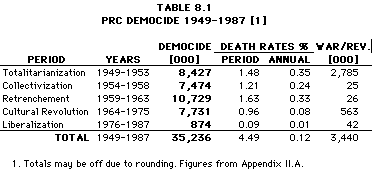
R.J. Rummel trash? On Reason Magazine? I thought your standards
were higher than that. He's a crank. You link to his "democide"
counts like they're somehow authoritative (they're not), and talk
about "liberty" and "institutions of liberty" as if these terms
have some universal meaning. How exactly do we attain "liberty",
then? Why didn't the Nazis attain liberty?
If only Germany were a "liberal democracy"! We would never have had
to deal with the Nazis then. Oh wait...
You need to read more opposing viewpoints.
"Its the amperage that kills you."
No. It's the fibrillation that kills you. Yes, rubbing your feet on
a carpet produces a very high voltage, but the current in the spark
is high, too. The *duration*, however, is small, since only a small
amount of charge is involved, so it doesn't do any appreciable
damage.
On the other hand, you could be killed with very low voltage and
very low current if the current is pulsing in a way that interferes
with your heartbeat.
Göring: After all, it is the leaders of the country who
determine the policy and it is always a simple matter to drag the
people along, whether it is a democracy or a fascist dictatorship
or a Parliament or a Communist dictatorship.
Gilbert: There is one difference. In a democracy, the people have
some say in the matter through their elected representatives, and
in the United States only Congress can declare wars.
Göring: Oh, that is all well and good, but, voice or no voice, the
people can always be brought to the bidding of the leaders. That is
easy. All you have to do is tell them they are being attacked and
denounce the pacifists for lack of patriotism and exposing the
country to danger. It works the same way in any country.
Dear Ronald Bailey,
not that it matters much, but there is no such name in the German
language as "LÖTTE", only LOTTE--without the Umlaut.
Other than that, I've often wondered whether the
Milgram-experiments can show what they want to show: that people
willingly yield to "authority" by inflicting pain or death on other
people. I am sorry, but I don't buy it. Who were these
"experimental subjects"? Unemployed/underemployed people killing
time by going through the classifieds? Then taking part in a study
where they are told they won't be held responsible under the laws
of the land if they electrocute people? Who would be so dumb to
believe that? If any one of them did, he must have been severely
retarded. Milgram is totally unconvincing.
Well, the U.S. has had concentration camps;
They key difference is that FDR's concentration camps were just
prisons for illegally depriving people of their liberty. Actually
killing all of the inmates wasn't part of their marching
orders.
-jcr
The US Gov. has already built many detention camps all across our county and have done so in secret go google or youtube for yourself I for one want to know for what these were built,is the end really near?
Rob, yes, I'm 100% certain that neither the Holocaust nor anything remotely on its gigantic scale happened in Cuba. I dislike the Cuban government as much as the next guy, but come on. The whole point the author makes is that our horrible behavior wasn't as bad as the Nazi's horrible behavior. If we're going to be in the business of measuring atrocities, then let's do it at least quasi-seriously.
First of all, if as these experiments suggest the general
proportion of people who will defer to authority over their own
judgement is 65% that makes a pretty hopeless case for democratic
rule; if in any given circumstance the majority of the population
will take the word of an authority over their own critical
thinking, that suggests the majority of democratic decisions will
favor an existing establishment. Maybe there's a connection between
that proportion and the natural tendency of governments to expand
over time?
Second, the concept that Americans are blameless when it comes to
genocide is ridiculous. How many millions died as a direct result
of the manifest destiny doctrine? How different was that, in real
terms, from Nazi beliefs? We just got our genocides out of the way
earlier, on our way to becoming a mature democratic state.
Unfortunate that individual repsonsibility and choice wasn't considered in this experiment. And what kind of simplistic ridiculousness is it that thinks the "good" Nazis were just being obedient to authority? Let's not forget that the Nazi party was the National Socialist German Workers' Party. It was typical ends-justify-the-means philosophy of any garden variety socialist. Statism in all its forms: Socialism, Communism, Fascism ultimately and always will lead to tyranny. History proves this. What of the Nazi's firm beliefs that they were doing the right thing? Sure, a small few disagreed, but nothing stopped until the Allied Forces forced an end to their plans. Obedience is only one small part of the gigantic socialist puzzle.
"Religion the great dictator. Yawn.
Religion has been the main and often only opposition to the
state."
Oh my. I'm not sure how to reply to this... Religion has been the
main opposition to the state? Errm... Are you being serious? What
of any number of life denying, theocratic regimes that still exist
in the world. Religion opposing the state? Forgive me, but that has
no basis in fact or reality. The Church of England "opposed" the
state? They aided and abetted each other! The Vatican in it's
former glory? The Inquisistion? Islamic totalitarianism? You can be
as religious as you choose to be, but you must understand that the
really intense and horrific bloodshed ended once major reformations
occured in the west. Religion had to be *tamed* in order for
civilization to continue. This is true. Disagree all you want.
I would agree with most of this article - but for the last
paragraph. Don't forget: Hitler & Co. also fought what they
thought their "War on Terror".
The NAZI view on Communists was not far from ours, on Jews then not
far from Muslims now, etc, etc.
The "Jewish World Conspiracy" of the "7 Elders of Zion" was not so
far as a propaganda lie from the Soviet- or now Islamic
Conspiracy.
AND: there is already a near 2.5 million work-slaves in camps
(called jails and prisons), on whom a whole huge industry
profits.
Bush has proven that most US citizens are not very different from
the 3rd Reich's subjects - and, looking at Gaza now, neither seem
press and media, still playing dirty profit jokes with the idea of
Auschwitz, when its false heirs (because Jew does not mean Zionist)
pocket the support real victims should have had, and play the
almighty little david - when Goliath is the defenseless
dwarf.
Shame - all round - and it will take long time to go away.
Site comments/questions:
Media Inquiries and Reprint Permissions:
(310) 367-6109
Editorial & Production Offices:
3415 S. Sepulveda Blvd.
Suite 400
Los Angeles, CA 90034
(310) 391-2245