
Jesse Walker from the July 2008 issue
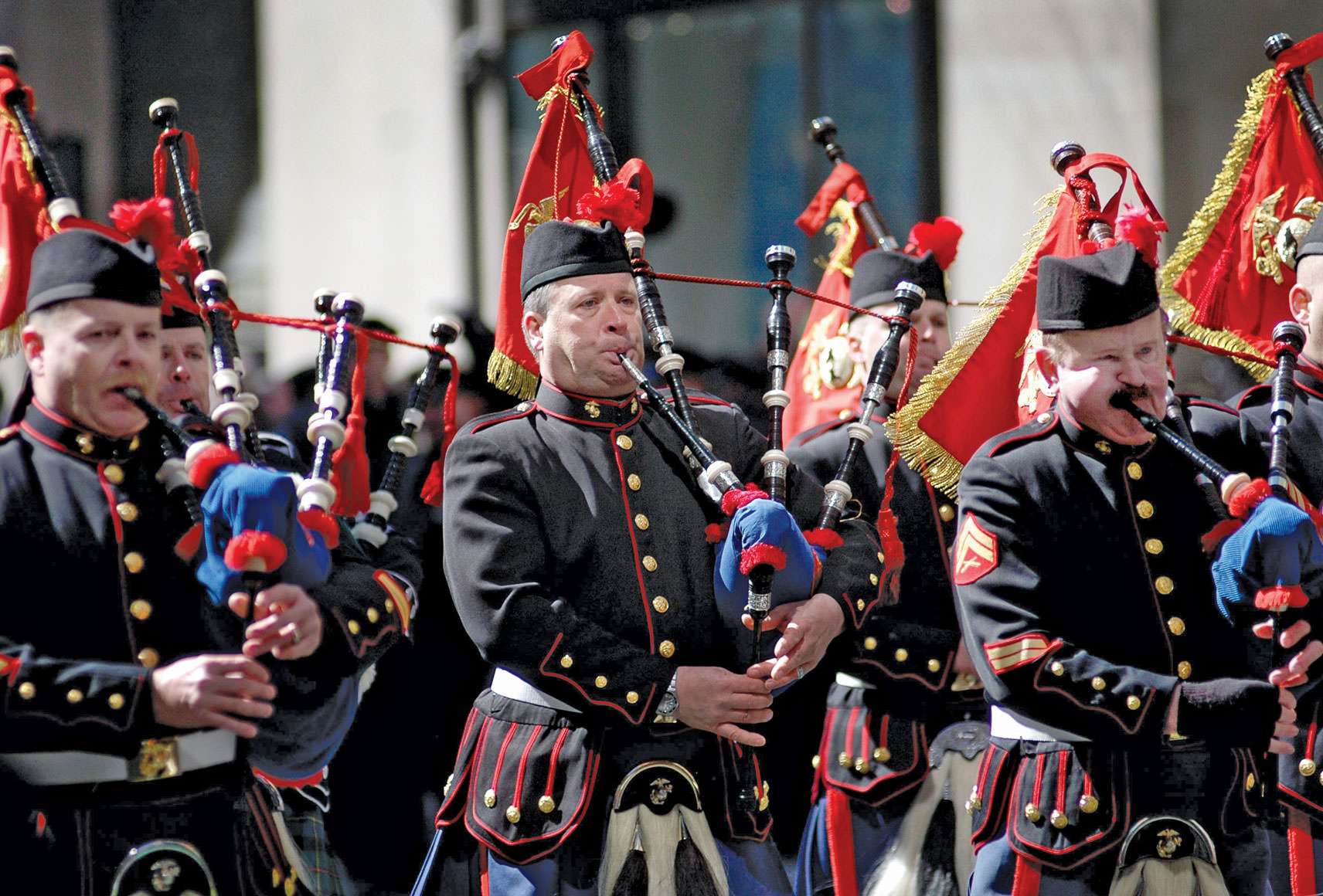
Nothing says “Scotland” like the great Highland bagpipe, that unwieldy contraption of air, tubing, and hide. You can imagine a grieving piper playing “Scotland the Brave” in 1305 as word spreads across the glens of the death of William Wallace, that patriot with the face of Mad Max. You can imagine it, but it’ll be fiction: In his forthcoming book Bagpipes, the historian and musician Hugh Cheape argues that the instrument didn’t exist until the early 19th century.
Rich Scottish expatriates created the Highland Society of London in 1788 to preserve “the martial spirits, language, dress, music and antiquities of the ancient Caledonians.” Preservation was the mother of invention: The society’s annual pageants, The Guardian reports, “helped create the ‘stage Highlander,’ a largely invented character who played bagpipes designed specially for these events. The mythology surrounding the great Highland pipes increased when allegedly authentic pipes linked to great events in Scottish history were given to national museums.”
It wasn’t the first time romantic nationalists would devise their own traditions. But that’s only part of the story. In the two centuries since then, Scots have embraced the instrument. The faux tradition became a real tradition, and the great Highland pipes are now as Scottish as Sean Connery in a kilt.
Note: The tartan kilt is a factitious tradition as well. But Connery, scholars report, has been a part of Scotland forever.

Help Reason celebrate its next 40 years. Donate Now!
Try Reason's award-winning print edition today! Your first issue is FREE if you are not completely satisfied.
I knew that a true torture device of that sophistication had to have been invented in modern times.
Sean Connery,
I believe you were asking for ear cotton from your battle buddy in
"The Longest Day" to get relief from the horrible squaking of the
pipes.
Someone ought to inform Wikipedia:
In 1760, the first serious study of the Scottish Highland bagpipe and its music was attempted, in Joseph MacDonald's 'Compleat Theory'.
I always heard that numerous societies through the ages invented
somehing like the bagpipes.
Only Scotland kept them.
"Someone ought to inform Wikipedia:"
[Citation needed]
Wikipedia got something wrong!!!!
Someone ought to inform Wikipedia
Just to be edited, overwritten, deleted and banned from editing for
providing information different from the groupthink?
"I knew that a true torture device of that sophistication had to
have been invented in modern times."
I like bagpipes. I'm not even Scottish but I like bagpipes (in the
hands of people who actually knows how to play). Were Scottish
Tablet candies invented by the same society? I LOVE those things -
too much perhaps.
So does this mean that Utilikilts aren't genuine Scottish
dress?
I thought those were skirts, not full dresses?
Sean Connery,
Apparently you are not aware that I am the founder of
"Italian-Americans for an Independant Scotland"
Look for the bumper stickers on the vehicles of exceptionally
aggressive drivers.
Ah, BrotherBen got to it first...The old joke about the call to
the police about the ugly lady in a plaid skirt torturing a sack
full of cats.
Tough to go wrong with solid material.
OT: Has the 'liberty mike' troll been revealed like the Neil troll yet?
GM, no that was a real comparison. From my 'shroomin days. I remember seeing the noise the cats were making. In technicolor HD.
"GM, no that was a real comparison. From my 'shroomin days. I
remember seeing the noise the cats were making. In technicolor
HD."
Did you ever listen to Revolution 9 on Shrooms?
This is just complete sheep-dung. A primitive version of the pipes originated in the Middle East (e.g., the silver pipes of Ur!), were spread to most of Europe by the Roman Legions (check your art history text for The Peasant's Wedding - 16th C Holland) and are associated with Scotland and Ireland by courtesy of the water and mountains (no sissy Renaissance instruments got there) and through the gentle ministrations of the British Army (God bless 'em!). What else has this clown written? Diatribes on global warming? Acid rain? Transfats? Second-hand smoke? Sheesh....Albainh gu brath!
GH,
No, but I certainly do not mind a bit if anybody else does, as long
as they are not using or occupying my property while engaged in
this curious behavior.
umsapiper got it right. There are lots of kinds of bagpipes. The Scots themselves have a number of other sorts of bagpipes you don't see as often as the ones in Walker's photo.
I once lived near a private boy's school who, instead of a
marching band, had a drum and bagpipe corps. They held practice at
6:30 three mornings a week.
You can get used to almost anything after a while.
Note: The tartan kilt is a factitious tradition as
well.
Wiki
doesn't agree with that one either.
Scotland: a place where all of the traditions can be traced to a
drunken bet.
I speak as a Scot who has been to Scotland and who has tossed a
caber (18 feet long and 130 pounds) while wearing a kilt. I've
never tried haggis though.
Old joke: Being a parent is like playing the bagpipes. Do it well
or not at all. Anything in between will just piss off the
neighbors.
It means contrived. In any case, I think the truth is that the
tartan is old, but the idea that every clan has had a unique tartan
is relatively new.
Incidentally, I'd like to take this moment to claim the Scottish
throne.
Yes, bagpipes in general are very old. However, ISTR that Scottish bagpipe tradition, along with a surprising amount of Scottish tradition in general, is not as traditional as one may think.
Finally, the basic truth about the bagpipe is stated. Bagpipes
are very old. As any lover of medieval and Renaissance music -- or
at least fan of David Munrow and the Early Music Consort of London
-- knows, the bagpipe, in simpler forms than the familiar Scottish
bagpipe Jesse writes about, has been squawking and skirling for a
very long time indeed.
Because of intonation quirks, bagpipes often do not play well with
other instruments. But, in their place, they have their special
charms, as do ouds, sitars, and the Japanese sho.
Oh, and the Jew's harp. Let's never forget the Jew's harp. (I have
two albums with Jew's harp solos. Listening to these tracks helps
unclog the mind.)
Is this a joke? Pipes have been around forever, originating in
Pakistan I believe. There are many types throughout history, across
the world. Look at Bosch's 15th century depictions of hell, for
one. Perhaps he's talking about the 3 droned highland pipe?
-P'ed off piper
I guess I don't get the comments about Wikipedia being wrong. I
simple Google search reveals that the book they talk about, "A
Compleat Theory of the Scots Highland Bagpipe", does exist, and is
from 1760. Worldcat says that Dartmouth has a copy, along with the
University of Texas library.
So, if Scottish bagpipes didn't exist until "the early 19th
century", what the heck was this guy doing writing about them in
1760?
twv,
Ouds play quite well with other instruments. Check out some Rabih
Abou-Khalil or Anouar Brahem. Those instruments just don't work
well with chordal arrangements, that's all.
"It takes an Irishman to play the pipes."-Sean Connery in
The Longest Day
Damn, that's a helluva good movie.
Ahcuah said: "So, if Scottish bagpipes didn't exist until "the
early 19th century", what the heck was this guy doing writing about
them in 1760?"
Probably the same guy writing about Jesus riding the dinosaurs.
AC/DC used the pipes in "It's A Long Way To The Top (If You Wanna Rock 'n' Roll)".
"It's a
Long Way to the Top (If You Want to Rock 'n' Roll)" is the best
rock song with bagpipes that I've heard.
Of course, when your lead guitarist is named Angus, you'd expect
some good pipes rock.
Angus and Malcolm Young were born in Scotland, as was the late Bon Scott. Brian Johnson is from the U.K. though I don't remember which country.
A bit of craic I learned as a kid:
We Irish gave the our cousins, the Scots, the kilt and the pipes. They still haven't got the joke! - anonymous
Ah, shit. Pro Lib, I missed your post, even though I previewed. Next time I'll look up in addition to checking my spelling.
My alma mater had a mascot who looked like Groundskeeper Willie and a marching band dressed in kilts, complete with pipers. If you were involved in the "Scottish arts" (bagpipes/highland dance), you could get a full ride. This, of course, bred resentment from everybody else, especially when they practiced early on weekend mornings.
I can see this as possibly being true insofar as the modern "highland" pipes are concerned, since they are kind of like a "concert grand" of bagpipes -- in other words, they're giant modern monsters meant to produce hugh volumes of sound. But bagpipes have been around since ancient Egypt at least & they're all over the place in medieval Celtic musics, including in France and Spain.
Oh yeah, and the greatest bagpipe recording every made was Bill
Monroe's "Scotland."
And he did it with fiddles, for god's sake...
"I speak as a Scot who has been to Scotland and who has tossed a
caber (18 feet long and 130 pounds) while wearing a kilt. I've
never tried haggis though."
I think the only proper time to toss haggis is after you've eaten
it.
The Black Watch had pipers in their assault on Fort Ticonderoga
in 1758, so I doubt that some Londoner conjured up the pipes two
years later.
--chuck
Hrm, either these are all lies or some guy who wrote a
controversial book is wrong (is that even possible?? can something
written in a book be wrong???).
In the early part of the second millennium, bagpipes began to
appear with frequency in European art and iconography. The Cantigas
de Santa Maria, compiled in Castile in the mid-13th Century, depict
several types of bagpipes. [4] Though evidence of bagpipes in the
British Isles prior to the 14th Century is contested, bagpipes are
explicitly mentioned in The Canterbury Tales (written around 1380):
"A baggepype wel coude he blowe and sowne, /And ther-with-al he
broghte us out of towne."[5]
Actual examples of bagpipes from before the 18th century are
extremely rare; however, a substantial number of paintings,
carvings, engravings, manuscript illuminations, and so on survive.
They make it clear that bagpipes varied hugely throughout Europe,
and even within individual regions. Many examples of early folk
bagpipes in Continental Europe can be found in the paintings of
Brueghel, Teniers, Jordaens and Durer.[6]
Evidence of the bagpipe in Ireland occurs in 1581, when John
Derrick's "The Image of Irelande" clearly depicts a bagpiper
falling in battle. Derrick's illustrations are considered to be
reasonably faithful depictions of the attire and equipment of the
English and Irish population of the 16th Century[7] In 1760, the
first serious study of the Scottish Highland bagpipe and its music
was attempted, in Joseph MacDonald's 'Compleat Theory'. Further
south, a manuscript from the 1730s by a William Dixon from
Northumberland contains music which fits the Border pipes, a
nine-note bellows-blown bagpipe whose chanter is similar to that of
the modern Great Highland Bagpipe. However the music in Dixon's
manuscript varied greatly from modern Highland bagpipe tunes,
consisting mostly of extended variation sets of common dance tunes.
Some of the tunes in the Dixon manuscript correspond to tunes found
in early 19th century published and MS sources of Northumbrian
smallpipe tunes, notably the rare book of 50 tunes, many with
variations, by John Peacock.
As Western classical music developed, both in terms of musical
sophistication and instrumental technology, bagpipes in many
regions fell out of favour due to their limited range and function.
This triggered a long (but slow) decline which continued in most
cases into the 20th century.
Extensive and documented collections of traditional bagpipes can be
found in the Musical Instrument section of the Metropolitan Museum
of Art in New York City, and at the International Bagpipe Museum in
Gijón, Spain, and Pitt Rivers Museum in England.
The kilt is not a "factitious tradition." The modern version of the kilt and "clan tartans" are false traditions. However, tartan itself is not a false tradition, and the kilt was worn by many, although it was certainly never universal nor was it ever a "skirt." A proper kilt was actually a large tartan blanket, worn wrapped around the waist (and over the shoulder).
Exactly, Brian, except that what you are describing is not so much a "proper kilt" as it is a plaid, pronounced "played." Worn by all (way back when), and usually made of plain homespun wool. That is, it's called a plaid, but it isn't plaid-patterned, in the modern sense of plaid. Although the wealthy certainly would/could have had plaids with patterns woven into them.
To various people who raised this objection:
Yes, the bagpipe family of instruments is old. The article is about
the Great Highland Bagpipe, a specific form of the instrument
associated with Scotland, which turns out (if the new research is
accurate) to be of more recent vintage than was widely believed.
They weren't playing Great Highland Bagpipes in ancient Near
East.
Yes, the bagpipe family of instruments is old
Yup! They've been around in one form or another ever since the
first human learned to fart and pick his arse at the same time.
Beans aren't called the musical fruit for nothing, ya know.
As a Czech, I can attest that bagpipes survived in the foklore
of a region of Bohemia (Chodsko) until today.
Chodsko is a border region which faces German Bavaria to the
southwest. The inhabitants used to guard the border against
Bavarian incursions. Their folk culture diverged quite a lot from
the Bohemian mainstream.
The Chod bagpipes are attested in chronicles and drawings well into
the Middle Ages, and they sound quite similar to the Scottish
bagpipes. Untrained person (like me) cannot detect the difference
by ear.
Ahh, kevrob beat me to it, but properly it goes;
"Actually the Irish invented the bagpipes, and gave it to the Scots
as joke, they still haven't gotten it."
Site comments/questions:
Media Inquiries and Reprint Permissions:
(310) 367-6109
Editorial & Production Offices:
3415 S. Sepulveda Blvd.
Suite 400
Los Angeles, CA 90034
(310) 391-2245