
Judge Richard Posner, RIP
Posner was one of the greatest legal scholars of all time, a founder of law and economics, and an enormously influential judge.

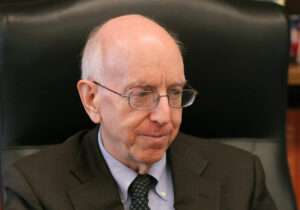
Judge Richard Posner passed away yesterday. Posner was one of the greatest legal scholars of all time, one of the founders of the field of law and economics, and probably the most influential lower-court federal judges of the last several decades. His contributions across a wide range of fields are so great, that no obituary can possibly do them justice.
As a longtime professor at the University of Chicago Law School, Posner was a pioneer of the application of economics to legal issues. His book Economic Analysis of Law, (which has gone through numerous editions since the first one in 1973), was and is the best overview of the field. His classic articles on antitrust law, regulations, the economics of common law, and many related issues were pathbreaking applications of economics to law that continue to influence economists, legal scholars, and policymakers even many decades later.
In addition to his many contributions to law and economics, Posner also published enormously influential books and articles on a dizzying array of other issues. I can only mention a few here. His book Sex and Reason is a tremendously insightful analysis of legal regulation of intimate relationships. How Judges Think and Reflections on Judging shed light on a variety of issues relating to judicial behavior, and legal philosophy. Law and Literature is one of the greatest books on the depiction of law in classic literary works. This list of pathbreaking Posner works can be extended almost endlessly!
Posner became a federal appellate judge in 1981 (appointed to the US Court of Appeals for the Seventh Circuit). There, he became perhaps the most influential federal lower court judge of his time, writing a variety of widely cited opinions. He was famous in legal circles for drafting almost all of his opinions himself, rarely relying on law clerks to do it.
A few of my own experiences with Posner and his work may shed some small additional light on the man and his achievements.
As a first-year law student, I was required to take an early-morning Contracts class. Not being a morning person, I periodically overslept and missed class (Posner, I'm sure, would never have done such a thing!). As a result, I was confused about some issues when final exam time came around. The class textbook was only of limited help in clearing up my confusion. So I decided to read the contracts chapter of Economic Analysis of Law. In a relatively few pages, Posner made everything much clearer, and I came to a much better understanding of a wide range of contracts issues than I had before, from studying the much longer textbook. Thanks to Posner, I did much better on the exam than I had any right to expect. He had a gift for distilling complex issues of law and public policy and making them readily understandable even to late-sleeping slackers!
A few years later, I was a law clerk for a federal appellate judge. Usually, when courts cite legal precedents, they do not indicate the name of the judge who wrote the decision. But our judge - who is more conservative than Posner and has a very different judicial philosophy - made clear that, in citing a Posner opinion, I should make sure to indicate Posner was the author. It's a small, but telling, indication of the respect Posner commanded from jurists across the political and jurisprudential spectrum.
Early in my academic career, I was co-editor of the Supreme Court Economic Review. One of the more difficult duties of academic journal editors is dealing with peer reviewers, who often procrastinate, submit inadequate reviews, or both. One time, on a Friday afternoon, I e-mailed Posner an article submission, asking him to review it. Due to his simultaneous work as legal scholar and judge, Posner was almost certainly much busier than most of our other reviewers. Still, on Saturday morning, I woke up to find a message from Posner in my e-mail inbox. I expected the message would indicate whether he accepted the assignment or not. But, instead, I found an extremely thorough and insightful review of the article I had sent him - one of the best peer review reports I have ever seen. In addition to his many other achievements and talents, Posner was extraordinarily hard-working and efficient. He made most of the rest of us seem lazy and indolent by comparison.
I was privileged to know Posner over a period of many years, though we interacted only occasionally. Most of my professional writings related to his work were critical, as in the case of my review of his book Law, Pragmatism, and Democracy, (to which he wrote a solid response, and I in turn a short rejoinder by me), and my criticism (in my book The Grasping Hand: Kelo v. City of New London and the Limits of Eminent Domain) of his defense of the Supreme Court's controversial ruling in Kelo v. City of New London.
In retrospect, I fear these writings did not always sufficiently convey the enormous respect - even awe - that I had for Posner's many achievements. But I did support his longstanding campaign to get rid of the Bluebook, the ridiculously overcomplicated system of legal citation. In general, I am not a fan of book-burning. But I was happy to follow Posner in making an exception for the Bluebook! For a time, we even collaborated in an effort to persuade law journal editors to rethink the system.
Much, much more can be said. No words of mine can even come close to doing justice to Judge Posner's many achievements, or to his generosity to students and younger colleagues, of which my own experiences with him, were just small examples. Thus, I will close by offering my profound condolences to those of his friends, family, and colleagues, who might read this post.
UPDATE: For more on Judge Posner's life and achievements, see this obituary on the University of Chicago Law School website.