
November 7 as Victims of Communism Day - 2026
I have long advocated using May 1 for this purpose. But November 7 is a worthy alternative candidate, which I am happy to adopt if it can attract a broad consensus.
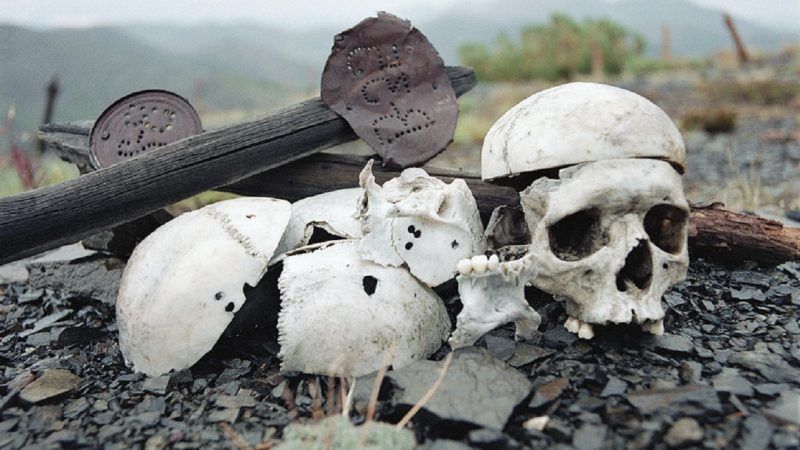

NOTE: The following post is largely adapted from last year's November 7 post on the same subject.
Since 2007, I have advocated designating May 1 as an international Victims of Communism Day. The May 1 date was not my original idea. But I have probably devoted more time and effort to it than any other commentator. In my view, May 1 is the best possible date for this purpose because it is the day that communists themselves used to celebrate their ideology, and because it is associated with communism as a global phenomenon, not with any particular communist regime. However, I have also long recognized that it might make sense to adapt another date for Victims of Communism Day, if it turns out that some other date can attract a broader consensus behind it. The best should not be the enemy of the good.
As detailed in my May 1 post from 2019, November 7 is probably the best such alternative, and over time it has begun to attract considerable support. Unlike May 1, this choice is unlikely to be contested by trade unionists and other devotees of the pre-Communist May 1 holiday. While I remain unpersuaded by their objections on substantive grounds, pragmatic considerations suggest that an alternative date is worth considering, if it can thereby attract broader support.
The November 7 option is not without its own downsides. From an American standpoint, one obvious one is that it will often fall close to election day. On such occasions, a November 7 Victims of Communism Day might not attract as much attention as it deserves, because many will - understandably - be focused on electoral politics instead. Nonetheless, November 7 remains the best available alternative to May 1; or at least the best I am aware of.
For that reason, I am once again doing a Victims of Communism Day post on November 7, in addition to the one I do on May 1. If November 7 attracts more support, I may eventually switch to that date exclusively. But, for now, I reserve the options of returning to an exclusive focus on May 1, doing annual posts on both days, or switching to some third option should a good one arise.
In addition to its growing popularity, November 7 is a worthy alternative because it is the anniversary of the day that the very first communist regime was established in Russia. All subsequent communist regimes were at least in large part inspired by it, and based many of their institutions and policies on the Soviet model.
The Soviet Union did not have the highest death toll of any communist regime. That dubious distinction belongs to the People's Republic of China. North Korea probably surpassed the USSR in the sheer extent of totalitarian control over everyday life. Pol Pot's Cambodia may have surpassed it in terms of the degree of sadistic cruelty and torture practiced by the regime, though this is admittedly very difficult to measure. But all of these tyrannies - and more - were at least to a large extent variations on the Soviet original.
Having explained why November 7 is worthy of consideration as an alternative date, it only remains to remind readers of the more general case for having a Victims of Communism Day. The following is adopted from this year's May 1 Victims of Communism Day post, and some of its predecessors:
The Black Book of Communism estimates the total at 80 to 100 million dead, greater than that caused by all other twentieth century tyrannies combined. We appropriately have a Holocaust Memorial Day. It is equally appropriate to commemorate the victims of the twentieth century's other great totalitarian tyranny.
Our comparative neglect of communist crimes has serious costs. Victims of Communism Day can serve the dual purpose of appropriately commemorating the millions of victims, and diminishing the likelihood that such atrocities will recur. Just as Holocaust Memorial Day and other similar events promote awareness of the dangers of racism, anti-Semitism, and radical nationalism, so Victims of Communism Day can increase awareness of the dangers of left-wing forms of totalitarianism, and government domination of the economy and civil society.
While communism is most closely associated with Russia, where the first communist regime was established, it had comparably horrendous effects in other nations around the world. The highest death toll for a communist regime was not in Russia, but in China. Mao Zedong's Great Leap Forward was likely the biggest episode of mass murder in the entire history of the world.
November 7, 2017 was the 100th anniversary of the Bolshevik seizure of power in Russia, which led to the establishment of the first-ever communist regime. On that day, I put up a post outlining some of the lessons to be learned from a century of experience with communism. The post explains why the lion's share of the horrors perpetrated by communist regimes were inherent flaws of the system. For the most part, they cannot be ascribed to circumstantial factors, such as flawed individual leaders, peculiarities of Russian and Chinese culture, or the absence of democracy. Some of these other factors, especially the last, probably did make the situation worse than it might have been otherwise. But, for reasons I explained in the same post, some form of dictatorship is virtually inevitable in a socialist economic system where the government controls all or nearly all of the economy.
While the influence of communist ideology has declined since its mid-twentieth century peak, it is far from dead. Largely unreformed communist regimes remain in power in Cuba and North Korea. In Venezuela, the Marxist government's policies have resulted in political repression, the starvation of children, and a massive refugee crisis - the biggest in the history of the Western hemisphere. The removal of President Nicolas Maduro has so far done little to change the nature of that regime.
In Russia, the authoritarian regime of former KGB Colonel Vladimir Putin has embarked on a wholesale whitewashing of communism's historical record. Putin's brutal and indefensible invasion of Ukraine owes more to Russian nationalist ideology than communism. But it is nonetheless fed in part by his desire to recapture the supposed power and glory of the Soviet Union, and his long-held belief that the collapse of the USSR was "the greatest geopolitical catastrophe of the century." It is also telling that most communists in Russia and elsewhere have joined with nationalists in backing Putin's line on the war.
In China, the Communist Party remains in power (albeit after having abandoned many of its previous socialist economic policies), and has recently become less tolerant of criticism of the mass murders of the Mao era (part of a more general turn towards greater repression).
China's horrific repression of the Uighur minority is reminiscent of similar policies under Mao and Stalin, though it has not - so far - reached the level of actual mass murder. But imprisoning over 1 million people in horrific concentration camps is more than bad enough.
Far-left support for Hamas since the horrific October 7, 2023 terrorist attack is yet another reminder of the inherently evil nature of communist ideology. Backing terrorism is part of a long history of support for repression and mass murder. Not all extreme socialists of the type who support Hamas are communists. But the latter are a subset of the former.
In the West, the popularity of "democratic socialism" in some quarters is a sign that many have failed to learn the lessons of the communist experience. Democratic socialism has many of the same flaws as its authoritarian counterpart, and - as the Venezuelan case shows - is unlikely to stay democratic for long, if implemented. Ironically, in their support for sweeping government control of the economy, democratic socialists have much in common with MAGA nationalists.
Victims of Communism Day is also a good time to remember our duty to help those victims. Among other things, it is unjust to deport migrants fleeing oppressive Marxist dictatorships, like those Cuba, Nicaragua and Venezuela, as the Trump Administration seeks to do to hundreds of thousands who entered the US legally under the CNVH program. This year, Trump ramped up efforts to deport Cubans back to their communist oppressors.If some on the left tend to ignore the evils of socialism, many on the nationalist right have been exacerbating the plight of its victims.
In sum, we need Victims of Communism Day because we have never given sufficient recognition to the victims of the modern world's most murderous ideology or come close to fully appreciating the lessons of this awful era in world history. In addition, that ideology, and variants thereof, still have a substantial number of adherents in many parts of the world, and still retains considerable intellectual respectability even among many who do not actually endorse it. Just as Holocaust Memorial Day serves as a bulwark against the reemergence of fascism, so this day of observance can help guard against the only ideology with an even greater number of victims.