
Will the Eleventh Circuit Allow the Endangered Species Act to Commandeer the Florida Department of Environmental Protection?
A pending case will test whether courts are willing to enforce the anticommandeering doctrine in the context of environmental protection.
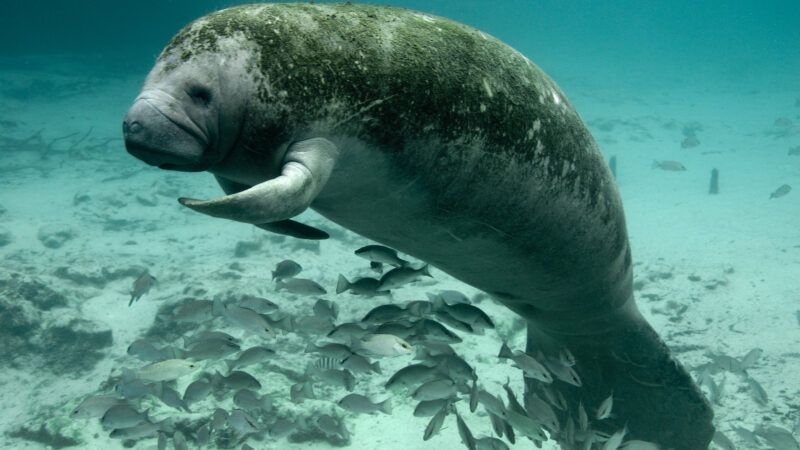
New Hampshire is not the only state subject to court-ordered commandeering. Next week, the U.S. Court of Appeals for the Eleventh Circuit will hear oral argument in Bear Warriors United v. Lambert, in which Florida is appealing a district court order effectively commandeering the state under the Endangered Species Act.
Bear Warriors United (BWU) is an environmental organization "dedicated to defending Florida's wildlife and serving as a powerful voice for nature." Among the species BWU seeks to protect is the manatee, which is currently listed as a "threatened" species under the Endangered Species Act (ESA).
In 2022, BWU filed suit against the Florida Department of Environmental Protection (FDEP) alleging that it was violating the ESA by failing to adopt and enforce sufficiently stringent regulations governing nitrogen discharges from septic tanks and wastewater treatment plants into the Indian River Lagoon, which is frequented by manatees. This failure, BWU alleges, contributes to eutrophication and the loss of seagrasses upon which the manatees rely and is thus a "take" under Section 9 of the ESA, which prohibits actions that "harm" listed species.
At heart, BWU's claim is that the FDEP is "taking" manatees because it is failing to control the private and other activities that threaten manatee populations. As the district court noted, it is "FDEP's ongoing failure to use its authority to regulate" more stringently that is at issue. Therein lies the problem.
There is reasonable debate about the extent to which the ESA's definition of harm encompasses conduct that affects species indirectly. The Supreme Court embraced a relatively broad definition of "harm" in the Sweet Home decision that encompasses habitat modification that, in turn, impairs the feeding, breeding or nesting activity of listed species. Relying upon this definition, some courts have concluded that omissions--in this case, failure to prevent activities that could adversely affect species--qualify as "harm." This is a controversial conclusion, however, and the Trump Administration has proposed narrowing that definition.
Whatever the proper definition of "harm" is under the ESA, BWU's claim has a larger problem: Under its theory, state governments are obligated to use their regulatory authority to enforce a federal regulatory scheme. This is not a case in which effluent from a state-run sewage treatment plant or other state activities are allegedly harming a listed species. It instead involves a state failing to use its sovereign regulatory authority in a manner that serves the federal government's goals. This is textbook commandeering. Thus even if one is inclined to accept the broad definition of "harm" that some courts have accepted, it cannot be enforced against state governments in this fashion.
The district court dismissed Florida's commandeering concerns in a cavalier (and somewhat incoherent) fashion. After noting in one order that "the anticommandeering doctrine does not bar federal laws that 'regulate state activities, rather than seeking to control or influence the manner in which States regulate private parties'" (quoting Reno v. Condon), the court proceeded to accept BWU's argument that the ESA's take prohibition could be used to control how FDEP regulates private parties. In another order the court correctly noted that "the anticommandeering doctrine does not apply when Congress evenhandedly regulates an activity in which both States and private actors engage" (quoting Murphy v. NCAA), but somehow missed that regulating private septic systems and wastewater treatment plants is not "an activity in which both States and private actors engage." It is, rather, precisely the sort of exercise of sovereign authority that only governments engage in, and is thus precisely what the anticommandeering doctrine protects from federal control.
This is not the first time a lower court has interpreted the ESA in a manner that violates the anticommandeering doctrines. In Strahan v. Coxe (1997), the U.S. Court of Appeals for the First Circuit concluded Massachusetts could be required to revoke licenses and permits for gillnet and lobster pot fishing under the ESA and Marine Mammal Protection Act without violating the anticommandeering doctrine. In the First Circuit's view, this was just federal supremacy in action, and the state was merely required to comply with federal law. But this misunderstands the dynamic. There is no question a state cannot immunize private action from federal prohibition, but this does not mean a state can be required to regulate or inhibit activity the federal government wishes to control, and this is true even if the state chooses to act within the relevant policy space. This is as true of gillnets and nitrogen discharges as it is of marijuana and gambling.
Although Strahan was wrong (as I discussed here at pp. 428-30), district courts have largely followed the First Circuit's reasoning. This has occurred even though, in 2018, in Murphy v. NCAA, the Supreme Court expressly held that the anticommandeering doctrine prevents the federal government from barring states from permitting a federally targeted activity (in that case, gambling) under state law.
The same principle applies in the environmental context. The federal government is free to regulate nitrogen discharges and other activities that harm listed species, and even to authorize citizen suits to assist in federal law's enforcement. It cannot require states to prohibit such activities, however. And just because a state has chosen to create its own regulatory apparatus, that apparatus cannot be required to apply standards dictated by federal law. Thus however expansively one is inclined to interpret the ESA's take prohibition, it cannot be applied as the district court did here.
I will be curious to hear how the Eleventh Circuit engages with these arguments next week, and whether it recognizes the errors of the First Circuit's analysis. There seems to be lots of confusion about commandeering these days. I also have a draft manuscript ("Conservation Commandeering") which goes into these arguments in greater depth. It will go up on SSRN soon. Until then, stay tuned.