
Andrew Kent on the Alien Enemies Act
His work further demonstrates that the AEA cannot be used in response to illegal migration or drug smuggling, but only when there is a military attack.
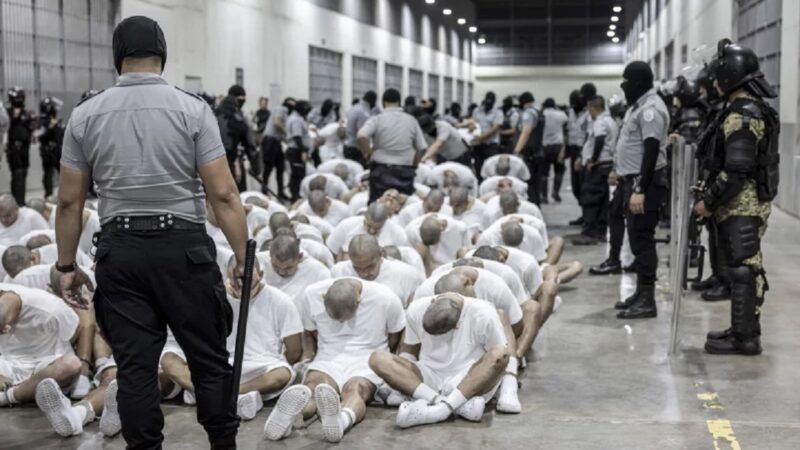
Fordham University law Prof. Andrew Kent has an excellent new Lawfare article outlining the reasons why Donald Trump's invocation of the Alien Enemies Act of 1798 is illegal. The AEA can only be invoked in the event of a war, invasion, or predatory incursion, or threat thereof. Contrary to the administration's claims, illegal migration and drug smuggling do not qualify, and the executive does not deserve sweeping deference in determining whether an "invasion" exists. Here is an excerpt:
The Supreme Court's Feb. 20 decision that struck down President Trump's tariffs imposed under the International Emergency Economic Powers Act exposed fractured reasoning among the six-justice majority about the correct approach to statutory interpretation. If the Court had one overall message, however, it was that delegations of emergency power to the president should not be treated as invitations for the executive to grossly stretch statutory text to cover actions entirely unimaginable by the Congress that passed the law.
If this approach applies beyond the Trump administration's tariff policy, Trump's invocation of the Alien Enemies Act (AEA) nearly a year ago should also be declared illegal. The Trump administration's use of the statute, aimed at alleged members of the Venezuelan criminal organization Tren de Aragua (TdA), has produced consequential litigation now pending before the U.S. Court of Appeals for the Fifth Circuit en banc, in W.M.M. v. Trump. The AEA is being used for the first time since World War II—and for the first time ever apart from declared wars.
The Supreme Court frequently directs that statutes be interpreted according to their meaning at the time of enactment. A legal-historical excavation of the AEA's meaning in 1798, when it passed the Fifth Congress and was signed by President John Adams, is therefore required to answer the questions raised in W.M.M.
Because the AEA has been used only infrequently—just in the War of 1812, World War I, and World War II—no comprehensive scholarly analysis of the statute existed before Trump's invocation in 2025.
I performed the historical research and compiled the findings in an academic article that examines the statute and its background, immediate context, and legislative purposes. Based on the article, I submitted an amicus brief in support of the detainees in W.M.M.
Here, I will describe the findings that lead me to conclude the statute is being used illegally today. Then I will note some hard questions raised in W.M.M. that are not resolved entirely by legal-historical analysis tied to 1798.
Kent's academic article and amicus brief in the W.M.M. case are also well-worth reading for anyone interested in these issues. My own new article "Immigration is Not Invasion" complements Kent's in various ways, by analyzing the meaning of "invasion" in the Constitution, as well as the AEA. The two meanings are the same, and in both cases an invasion is - as James Madison put it - "an operation of war." It must be a military attack, not merely some kind of illegal cross-border movement. As I explain in the article, this follows from the standpoint of leading versions of both originalism and living constiutionalism. I also explain in greater detail than Kent why courts should not defer to the executive's unsupported assertions that an "invasion" exists. Otherwise, you get absurdities such as the Trump Justice Department's claim that the president could invoke the AEA in response to the "British Invasion" of rock stars like the Beatles.
Like Kent, I have also filed an amicus brief in the W.M.M. case, which I coauthored on behalf of the NYU Brennan Center, the Cato Institute, and others.
My July 2025 Dispatch article, "Not Everything is an Emergency," outlines general reasons why courts should not defer to executive invocations of emergency powers, but rather should require the government to prove that the supposed emergency justifying the use of extraordinary powers actually exists.