
Virginia Votes To Overturn Lifetime Voting Ban for Felony Offenders
Virginia's Question 3 passed by a comfortable margin, ending more than 100 years of felon disenfranchisement in the state.
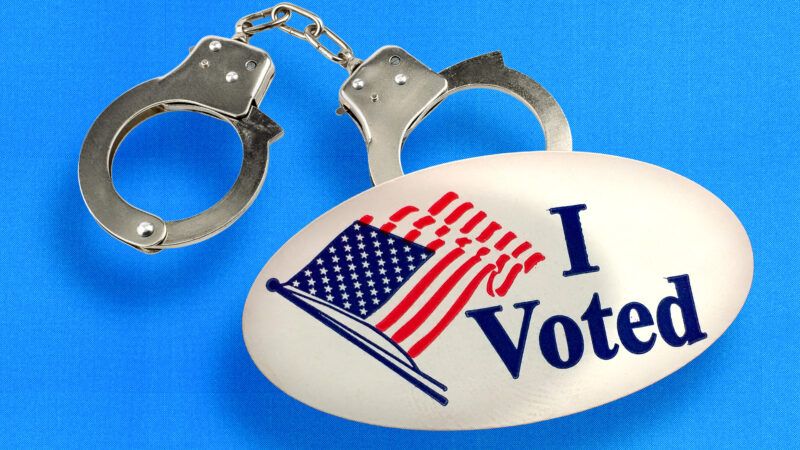
Virginia voters passed a ballot initiative Tuesday night ending the state's lifetime voting ban for felony offenders and scrapping one of the harshest such restrictions in the country.
Virginia's Question 3 asked voters to restore voting rights to those convicted of felonies upon their release from prison. The legislatively referred constitutional amendment, which passed by a margin of 56 percent to 43 percent, repeals a provision of the state's 1902 constitution that imposed a lifetime voting ban on felony offenders, absent a restoration order from the governor.
In recent years, similar felon voting restrictions have fallen in other states across the country, leaving Virginia as a notable outlier. Florida voters passed a constitutional amendment in 2018 to end the state's lifetime voting ban for felony offenders, and California voted in 2020 to restore voting rights to people exiting prison. According to the National Conference of State Legislatures, Virginia was one of 10 states that indefinitely revoked voting rights for some felony offenses.
The passage of Virginia's Question 3 follows more than a decade of lawsuits and political wrangling over efforts to overturn Virginia's felon disenfranchisement law. Criminal justice advocates said the ban, originally motivated by Jim Crow racism, imposed a lifetime punishment on offenders who had already served their time.
In 2024, The Sentencing Project estimated that more than a quarter million Virginians were denied the right to vote because of their criminal records, including one out of every 10 black Virginians.
"For 196 years, Virginia's Constitution has carried forward a Jim Crow-era policy excluding people from democracy because of a felony conviction," Sheba Williams, founder and executive director of Virginia nonprofit Nolef Turns, said in a press release. "Virginians chose a different future, one that recognizes that people deserve a voice in the decisions that shape their lives. They rejected a system rooted in exclusion and overturned one of the nation's longest-running barriers to democratic participation."
In 2016, former Democratic Gov. Terry McAuliffe announced that he was issuing an order to automatically restore the voting rights of more than 200,000 Virginians who had completed their prison sentences, including violent felons. The order also allowed ex-offenders to petition a judge for the restoration of their Second Amendment rights.
However, the McAuliffe administration made a mess of the restoration order. The order accidentally restored voting rights to some felons who were still in prison, as well as 132 sex offenders held in civil commitment—a process where a judge can continue to indefinitely detain sex criminals in a state treatment facility after the completion of their prison sentence, if their mental illness or disorder is deemed likely they will offend again.
Furious Republicans sued to block the order, and the state supreme court ruled that McAuliffe didn't have the authority to grant such an en masse restoration without signing off on each case.
Since then, the number of restorations has ebbed and flowed according to the whims of the Virginia governor. In 2021, the number of restorations sharply fell after former Republican Gov. Greg Youngkin reversed the previous policy of automatically granting restorations. Current Democratic Virginia Gov. Abigail Spanberger announced in August that her office had restored voting rights to more than 100,000 Virginians since she took office this year.
In response to the passage of Question 3 and two other ballot measures, Mary Bauer, executive director of the American Civil Liberties Union of Virginia, said in a press release that "voters resoundingly affirmed a principle that belongs at the heart of our democracy: power belongs to the people, not politicians."
"In a Commonwealth whose history bears the deep scars of injustice, this victory belongs to every Virginian who refused to accept that history as our destiny," Bauer said.