
How Did Republicans Lose This Badly? Voters Turned Against Trump's Tariffs.
It wasn't all about the war. Trump's signature economic policy is a big part of the reason why Republicans got trounced in the midterms.
There is an oft-repeated political cliché that says tariffs are bad economics but good politics—the logic being: They might be costly, but they allow politicians to look like they are prioritizing domestic jobs and workers over foreign trade.
That line turned out to be only half right.
Voters turned decisively against President Donald Trump and Republicans in Tuesday's elections, delivering a historic beatdown that was the most lopsided midterm result since the post-Watergate wipeout of 1974. The results are so overwhelming that it's probably not accurate to blame any singular issue for the GOP's meltdown. It was a little bit of everything: the corruption, the war, the thuggish immigration enforcement, ongoing inflation, general exhaustion with Trump, and so on.
Vice President J.D. Vance and others in the Republican Party are reportedly trying to pin the blame for this result entirely on the war. "The reason we lost is the war," Vance told The New York Times on Wednesday—conveniently pinning all the blame on the one major Trump administration decision that he's questioned.
But the tariffs are a major part of the story.
Tariffs are Trump's signature economic policy. More than that, in fact. They have become the signature economic policy for the entire populist movement that has sprung up around Trump. The president promised a "golden age," and allies like Oren Cass and Peter Navarro promised a realignment that would bring working-class voters into the GOP for good.
So how do Americans view this tentpole policy of the populist right?
According to an NBC News exit poll of midterm voters, just 21 percent said the tariffs had helped the national economy. Even fewer voters, just 14 percent, said the tariffs had helped their local economies. Meanwhile, more than 60 percent said the tariffs had caused harm.
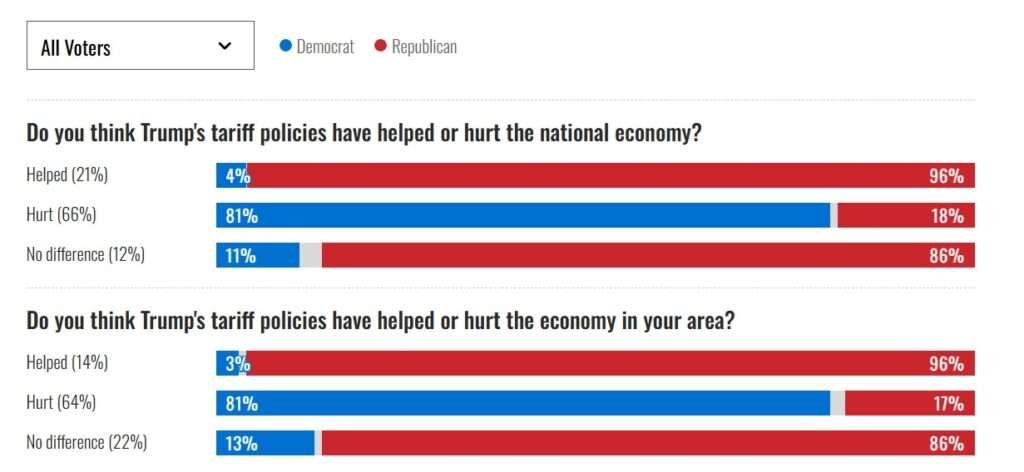
The short version: It turns out that tariffs are bad economics and bad politics.
That's not news to Reason readers (or probably to most people outside the White House). For years, we've documented how Trump's tariffs have raised prices, harmed businesses, disrupted supply chains, and more. One study found that the tariffs were as painful to American manufacturing as an additional 8.7 percent corporate tax would have been.
It's also worth remembering that the tariffs have failed to achieve their primary policy aim as well: America's trade deficit last month hit the highest level since March 2025.
Tariffs made everything more expensive and didn't provide much in return. Trump has talked for years about how the tariffs would generate tons of money for the government—as if that's a good thing. Those claims were wildly exaggerated, even before the Supreme Court forced the Trump administration to refund a significant amount of the tariffs because they had been unlawfully imposed.
Politically, the tariffs have been a drag on Trump's approval rating since the moment he stood on the White House lawn to declare "Liberation Day." The trends that led to a Democratic landslide on Tuesday night began in April 2025, when Trump very publicly promised to raise taxes on Americans. Who could have known that was a mistake?
There's another political cliché that says you never want to be on the wrong side of a 60–30 issue—meaning that candidates shouldn't prioritize niche interests over what the majority favors.
Trump just found himself on the wrong side of a 60–20 issue. If you're wondering how the Democrats could have pulled off such a stunning landslide last night, that's a good place to start.