
Anakin Skywalker Is a Great Character, Not a Great Role Model
The online right is again meme-ing its way toward a profound misunderstanding of the Star Wars protagonist.
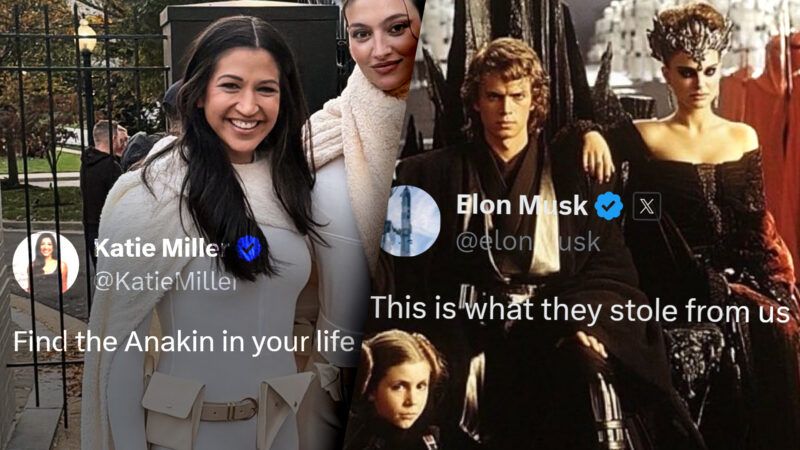
It's been Anakin Skywalker appreciation week on X for the last several days, and this prominent Star Wars prequel revisionist is all in favor of that. I'm glad that, 20 years later, this character—portrayed by Hayden Christensen in Attack of the Clones (2002) and Revenge of the Sith (2005)—is finally getting his due in an era when social media has made it easier for fan communities to challenge the critical consensus.
Still, some of these Anakin appreciation posts—which have taken on a right-wing political valence—seem to be missing the point of the character, which is definitely not that he was a good guy who was right about everything. Anakin is compelling because he is flawed and ultimately succumbs to evil, not because his malevolence was somehow justified. This is a very important distinction, and one that right-wing dudes on X should take under consideration.
The point I'm making is obvious when one considers other popular, compelling fictional protagonists who commit unspeakable evils; no serious person really thinks that Breaking Bad's murderous drug dealer Walter White and The Sopranos' even more murderous gangster Tony Soprano are great role models. Yet when it comes to Anakin, some large number of right-wing guys on X seem to earnestly think he had the right idea because they imagine that deep down, his politics matches theirs.
To be abundantly clear, I am not saying that it's problematic to make jokes about Anakin that position him as a right-wing culture warrior as opposed to liberal institutionalists like Padmé (his wife) or Obi-Wan Kenobi (his mentor). Many of them are quite funny—I, too, enjoy "For the better, right?"—and they are certainly nothing new. Political conservatives have long been penning contrarian, semi-satirical screeds about the Star Wars bad guys—The Weekly Standard published "The Case for the Empire" back in 2002. I'll be honest: I don't think those guys really meant that, but instead just wanted to rile up liberals.
Heck, maybe that's also true of this current wave of Anakin enthusiasm (though it feels different), which was kicked off (as far as I can tell) by the Education Department (?), which posted the following image on X:
There's Magic in Learning 🪄 pic.twitter.com/2Vkzkhsfn3
— U.S. Department of Education (@usedgov) October 30, 2026
Before you could say now this is podracing, a bunch of conservative accounts began tweeting similar Anakin memes depicting his romance with Padmé, the two of them ruling the empire together, and what their family might have looked like had it remained intact. "This is what they stole from us," wrote Elon Musk, alongside an AI-generated image of Anakin ruling the galaxy with Padmé, young Luke and Leia at their side, and the praetorian guard flanking them. As is the case with most social media posts of this ilk—vague lamentations that life is not as it should be—who "they" are and how anything was "stolen" remain unexplained.
Others are more explicitly political. The Blaze's Logan Hall posted a screenshot of Anakin arguing with Obi-Wan during their iconic duel and added this dialogue box: "Anakin we are a GALAXY of IMMIGRANTS!" (Musk retweeted it.) Another viral post described young Anakin standing in front of the alien-composed Jedi Council as "the White male experience." And there are countless posts in which a frightened Padmé calls out Anakin for sending "racist memes" to a group chat. (In the actual scene, she confronts him for murdering children.)
Let's back up a bit.
As most people know, the Star Wars saga is about a group of rebels fighting against an evil empire. The Galactic Empire is ruled by Emperor Sheev Palpatine, who is eventually revealed to be not just an authoritarian leader but also an all-powerful occult sorcerer along the lines of Harry Potter's Voldemort or The Lord of the Rings' Saruman. (He is, if anything, a less sympathetic villain than either of them.) Palpatine's faithful enforcer is Darth Vader, who was once a promising Jedi—a good sorcerer/knight—known as Anakin Skywalker. The purpose of the Star Wars prequels, according to creator George Lucas, was mostly to show how Anakin was corrupted by Palpatine and came to serve him.
What we learn in the prequels is that Anakin, like many teenagers, had a variety of personal issues, and Palpatine skillfully played on his distrust of authority and fear of losing his loved ones in order to manipulate him into turning evil. What makes Anakin such a popular character for young guys is that this is relatable, at least up to a point. Anakin wants to spend more time with his girlfriend—later his wife—but the bullshit rules of his workplace don't allow it. Anakin is really awesome at sword fighting and magic, but he gets treated like a member of the junior varsity team. Anakin is increasingly asked to complete dangerous tasks and even compromise his own (flawed) sense of right and wrong, but is denied a promotion (the rank of master) he deserves. Anakin begins to experience increasingly harrowing visions of loss, and his counselors (Yoda and Mace Windu) tell him to try not thinking about all that.
In the end, Anakin betrays the Jedi because he thinks it's the only way to save Padmé. This involves him slaughtering friends and foes alike, including the many children who are training to become Jedi. But ultimately, Anakin loses Padmé anyway, is horribly disfigured in a final battle with Obi-Wan, and is strapped into a mechanical suit by Palpatine. Reduced to playing the part of the emperor's chief lackey, he is a fundamentally broken man.
The tragedy of Anakin makes for a great story. It does not make him a great person.
While the audience, particularly the younger male audience, might sympathize with his desire to keep Padmé alive at all costs, Anakin's subsequent actions—murder and betrayal—are both heinous in their own right, and ineffective at saving Padmé. Undone by hubris, he allows himself to be duped by Palpatine: He makes a deal with the devil, and the devil doesn't even deliver on his side of the bargain. Really, when Padmé and Obi-Wan tell him throughout the film that he is becoming the very evil he swore to oppose, they are completely correct.
Perhaps that's why I bristle just a bit at the payoff of all these Anakin memes, which almost universally suggest that Anakin is right and everyone else is wrong—that, politically speaking, Anakin's reactionary solution is the correct one, whereas Obi-Wan and Padmé are naively liberal. How exactly did that work out for him again? Oh, that's right, he got agonizingly burned in lava.
So by all means, be a fan of the character: I certainly am. (I've been Anakin at Halloween parties, and much like Stephen Miller, I made my better half wear a Padmé costume.) But as with various Trump administration figures' penchant for identifying themselves with fictional villains, there's an important difference between thinking a character is cool and meme-ing yourself into agreement with a murderous stooge.