
The Failed Indictment of Cassidy Hutchinson Reflects Grand Jury Resistance to Politically Motivated Charges
Rejections of the Trump administration's dubious cases are a striking departure from the historical pattern of deference to federal prosecutors.
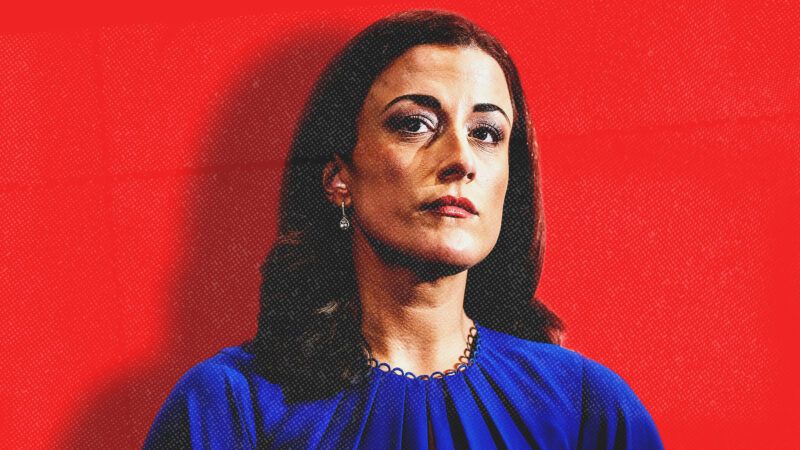
"I am very concerned about the weaponization of the Justice Department," Sen. Bill Cassidy (R–La.) told reporters in August, explaining his reservations about voting to confirm Todd Blanche as attorney general. Cassidy specifically cited the attempt to prosecute Cassidy Hutchinson, a White House aide during President Donald Trump's first term, based on her 2022 testimony before the House select committee that investigated the 2021 riot at the U.S. Capitol. "I'm told there is a grand jury being empaneled to investigate her," Cassidy said. "Why? Tell me that. Shouldn't every American be afraid of the weaponization of the Justice Department?"
Grand jurors in Washington, D.C., who on Tuesday declined to approve an indictment of Hutchinson, apparently shared the senator's concerns about the case against her. That setback is part of a pattern: Grand juries, which historically have almost never rejected charges proposed by federal prosecutors, have done so repeatedly during the last two years, reflecting the Trump administration's tendency to pursue politically motivated cases based on inadequate evidence.
A grand jury hears only the government's side of a case, and the probable cause standard for approving an indictment, which requires reasonable grounds to believe a crime has been committed and that the person identified by prosecutors committed the crime, is much less demanding than the proof beyond a reasonable doubt required for a conviction. But the Justice Department's manual for prosecutors says they should not pursue criminal charges unless "the admissible evidence will probably be sufficient" to meet the latter test. It is a pretty striking indication that prosecutors are disregarding that injunction when a grand jury determines that they have failed to meet the minimal burden of establishing probable cause.
Hutchinson, who at the time of the Capitol riot was White House Chief of Staff Mark Meadows' principal assistant, delivered the testimony at the center of the failed indictment on June 28, 2022. She described Trump as unconcerned about weapons carried by some of the people who attended the speech he delivered the day of the riot, during which he reiterated his false claim that Joe Biden had stolen the 2020 presidential election and urged his supporters to "fight like hell" against congressional ratification of his victory.
Hutchinson said Trump wanted the Secret Service to stop screening rally participants with magnetometers because he was worried it would reduce the size of the crowd. "I don't effing care that they have weapons," Trump said, according to Hutchinson's approximate recollection. "They're not here to hurt me. Take [the] effing mags away. Let my people in. They can march to the Capitol from here. Let the people in."
Hutchinson also said Trump was irate when the Secret Service told him he could not join the protesters at the Capitol. That much was consistent with the testimony of other witnesses. But Hutchinson added disputed details, saying Deputy Chief of Staff Tony Ornato had told her Trump was so angry that he "lunge[d] towards Bobby Engel," the head of his protective detail, and "reached up towards the front of the vehicle to grab at the steering wheel." The Secret Service agent who was Trump's driver that day contradicted Hutchinson's account, and Ornato said he had no recollection of any such incident.
Last March, Reps. Barry Loudermilk (R–Ga.) and Jim Jordan (R–Ohio) urged the Justice Department to prosecute Hutchinson for lying to Congress. "Hutchinson's potential prosecution became a point of controversy between lawmakers and employees of the Justice Department," CNN reports. "Some inside the department believed there was not enough evidence to bring a viable criminal case."
You would expect such a case to be handled by Jeanine Pirro, the U.S. attorney for the District of Columbia. But the investigation of Hutchinson was instead conducted by the Justice Department's Civil Rights Division, which is run by Assistant Attorney General Harmeet Dhillon, another Trump loyalist.
You might wonder what scrutinizing Hutchinson's testimony had to do with "protecting the civil and constitutional rights of all Americans," which is how Dhillon's division describes its mission. Dhillon's involvement is all the more puzzling given that Pirro previously had not hesitated to pursue dubious charges against the president's enemies.
Last February, Pirro sought an indictment of six Democratic members of Congress who appeared in a November 2025 video that reminded U.S. military personnel of their duty to "refuse illegal orders." Trump condemned that message as "SEDITIOUS BEHAVIOR AT THE HIGHEST LEVEL," saying the lawmakers "should be ARRESTED AND PUT ON TRIAL." But as a federal judge later noted, the allegedly criminal video was "unquestionably protected" by the First Amendment.
That did not deter Pirro from trying to deliver on her boss's threat. But as in Hutchinson's case, the grand jury apparently was not willing to participate in Trump's vendetta. After it unanimously refused to approve the indictment, Pirro gave up.
That embarrassing experience may have deterred Pirro from getting involved in Hutchinson's case, especially if she thought there was not enough evidence to obtain a conviction. She would have had good reasons for reaching that conclusion.
It is not clear exactly what charges the grand jury rejected this week. But the most obviously relevant statutes are 18 USC 1001, which covers false statements "in any matter within the jurisdiction of the executive, legislative, or judicial branch," and 18 USC 1621, which covers false testimony under oath. Both are felonies punishable by up to five years in prison. But a conviction under Section 1001 requires proving that the defendant "knowingly and willfully" made a "materially false, fictitious, or fraudulent statement," and the perjury statute applies only when a sworn witness "willfully and contrary to such oath" makes a "material" statement that "he does not believe to be true."
Those elements would have been hard to satisfy in Hutchinson's case. Her testimony about Trump's insouciant attitude toward weapons carried by his supporters was based on what she said she heard him say, an account that pits her word against that of a habitually dishonest politician whose speech that same day was full of misrepresentations. And even if her recollection of Trump's comments was not fully accurate, that does not necessarily mean she intentionally gave false testimony. The same goes for the alleged lunging-and-grabbing incident, an account Hutchinson said was based on a conversation with Ornato that he says he does not recall.
Maybe Hutchinson, who had a lawyer and was surely aware of the potential penalties for lying to Congress, nevertheless fabricated both of those claims. But assuming her testimony was inaccurate, it seems more likely that she misremembered or misconstrued what Trump and Ornato said. In any event, the task of proving the first proposition beyond a reasonable doubt would give pause to any reasonably cautious prosecutor. And the grand jurors, even without the benefit of hearing a rebuttal to the government's case, thought the evidence of deliberate deception was so weak that it fell short of probable cause.
That determination is just the latest in a series of similar rebukes. In addition to the rejection of Pirro's charges against the "Seditious Six," they include the attempt to prosecute New York Attorney General Letitia James for mortgage fraud, which two separate grand juries in two different Virginia cities blocked last December.
Grand jurors also have stood athwart felony prosecutions of protesters in Washington, D.C., including Sean Dunn, the guy who threw a sandwich at a Customs and Border Protection officer, and Sydney Reid, who allegedly interfered with immigration arrests while using her phone to record them. In the latter case, Reason's Joe Lancaster noted, prosecutors unsuccessfully sought a felony assault indictment "not once, not twice, but a staggering three times." Reid was ultimately acquitted of a misdemeanor charge.
In the summer of 2025, federal grand juries approved just seven of 38 proposed felony indictments against protesters in Los Angeles, an amazingly bad track record. A few months later, federal prosecutors dropped assault charges against two Chicago protesters after a grand jury declined to indict them.
"For decades, federal grand juries have almost never said no," Ballard Spahr attorneys Henry E. Hockeimer Jr. and Brad Gershel noted last year. In 2016, for example, grand juries declined to approve federal indictments just 0.004 percent of the time. "That dynamic is now being tested," Hockeimer and Gershel added. "As the DOJ has adopted a more assertive charging posture in politically sensitive cases, grand juries appear to be reasserting their independence."