
A Months-Old Anti-Robotaxi Group Is Steering Transportation Policy From Albany to D.C.
Even though its claims about job loss and safety don't hold up, the group has convinced the likely next mayor of D.C. to slow Waymo's development.
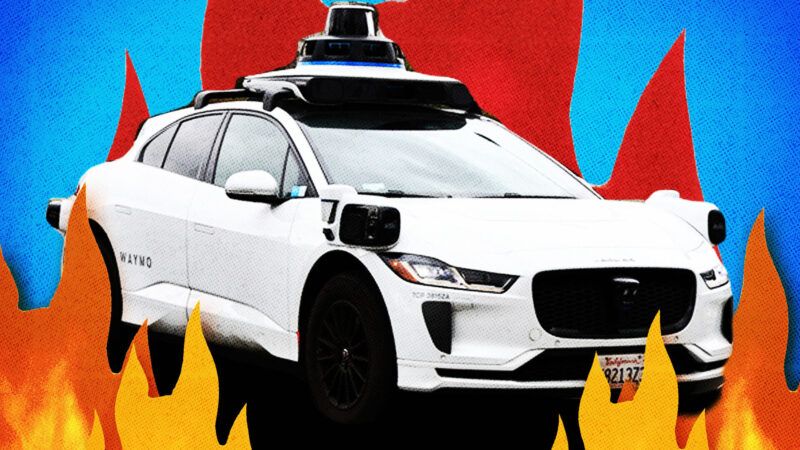
At a protest against a bill to legalize Waymo in Washington, D.C., earlier in October, the main tagline was: "Robotaxis don't vote; we vote." Little is known about the group behind it, raising questions about who's fueling the pushback against robotaxis in America's major cities.
People First Transportation Alliance (PFTA), the organization in question, describes itself as a "statewide coalition of labor unions" dedicated to putting "people over untested technology." The PFTA states it's a "coalition of community organizations, safe-streets advocates, and faith leaders." However, as The Washington Post reported on Monday, the group appears to have overstated its affiliation with four of the 13 individuals and organizations listed as its founding members.
"Several groups and individuals said statements made about them on the Transportation Alliance website were inaccurate," the Post reported, adding that PFTA "appears to be newly formed, with a minimal social media presence. Its website domain was created in late April, according to the Internet Corporation for Assigned Names and Numbers." The group created its social media accounts in May, but it has no posts and no followers.
Apart from its recent interest in the nation's capital, the PFTA lists New York and Philadelphia as its priorities, two cities led by lawmakers who publicly oppose Waymo's presence. Yet for a relatively unknown, recently created organization, the PFTA has found success in its campaign to shut autonomous vehicles like Waymo out of America's Northeast.
In February, the New York Post reported that Gov. Kathy Hochul (D–N.Y.) withdrew her own proposal—which would have allowed commercial robotaxi services such as Waymo to operate in smaller cities in upstate New York—after a PFTA-led coalition prompted enough backlash to kill support for the measure. A Hochul spokesperson told the Post that it was "clear that the support was not there to advance this proposal."
The PFTA told the Post that the organization would urge the state to "pass legislation requiring a human driver behind the wheel in every vehicle and a comprehensive study leading to a plan to address the impact driverless cars would have on New York State."
The group's resolution comes despite customer support for autonomous vehicles: A 2025 study on Waymo, Uber, and Lyft by Obi—a company that aggregates real-time rideshare prices—found that 70 percent of riders who've used Waymo preferred it over Lyft or Uber and 42.7 percent of all respondents were willing to pay Waymo's premium price (up to $10 more) to use the service.
Despite consumer support, autonomous vehicles can't count on a fair shake from lawmakers in some of the country's largest cities. In New York City, Waymo's permit to operate a pilot program on public streets expired in March. Mayor Zohran Mamdani has so far been noncommittal on renewing the company's permit. At a press conference that same month, he said his administration would be prioritizing workers such as the city's taxi drivers who "for far too long, have been sold a dream of being able to work their way to the middle class, only to have the rug pulled out from under them."
Despite the mystery surrounding the PFTA, its D.C. protest drew enough public support to elicit a statement from a person who will likely be the city's next mayor, current D.C. Councilmember Janeese Lewis George. In a post on X, Lewis George said D.C. was "facing a jobs crisis" that would be exacerbated by "rushing the legalization of autonomous vehicles." She urged the D.C. Council—which is currently considering a punitive proposal to legalize commercial autonomous vehicles—to "get this right and not rush Waymo legislation this year."
It's unclear how much longer Lewis George wants the District's residents to wait before autonomous vehicles are available for use. D.C.'s approach to legalizing commercial robotaxis hardly seems rushed.
Waymo began testing its vehicles in the city nearly two and a half years ago, in spring 2024. The company's co-CEO Tekedra N. Mawakana said its fleet has driven "more than 300,000 miles in Washington, D.C."Meanwhile, the District Department of Transportation (DDOT) has been conducting studies and organizing working groups on autonomous vehicles for nearly a decade. Still, the agency has been unable to draft a regulatory framework that would eventually enable commercial robotaxi use in the nation's capital. In March, UrbanTurf reported that DDOT would be conducting a long-awaited study on autonomous vehicles—originally due in 2022—and "expects to propose recommendations on AV deployment later this year."
Opponents of autonomous vehicles, such as Lewis George and the PFTA, often cite job loss as a reason not to legalize the tech. Still, with only 200 full-time ride-share drivers in a city of roughly 400,000 workers, as Lewis George has reportedly stated, the situation is a far cry from a crisis.
As for PFTA's public safety claims, Waymo's independently reviewed data show that, compared with an average human driver over the same distance, its vehicles caused 95 percent fewer serious-injury-or-worse crashes and 93 percent fewer pedestrian crashes with serious injuries.
PFTA claims it represents the people most directly affected by transportation policy. The little publicly available information suggests the group is more focused on protecting its members' position in the ride-share market than enhancing the experience of riders, who are increasingly opting for robotaxis when given the opportunity.