
2,400 Baseball Games for the Price of 1
Fake wide receivers running scams, Djokovic bounced, Messi retires, The Giving Tree wasn't about stadium subsidies, and more…
Hello and welcome to another edition of Free Agent! Jason has been placed on the PUP (physically unable to publish) list this week, so I've been called up for a spot start.
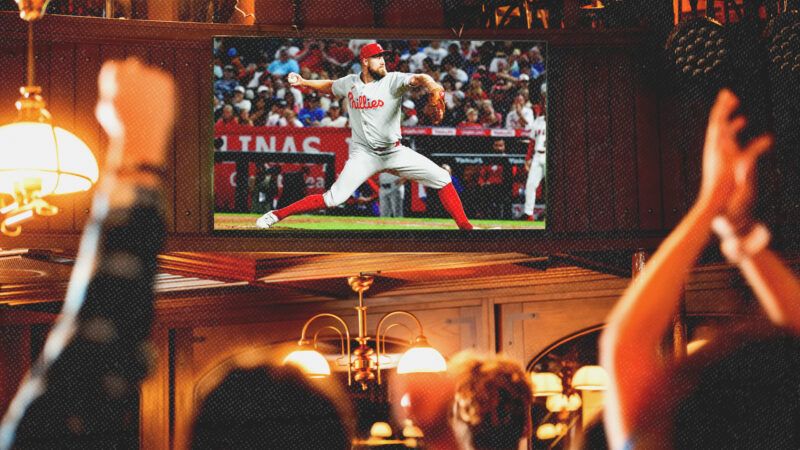
Real football doesn't start for another week (and "week zero" of college football is mostly nonsense), which means this is still baseball season, baby. Watching America's pastime has actually never been more affordable, despite those $15 beers at Nationals Park. Sharpen your pencils and grab your scorebooks.
As I said, real football starts next week—and you can join the fun by signing up for the one and only official Reason survivor pool. Don't be lame, do it.
Don't miss sports coverage from Jason Russell and Reason.
Locker Room Links
- Federal prosecutors have accused Daejon Labrayae Love of posing as a fake player for the San Francisco 49ers as part of a scam that defrauded more than two dozen women out of more than $1.3 million. Love allegedly "had romantic relationships with many of the victims and told them he wanted to build wealth and a future together," before asking them to take out personal loans to invest in "nonexistent investment vehicles." Getting deeply invested in a scenario that ultimately fails to reward you? Every 49ers fan under 35 can relate.
- Novak Djokovic was upset in the first round of the U.S. Open by Mariano Navone in a match that lasted more than four and a half hours and included at least one puke break for the 24-time major champion, who said afterward that "I didn't enjoy myself." Checks out.
- End of an era: Lionel Messi says he is retiring from international soccer. Messi was the first player to score 20 career World Cup goals (though France's Kylian Mbappe has already surpassed his scoring mark). See them all here.
- The end of a different era: ESPN is phasing out its "BottomLine" score and stat ticker—probably because we're all already checking the scores and stats on our phones.
- A bunch of kids from Curaçao, a nation of about 150,000 people, won the Little League World Series for the second time.
- Folarin Balogun, the breakout star of America's World Cup run this summer, will be playing in the English Premier League this season. Everton purchased Balogun's contract from Monaco for a reported 40 million pounds (about $54 million).
- Elsewhere in Reason, Nick Gillespie explains how the 2006 film Idiocracy predicted the future—and maybe offers some hope too?
- Did you have a bad week? Buck up, at least you didn't commit an error in six consecutive games like New York Yankees shortstop George Lombard Jr. (Adding injury to insult, Lombard also tweaked his knee and could miss a few games, although maybe that's for the best.)
This hasn't happened to a Yankees player in more than a century 😳
George Lombard Jr. has committed an error in 6 straight games, the longest streak by a Yankee since Chick Fewster in 1921. pic.twitter.com/S58qmwsZLE
— ESPN Insights (@ESPNInsights) August 28, 2026
More Baseball for Fewer Bucks
It's popular to complain about how much more expensive life has gotten—and I get it, high inflation sucks. But while it is easy to notice when prices increase or when the quality of goods and services erodes, it is often more difficult to quantify the abundance of modern life relative to the recent past.
Sports fans are probably more aware of those changes than a lot of other people. Many of us remember the dark days when the Red Zone channel didn't exist and when not every NCAA Tournament game was on TV. Still, quantifying this stuff can be pretty staggering.
A few years ago, the economist Gale Pooley offered this comparison on his Substack: "A ticket to a Yankees game in 1923 cost $1.10. Unskilled workers back then were earning 22 cents an hour so it took them five hours of work to earn the money to buy a ticket. Blue-collar workers were earning 44 cents an hour so it only took them 2.5 hours."
Of course, in 1923 there was no other way to watch the Yankees except at the ballpark. Today, the average wage in the U.S. is about $37 per hour, and a full season subscription to MLB.TV costs $149.99. That means that less than five hours of work can buy you a virtual ticket to every Major League Baseball game played this season (minus the blackouts and in-market games).
Or, as Pooley put it: "Enjoying baseball has become 242,000 percent more abundant."
Yes, there are diminishing returns to getting 2,400 baseball games on your television. But this is a service that the richest person on the planet in 1920 (or 1950 or 1980) could not have bought at any price, and you can get it for less than a full day's work. Inflation is bad, and politicians should stop pursuing policies that worsen it. Still, the best way to see how astonishingly wealthy modern America is is to notice the remarkable things we take for granted.
Playoffs Are for Winners
There are just four weeks left in the MLB season—and your team is probably still in the race, at least if it resides in the American League. Aside from Tampa Bay, Boston, and New York, the rest of the league is so mediocre that a team with a losing record might make the playoffs for the first time in baseball history. This happens routinely in the NBA and occasionally in the NFL, but it feels particularly gross in baseball because the 162-game regular season is supposed to be more meaningful and, historically, making the playoffs was more difficult than in other sports. Should baseball change its rules to prevent this from happening (in the future, no changes can be made this year)? ESPN's Bradford Doolittle has some ideas, and the first one is pretty good: Simply don't allow it.
"You have just five teams reach the .500 mark in a league? Fine," he writes. "You get five playoff spots. The team that otherwise would have played a seed held by a losing team advances to the next round."
Yes, this would obviously mess up the TV contracts by potentially reducing the number of playoff series. But I'd be even more radical about this idea. Make the cutoff something like "12 games behind the team with the best record." So if the best team in your league wins 97 games, every other team needs 85 wins to qualify. Then draw up a bracket based on however many teams clear the bar.
Added bonus: that means the team on top can knock out potential playoff teams by winning otherwise meaningless games in the season's final weeks—each win raises the bar for the stragglers. If you can't stay within 12 games over the course of 162, sorry, you don't deserve a crack at the championship.
That'll never happen, but it should. (Tweet me your own crazy suggestions.)
A related point: There is going to be major offseason drama in MLB as the players and owners negotiate a new collective bargaining agreement. The widespread assumption is that the owners will try to implement a salary cap (in one form or another) to limit how much big market teams like the Los Angeles Dodgers and New York Mets can spend. But doesn't the extreme parity in the American League suggest that the playing field is already pretty level under the current system?
Swing and a Miss
It looks like the Tampa Bay Rays will finally get their long-sought-after new ballpark, as the Hillsborough County Commission gave its final stamp of approval to a subsidy plan that will see the public kicking in about $2 billion in tax breaks and other goodies.
But here's the real insult to the taxpaying public of the greater Tampa area. Just moments after voting for the subsidy package, Commissioner Chris Boles explained that his decision was motivated by The Giving Tree—otherwise known as the worst children's book ever written—and then went on to admit that he completely misunderstands his own metaphor.
"You have a seed, and you let it grow, and it gives back over time, and it does all these things," Boles said. "And in a way, this park is like the Giving Tree."
As Neil deMause notes at his Field of Schemes blog, that is not at all how The Giving Tree goes: "The boy protagonist doesn't plant the seed that turns into the tree, he just shows up, finds the tree in the first, eats its apples, climbs its trunk, ultimately cuts it down, and then as an old man sits on its stump."
In this case, I'm afraid the taxpayers of Hillsborough County are the metaphorical tree.
The Next Indiana?
OK, we can't make the whole newsletter about baseball.
In the era of transfer windows and Name, Image, and Likeness money, which school has the best shot at duplicating Indiana's incredible turnaround from Big 10 doormat to national champions? How about Thomas Jefferson's very own University of Virginia?
Virginia smoked N.C. State, 34–6, in one of the marquee-ish games of the opening week of the college football season, and The Athletic's Ralph D. Russo tabs them as a possible Cinderella story this season. "A straight line can be drawn from Indiana to Virginia when it comes to roster-building strategy. It's all about experience, production and fit when coach Tony Elliott's program dips into the portal," he writes. Or maybe another basketball blueblood, Kentucky, can also make the leap to football powerhouse?
Such underdog runs are amazing because they are so rare, so don't get your hopes up. For what it's worth, ESPN's college football simulations give Virginia a 1.7 percent chance of winning it all. Kentucky, meanwhile, has only a 1 percent chance of topping the SEC. Dare to dream, kids!
Replay of the Week
As a Phillies fan, I am admittedly a little biased here—but their 9th inning in Anaheim on Friday night included a game-saving home run robbery followed by a game-winning grand slam. Have you EVER seen that before?!
All the swings of emotion during an outrageous top of the 9th in Anaheim 😱 pic.twitter.com/S71Dd50G7t
— MLB (@MLB) August 29, 2026
That's all for this week. Enjoy watching the real games of the weekend: The Minnesota state amateur baseball championships, which continue through Labor Day.