
The Math on Trump's Haitian Deportation Flights Doesn't Add Up
The Trump administration created 330,000 new illegal immigrants by revoking TPS from Haitians. It plans to deport just 10,400 per year.
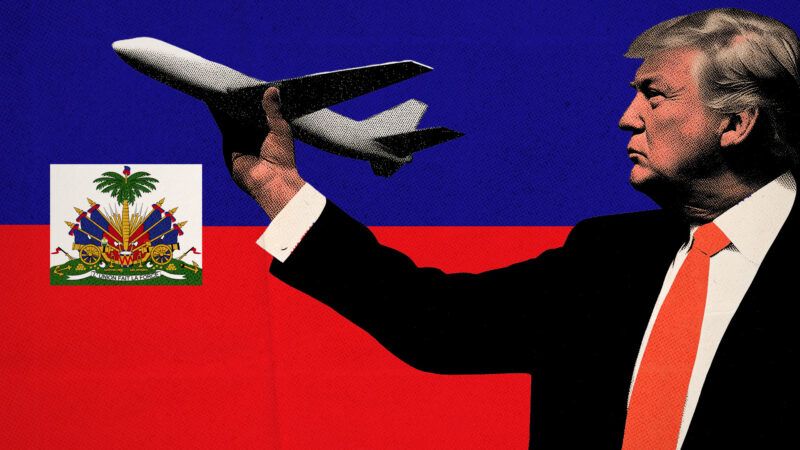
Having stripped more than 300,000 Haitian immigrants of a special legal status that allowed them to live and work in the United States, the Trump administration is now beginning efforts to deport them.
The administration is planning to "expel thousands of Haitians" who won't willingly return to the war-torn, earthquake-prone country, The New York Times reported on Thursday. According to documents reviewed by the Times, the administration is now seeking to "increase the pace of flights from once a month to once a week."
One deportation flight, with 57 people on board (including several children), landed in Haiti on Thursday, according to the Miami Herald. A flight last week carried 160 deportees.
But let's do a little back-of-the-envelope math—with a hat tip to Daniel Di Martino of the Manhattan Institute.
Assume the Trump administration is able to achieve its goal of one deportation flight to Haiti every week. And assume that each of those flights will be full. We'll give them the full benefit of the doubt and assume that means there are 200 deportees on each plane.
That's 10,400 deportations in a year. Not a small number by any means. But maybe you're willing to believe that the government won't make any mistakes and every single deportee is a hardened criminal (even the kids, apparently) who deserves to be thrown into one of the world's worst humanitarian crises.
That's still just 10,400 people out of more than 300,000 Haitians in the U.S. who had temporary protected status (TPS) before the Trump administration revoked it.
Those 300,000 Haitians were able to work here legally under TPS, which means they were also paying taxes. Now, with their legal status revoked, they cannot do that.
In Florida, where about half of the Haitian TPS population lives, that could mean the loss of "$1.5 billion in annual economic contributions, along with $174 million in federal and payroll taxes, and $176 million in state and local taxes," according to a Princeton University analysis published by the Miami Herald.
Before their TPS status was revoked, Haitians accounted for about 25 percent of the total TPS population in the U.S., a group that has "a labor force participation rate nearly 15 percentage points higher than U.S.-born individuals," according to the Penn Wharton Budget Model. That same study found that TPS recipients are "5.4 times more likely than U.S.-born workers to work in building and grounds cleaning and maintenance" and were "3.2 times more likely to be employed in construction."
In other words, this is a population that is working at high rates, filling jobs that few Americans are doing—and, particularly when it comes to construction, helping to offset a serious labor shortage.
Now, those Haitian immigrants can't work legally and can't pay taxes. But even if you assume the Trump administration hits all its deportation goals, most of those Haitians won't be deported anytime soon.
What will they do instead? Many will keep working, but illegally. Some might turn to crime. Those who need emergency health care and other public services will now do so without paying taxes to help support them. The Trump administration sees undocumented immigrants as a burden on America—but by kicking all these Haitians out of their jobs, hasn't it contributed to the very problem it claims to be solving?
All of that, just so the Trump administration can make a show of deporting a few thousand Haitians. The math doesn't work.