
Lots of Trump's Tariffs Expire on Friday. It's Thursday Afternoon, and No One Knows What Will Replace Them.
The U.S. economy is not a reality show. The Trump administration should stop acting like it is.
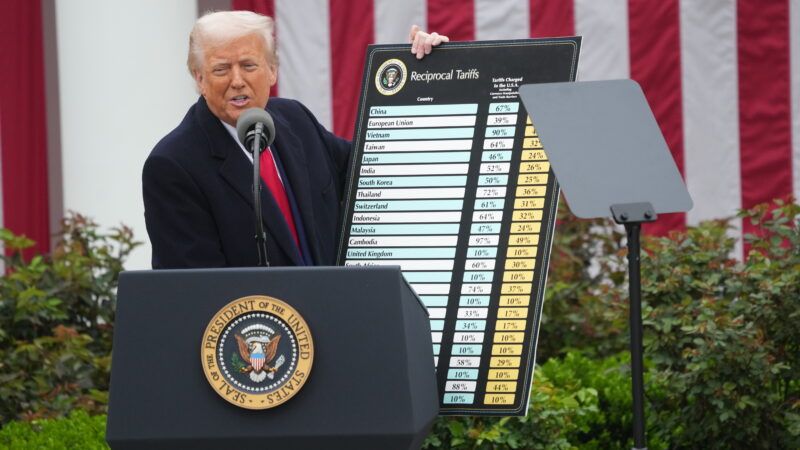
Consider one of the biggest challenges facing American businesses in the midst of President Donald Trump's global trade war: As of Thursday afternoon, no one knew what tariffs would be charged on which imports entering the country as soon as Friday morning.
Trump is no stranger to improvisational, make-it-up-as-you-go policy, but even by his standards, this is pretty ridiculous.
To understand the wild uncertainty facing American businesses this week, you have to back up a few months. In February, the Supreme Court struck down many of the tariffs Trump had imposed last year when it ruled that the International Emergency Economic Powers Act (IEEPA) did not grant presidents the power to impose tariffs. Trump responded by implementing a 10 percent "global tariff" via a different legal mechanism: Section 122 of the Trade Act of 1974.
But that law only allows for temporary tariffs that last a maximum of 150 days, unless Congress votes to extend them, which it has not. As a result, the tariffs Trump imposed in February will expire at midnight tonight.
The Trump administration had 150 days to provide some clarity and stability to American businesses that buy and sell things overseas. It did not do that.
"You'll have to stay tuned, and you're gonna be busy over the next few days," U.S. Trade Rep. Jamieson Greer told The Wall Street Journal earlier this week when asked about the upcoming tariff deadline.
That's, uh, not very helpful. The U.S. economy is not a reality show. The Trump administration should stop acting like it is.
On Thursday, White House press secretary Karoline Leavitt said an announcement about tariff rates would be coming later in the day. As of 4 p.m., however, no such announcement has been made. (It's possible the White House is deliberately waiting until after the stock market closes, given how the market has reacted to previous tariff hikes.)
"How in the world does someone decide whether to expand their factory when they wake up in the morning and have no idea what the tariff on the materials they need will be?" Bryan Riley, director of the Free Trade Initiative at the National Taxpayers Union Foundation, asked rhetorically in an email to Reason. "Or how many acres of crops to plant? Or how many workers to hire? Or how many Christmas toys to order?"
All good questions. Thursday did not get the same level of national media attention as Trump's so-called "Liberation Day" tariff announcements of April 2025. For good reason, the White House decided to avoid turning this latest bit of major tariff news into a spectacle.
But what happened on Thursday is in many ways even less defensible than what happened on Liberation Day. Trump's trade policies are more unpopular and less successful than ever, but he seems determined to continue jerking American businesses around, with little warning and no regard for the uncertainty it is creating.
The chaos and uncertainty created by these new, last-minute tariff announcements ought to underscore the importance of having Congress, rather than one (highly mercurial) president, set American trade policy.
Studies show that the heightened level of uncertainty caused by Trump's handling of the tariffs has harmed the economy. That is, of course, on top of the direct cost of the tariffs themselves, which have been a massive tax increase on Americans. Various estimates show that the Section 122 tariffs cost American businesses between $25 billion and $30 billion during the 150 days that they were in place.
No wonder the trade war and tariffs are unpopular—and getting more unpopular as time passes.