
Why Are Americans Less Patriotic Than Ever?
As the United States celebrates its semiquincentennial, all age groups are less likely to love America than in the past.
As America gears up to celebrate its 250th birthday, you've probably encountered headlines like this Newsweek one: "US Gen Z, Young Millennials Less Patriotic Than Older Generations: Poll."
It's true that polls consistently show that younger Americans are more likely to be ambivalent about the United States than their parents or grandparents. For instance, the poll cited by Newsweek finds that for people between the ages of 18 and 34, "56 percent said they were somewhat or very patriotic." Among people older than 65, the corresponding number is 86 percent, leading to the conclusion that there's "a clear generational gradient: Each successive age group reports higher levels of patriotism than the one below it."
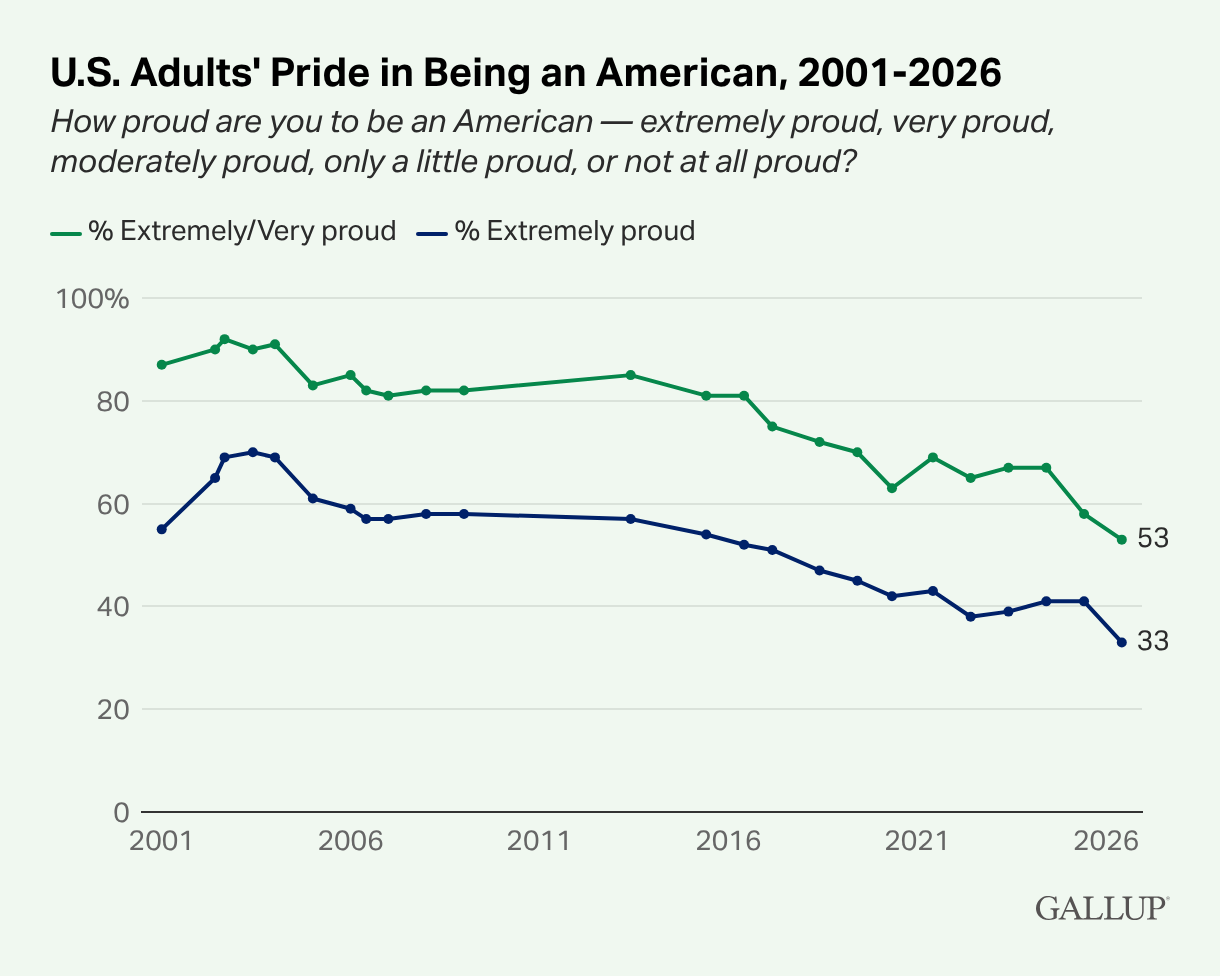
But such facile analyses ignore the bigger and arguably more important trend: Americans overall are less patriotic than we used to be. Over the past 25 years, reports Gallup, pride in "being an American" is way down from its peak in September of 2002, when fully 92 percent of respondents said they "extremely" or "very proud" to be American. The most recent survey, conducted in June, found just 53 percent were still going full Lee Greenwood, even as the 83-year-old "God Bless the U.S.A." songwriter opened the America 250 celebrations in Washington, D.C.
The reasons for such a massive and persistent drop are many and overlapping. A huge part of the answer surely lies in increasing political polarization, which is negatively restructuring all parts of people's lives by restricting "the range of people with whom they are willing to have relationships, the brands they purchase, and the jobs they take." One of the great historic promises of America was that it was a place you could escape politics and partisanship, but these days not so much.
Gallup finds that just 14 percent of self-identified Democrats are "extremely proud" to be an American, compared to 70 percent of self-identified Republicans. This is the largest gap on record, and the partisan divide is incredibly volatile. While Republicans consistently voice more pride than Democrats, their patriotic feelings dropped quickly after President Donald Trump was voted out of office in 2020 and then climbed 18 points after he was re-elected in 2024. Similarly, Trump's second term corresponds with a precipitous 20-point decline in feeling "extremely proud" to be an American among Democrats between 2024 and now.
Interestingly, patriotism over just the past year declined sharply among Republicans, with a seven-point drop in the percentage saying they are extremely proud. That is perhaps a testament to both Trump's record of public failures in matters large and small and in anticipation of big losses in the midterm elections.
Given the outrage voiced by many on the right over this week's Supreme Court ruling upholding birthright citizenship, the GOP negativity seems likely to grow. In a widely circulated post on X, conservative influencer Matt Walsh called the ruling "total madness" and "suicide" and said the Court approving a law that has been on the books for 150 years "fills me with rage so deep I can't describe it." Walsh's outrage was echoed by politicians such as outgoing Rep. Nancy Mace (R–S.C.), who announced, "Impeach rogue, activist judges. We're looking at you Amy Coney Barrett," and Sen. Mike Lee (R–Utah), who snarked, "If a woman gives birth at the Supreme Court, is her baby entitled to automatic status as a justice?" Writers at the MAGA outlet The Federalist called the ruling "apocalyptically and indefensibly bad" and groused "very, very difficult to see where we go from here."
And Republicans are the patriotic ones! If Democrats do win big in the midterms—and retake the White House in 2028—we can expect the number of them feeling good about the country to rebound. But those gains are unlikely to change the overall mood of the country.
The downward trajectory of patriotic feeling is not an isolated trend. As Gallup has documented, for decades, trust and confidence in major U.S. institutions—including federal, state, and local governments; education; big and small businesses; and churches and nonprofits—have declined. In its most recent comprehensive review (2023), Gallup found that just 26 percent of Americans had "a great deal or quite a lot of confidence" in "major U.S. institutions." That's down from a recent high of 43 percent in 2004. If we're being honest, the 21st century has been a rough ride. The weirdness of the 2000 election that took months to resolve, the 9/11 attacks, two decades of poorly conceived and ineptly prosecuted wars, the worst financial crisis since the Great Depression, convulsions over racially biased policing, the COVID pandemic and resulting lockdowns—any one of these things would call into question optimism and positive feelings toward the American experiment. Add to that large-scale scandals involving the Catholic Church, the Boy Scouts, and charities like United Way; the rise of China as an economic rival; the first major postwar invasion of a country in Europe; major demographic shifts in the United States; widespread use of social media and AI, and more, and it's easy to understand why trust and confidence in institutions are declining, or at least under serious stress.
In such a context, it's not surprising that longstanding attitudes toward America are undergoing continuing reevaluation. What might be surprising is that continuing improvement in material conditions are either ignored or waved away as insignificant. Yet inflation-adjusted median household income, a good proxy for general financial well-being, is at an all-time high and intergenerational mobility is still the rule not the exception, with about 70 percent of 30-year-olds outpacing their parents at the same age. Crime, especially violent crime, continues its decades-long decline after a pandemic increase, and life expectancies are going up. The rise of a true global middle class goes largely unremarked upon, even as roughly half of Americans say life was better in the 1950s, an era marked by de jure segregation, strict gender roles, relatively tiny houses, limited educational opportunities, and the ever-present specter of beatniks and nuclear annihilation.
Americans famously don't know much about history (a new CATO poll finds "Nearly Half of Americans Don't Know What America's 250th Is Celebrating"). Over the last 250 years, that unwillingness to either care about or respect what came before us helped to create a vibrant, dynamic society that moved consistently into a future that was better, fairer, and more prosperous; the lack of respect for the past also ultimately allowed us to fix and correct grotesque miscarriages of justice such as slavery. Now, that lack of history may be contributing to a sense of aimlessness and nihilism, of thinking that the United States is either uniquely evil (a common sentiment on the progressive left) or that our best days are behind us (the traditionalist right).
It's troubling that fewer and fewer of us are proud to be an American, but in the end that probably doesn't matter half as much as the reality that the United States is thriving and that individuals have a wide scope for living the lives they envision for themselves. Understanding that old institutions need to earn and keep our trust and confidence—or else be replaced by new ways of doing things—may be the best lesson to ponder over the semiquincentennial weekend.