
Elon Musk Becomes the World's First Trillionaire. Is That Such a Bad Thing?
Growing economies benefit all people, not just the uberwealthy.
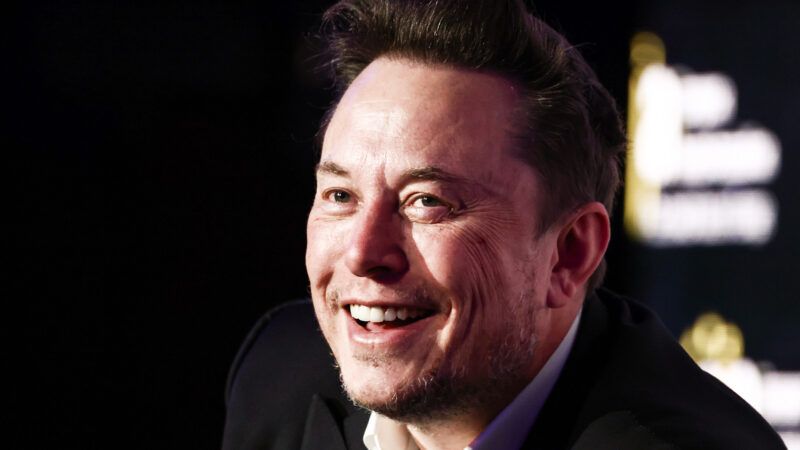
Elon Musk, the world's richest man, extended his lead by becoming the first trillionaire in world history. Many progressives have bemoaned this result for years, but is there really anything to fear?
The space exploration company SpaceX went public this week, announcing on Thursday an initial price of $135 per share. Musk, the founder, CEO, chief technology officer, and chairman of the board, "holds roughly half of the company's stock, including shares that he might earn far in the future tied to accomplishments such as shooting computer data centers into space and creating a human settlement on Mars," Shira Ovide and Faiz Siddiqui report at The Washington Post. "Those Musk shares in SpaceX are worth about $867 billion at Thursday's IPO price. Combined with the chunk of the automaker Tesla that also belongs to Musk, his stock in the two companies is valued at more than $1.1 trillion combined."
The company's stock opened at $150 and hit $170 after trading began, putting Musk comfortably above the trillion-dollar mark even without the bonus shares tied to space colonization.
The news was hardly a surprise. Musk even referred to himself as a trillionaire in March, in a cheeky reply to Rep. Alexandria Ocasio-Cortez (D–N.Y.) on X—the platform formerly known as Twitter before Musk bought it outright in 2022.
Of course, Musk does not actually have $1 trillion in checking and savings—he is a trillionaire on paper, and he will only remain one as long as both SpaceX and Tesla maintain healthy stock prices.
Still, it represents a significant milestone in the history of human achievement.
In fact, this has been a long time coming, for Musk or anyone. As Chase Peterson-Withorn notes at Forbes, it took more than a century after the world's first millionaire to crown its first billionaire, with the first trillionaire coming just over 100 years after that.
There was speculation in 2020 that Amazon founder Jeff Bezos could become the first trillionaire when COVID-19 lockdowns sparked a massive uptick in online ordering. Online commenters were unenthused at the prospect, though one wonders how many of them spent the early days of the pandemic stocking up on toilet paper and generic Robitussin.
Ultimately, Bezos' gains leveled off, and his wealth currently sits at a paltry-only-by-comparison $262 billion.
At least as far back as 2021, analysts at Morgan Stanley suggested not only that Musk could become the first trillionaire, but that it would come from SpaceX.
Of course, progressives have blanched at the idea of a single person controlling that much wealth.
"This is not only grossly immoral. It is insane economics," Sen. Bernie Sanders (I–Vt.) wrote in September, when reports suggested Musk's Tesla compensation package could push him above billionaire status. "No society can survive when one man becomes a trillionaire while the working class struggles to survive. This cannot stand."
Earlier this year, Sanders proposed an annual 5 percent wealth tax on U.S. billionaires.
Last month, Ocasio-Cortez declared that no billionaire becomes one honorably: "You can get market power, you can break rules, you can abuse labor laws, you can pay people less than what they're worth, but you can't earn that."
It's simply impossible, per Ocasio-Cortez, that any person could make something—a product, a service, an experience—that creates billions of dollars of value for consumers, without somebody else being worse off as a result.
But SpaceX has pioneered innovations in space travel that very recently seemed like science fiction. "SpaceX's ability to lower launch costs by roughly 90 percent—through reusable first-stage boosters, but also a vertically integrated manufacturing process and a high-cadence flight rate—is mega innovation equal to any of the past quarter century," writes James Pethokoukis of the American Enterprise Institute. "That massive cost decline, with another 90 percent or more potentially on the way through full reusability, has fundamentally altered the economics of space and finally made possible the dreams of the original Space Age: orbital cities, deep-space habitats, space-based solar, asteroid mining."
Besides, economics is not zero-sum. Musk's balance sheet growing to a trillion dollars does not mean other people lose money; it means the economy as a whole is growing.
And growing economies are good for everybody, not just the uberwealthy: Between 1990 and 2025, the global share of people living in "extreme poverty" declined by nearly two-thirds, from 2.31 billion to 808 million, even as the global population increased by nearly 3 billion—an accomplishment J.D. Tuccille called "nothing short of miraculous." It's not a coincidence that over that same period of time, global gross domestic product (GDP) roughly quadrupled, boosting countless thousandaires into millionaires and millionaires into billionaires in the process.
This is not to say Musk and his wealth are completely beyond criticism. After all, despite talking a big game about the government butting out of business affairs, his companies have benefited from tens of billions of dollars in government contracts. Just last month, SpaceX won a $4 billion contract with the Space Force.
But it remains the case that many companies, including SpaceX, contribute to the economy by creating a product that others are willing to pay for, and there's nothing exploitative about that.
Even some of the cynics currently naysaying about Musk have shown a bit of hypocrisy on the subject.
Sanders long railed against "millionaires and billionaires," making them a target of his 2016 presidential campaign. But when he ran again in 2020, Sanders suddenly cut the phrase in half, to just "billionaires."
Perhaps not unrelated is the fact that in the intervening years, Sanders himself became a millionaire.