
DHS Says It Has 'Zero Tolerance' for Protesters' 'Verbal Assaults.' Here's What the Law Says.
Protesters continue to clash with law enforcement outside the Delaney Hall immigration detention facility, but questions remain over whether DHS policies comply with First Amendment law.
Protests over poor living conditions for detainees at Delaney Hall immigration detention center erupted over the weekend, leading to the arrest of over 80 people, the Associated Press reported on Saturday. Some of the protesters arrested by Immigration and Customs Enforcement (ICE) agents are accused of assaulting law enforcement officers, obstruction, and threats. But questions remain about whether the Department of Homeland Security's (DHS) enforcement policies violate the First Amendment and chill speech on the ongoing public debate over immigration policies.
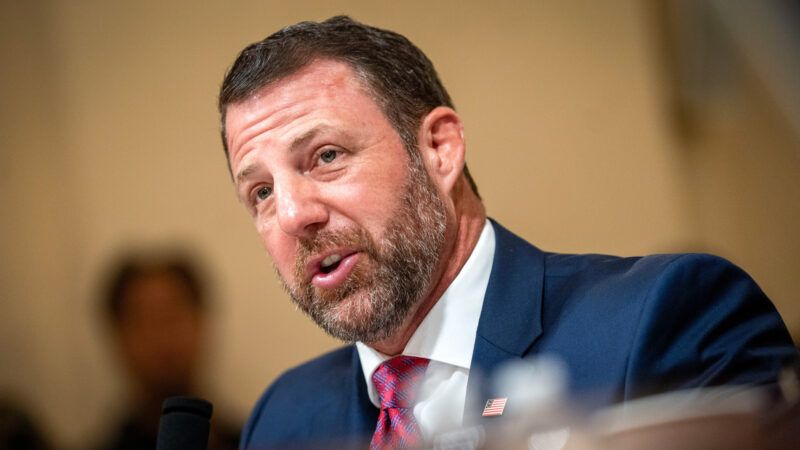
The crackdown on protesters is not surprising given Homeland Security Secretary Markwayne Mullin's statements during congressional hearings last week, in which he took a hard line against violent protesters. During a House Committee on Homeland Security hearing on June 3, Mullin testified that he is "OK with protest," so long as it is done "in a peaceful way, in a legal area." However, Mullin asserted, he has "zero tolerance" for individuals who "verbally assault our officers," "go after our vehicles," or "assault our property." "You assault one of our officers, we will find you. We will arrest you," he continued.
While Mullin is right that the destruction of government property and assaulting, resisting, or impeding law enforcement officers are both federal crimes, there is no such thing as "verbally assaulting" an officer under the law, Aaron Terr, the director of public advocacy at the Foundation for Individual Rights and Expression (FIRE), tells Reason.
Under the First Amendment, individuals are free "to criticize, mock, or disparage law enforcement officers" who "have no greater right than anyone else to be shielded from offense or criticism," Terr explains. "In fact, the Supreme Court has recognized that properly trained officers are expected to show even more restraint than the average citizen when confronted with provocative or challenging speech."
"The First Amendment's broad protections are essential to preserving the public's ability to criticize and hold accountable those entrusted with enforcing the law," Terr says, which is why speech is generally protected "unless the speech falls into one of the narrow categories of unprotected expression."
One such category includes true threats, defined by the Supreme Court in Virginia v. Black (2003) as "statements where the speaker means to communicate a serious expression of an intent to commit an act of unlawful violence to a particular individual or group of individuals."
When assessing whether speech constitutes a true threat, "context always matters," says Terr. "Courts look at the surrounding circumstances to determine whether a reasonable person would understand the statement as a serious expression of intent to commit unlawful violence, as opposed to a joke, hyperbole, or venting," all of which fall under protected speech.
The distinctions between true threats and other forms of protected speech can be rather nuanced. For example, in 1969 the Supreme Court in Watts v. United States reversed a jury's decision to convict a young man, recently drafted into the Vietnam War, for saying at a public rally, "If they ever make me carry a rifle the first man I want to get in my sights is L.B.J." The Court held that the statements were protected speech and amounted to crude political hyperbole rather than a true threat. "The language of the political arena," the Court wrote, "is often vituperative, abusive, and inexact" but must be interpreted "against the background of a profound national commitment" to "uninhibited, robust, and wide-open" debate on public issues.
When asked by Reason how the DHS defined verbal assault and whether it aligned with First Amendment law, a spokesperson responded via email with the Justice Department's statement regarding the arrest of a Delaney Hall protester, Nicholas Matthew Scelfo, who allegedly threatened to assault and murder an ICE officer and his family. Video posted by ICE on social media shows Scelfo pointing at agents during a May 27 protest, shouting, "I'll kill your whole fucking family. Your whole fucking family is dead." If convicted on the threat charge, he faces up to 10 years in prison and a maximum fine of $250,000, according to the Justice Department.
Another Delaney Hall protester was detained and dragged away by ICE agents on June 5 for allegedly threatening an officer. Video of the incident shows an ICE agent yelling at a group of protesters to back up before singling out a protester off-camera, shouting, "What did you just say? You're going to kill me? You're going to kill me?" Agents surround the suspect and drag him away as he exclaims, "I ain't say nothing! I ain't say nothing!"
As shocking as these statements may seem, "a statement like 'I'll kill you' is not automatically a true threat simply because those words are used," said Terr. Things like "the nature of the protest, the level of antagonism between the protester and the officer, the protester's tone, and any accompanying conduct" are all relevant to a court's analysis on whether statements rise to the level of a true threat, Terr says.
But whether law enforcement officers with the power to make arrests abide by the courts' distinctions between true threats and otherwise protected speech is another question entirely. "Unfortunately, administration officials and federal agents have repeatedly demonstrated either a misunderstanding of, or disregard for, the distinction between protected speech and illegal conduct," says Terr. The DHS under President Donald Trump has put forth policies inconsistent with the First Amendment, Terr continued, from saying recording on-duty officers constitutes unlawful doxxing or obstruction, to attempting to unmask online anonymous critics. "These actions all seem designed to chill protected speech rather than enforce the law," says Terr.