
The Libertarian Party's New Leader Has No Interest in Playing Kingmaker
"There's no deals that can be made for a cabinet position when you're sacrificing our set of principles in our platform," says Evan McMahon.
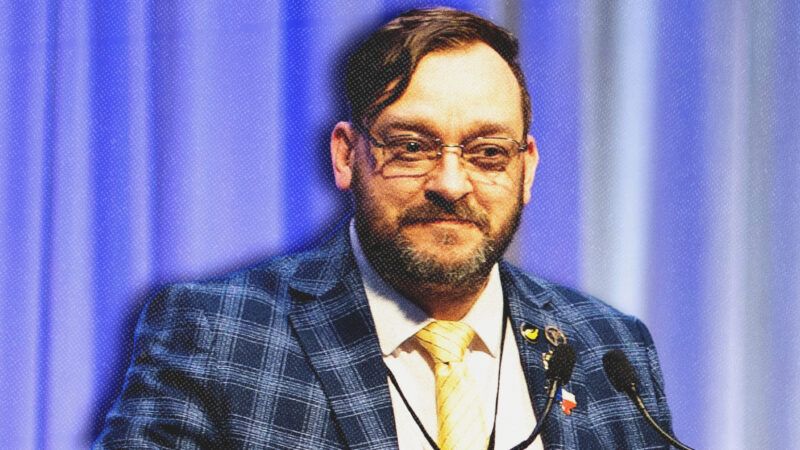
As the new leader of America's largest third party, Evan McMahon doesn't plan on playing kingmaker to help Democrats or Republicans get elected.
"The proper approach for a Libertarian candidate to take is to be a libertarian and run," says McMahon, who was elected the party's new chair at its convention last weekend. "Not to seek an armistice with somebody who's going to grow the state, who's going to bomb and kill children in other countries."
Most of the time, that would be a rather noncontroversial take. In recent years, however, the Libertarian Party has been controlled by a faction that toyed with the idea that the best way to achieve pro-liberty political change is by cozying up with one of the two major parties. In practice, that meant doing things like inviting Donald Trump to speak at the Libertarian National Convention two years ago.
Instead of playing spoiler, the idea was to use Libertarian voters as leverage to gain a seat at the table (or perhaps a position in the cabinet), even if doing so came at the expense of the party's own nominees. That has been a controversial approach within the party, which has seen membership and donations decline, and has yielded few positive results—yes, Trump freed Ross Ulbricht, but most of his second term has largely been a libertarian nightmare.
McMahon wants a clean break with all of that.
"There's no deals that can be made for a cabinet position when you're sacrificing our set of principles in our platform. It's just abhorrent to me," he tells Reason.
If you believe the Republican Party is the most effective vehicle for achieving libertarian goals, then "go be with them," he adds.
McMahon supported the successful effort at last week's convention to disaffiliate the Libertarian Party of New Hampshire, something he says was "necessary" and had been "a long time coming."
The former New Hampshire affiliate had endorsed Trump in 2024, rather than backing Libertarian nominee Chase Oliver. The state party has also gained a reputation for posting racist, bigoted, and authoritarian content on social media. The affiliate had become "a toxic group that is doing damage to our brand and to our candidates and our affiliates," McMahon told Reason.
Looking forward, McMahon believes the Libertarian Party needs to do a better job of speaking to disenchanted and frustrated voters on both sides—and bring them into the fold as dues-paying members. He's set an ambitious goal of growing the party's base to 66,000 "sustaining members" (those who donate at least $25 annually) by 2028.
Telling some current members to take a hike might make the task even more difficult, but McMahon points to the fact that there are more than 700,000 registered Libertarian voters in the country.
"If you don't have a strong membership base, you don't have candidates. You don't have volunteers to go out and support those candidates," he says. "You need people who can show up at zoning board meetings, town council meetings, and all the other different levels of government to be a representative of the party."
McMahon got into Libertarian politics in 2010 after previously working on Republican campaigns in the Indianapolis area. Since making the switch, he's been a driving force in the Libertarian Party of Indiana, which he has chaired since 2021. He helped run Donald Rainwater's 2020 gubernatorial campaign, which received more than 11 percent of the vote statewide (Rainwater's follow-up bid in 2024 scored less than 5 percent, but he got on stage with the major party candidates during the debates). He's helped start dozens of local Libertarian chapters, both in Indiana and across the rest of the country, as part of the Libertarian National Campaign Committee.
Much of the criticism that McMahon has faced, at the convention and online in the days since it ended, surrounds two issues: His criminal record (which is not in doubt) and his alleged support for aggressive COVID-19 countermeasures during the pandemic—the only evidence of which seems to be a social media post in which McMahon urged people to "#StayTheFuckHome."
Pressed about both, McMahon is happy to discuss them. The COVID-19 post, he says, was not an endorsement of government-imposed lockdowns, school closures, or vaccine mandates, which he spoke out against as chair of the Libertarian Party of Indiana. It was a call for personal responsibility. The same is true for his habit of wearing a mask in public during the pandemic—something McMahon says he started doing during flu seasons before COVID-19, because he is immunocompromised and trying to protect his own health.
The other issue is more serious and more illustrative. McMahon was arrested in 2003 and ultimately pleaded guilty to burglary and drug charges, for which he served three years under house arrest. He says he does not remember committing the crime—he was blacked out and woke up in the "drunk tank" afterwards—but has taken full responsibility for it.
In fact, the brush with the law "saved my life," he says, as it forced self-reflection that led to sobriety and a successful career.
So, I ask the natural follow-up: What is it like to be sober at a convention full of libertarians?
"It is hard, man," he laughs, before getting serious. "I think that you have the right to put what you want in your body. I just know that I'm allergic to it and that if I do it, my life will be turned upside down."
A little sobriety—of the political kind, if not the other types—might be the sort of thing the Libertarian Party needs right now. In the wake of the pandemic, the party has been riven by an internal power struggle, allegations of self-dealing by insurgent party leaders, and the flirtation with endorsing Trump (or even Robert F. Kennedy, Jr., my goodness). Membership has declined, and so have donations. At a time when record numbers of Americans are disgruntled with the two major parties, the Libertarian Party has also managed to make itself a less attractive alternative.
Time will tell if McMahon is able to turn things around, or if his election and the controversial ouster of the New Hampshire affiliate is just the beginning of a new stage in the party's civil war.
Regardless, the Democrats and Republicans are unlikely to become more appealing to the "politically homeless" in the next few years. The opportunity to build a functional third party is still there, and the need for one has never been more urgent.