
Jared Polis' Controversial Commutation of Tina Peters' Prison Sentence Upholds Freedom of Speech
Colorado's governor agreed with a state appeals court that the former Mesa County clerk had been punished for her wacky beliefs about the 2020 election as well as her illegal conduct.
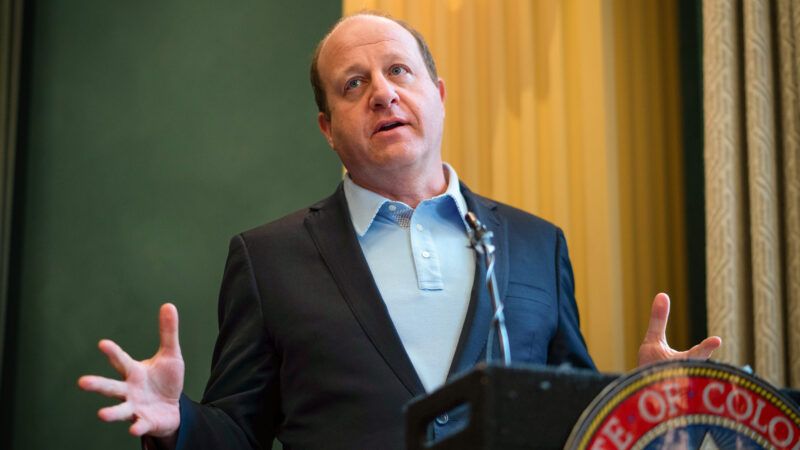
Colorado Gov. Jared Polis, a Democrat, is catching a lot of flak for granting clemency to former Mesa County Clerk Tina Peters, a conspiracy theorist who was sentenced to nearly nine years in jail and prison for compromising election security in a vain effort to show that voting machines were rigged against Donald Trump in 2020. Yet despite the vehement criticism of Polis' decision and legitimate questions about its timing, his stated reasons for approving Peters' early release are compelling.
On Friday, Polis commuted Peters' sentence to four years and four and a half months, saying she would be released on June 1 to serve the rest of that sentence on parole. Trump, who had repeatedly said Peters should be freed and had even granted her a pardon that had no practical effect because the president's clemency powers do not extend to state crimes, was predictably pleased.
Just as predictably, Trump's detractors were incensed. Colorado Secretary of State Jena Griswold, a Democrat, warned that the commutation would "validate and embolden the election denial movement and leave a dark, dangerous imprint on American democracy for years to come." Matt Crane, a former Republican election official who is now executive director of the Colorado Clerks Association, said the organization's members were "furious, disgusted, and deeply disappointed" by the governor's "shameful" decision, saying it "supports the attack on the legitimacy of American elections."
Such reactions fail to grapple with Polis' avowed justification for commuting Peters' sentence. In his May 15 clemency letter to Peters, Polis mentioned two main concerns about her punishment. First, he said, nine years of incarceration is "an extremely unusual and lengthy sentence for a first time offender who committed nonviolent crimes." Second, Polis agreed with a state appeals court that the sentence was based partly on Peters' beliefs rather than her illegal conduct, thereby violating her First Amendment rights.
The bizarre episode at the center of the case against Peters involved unauthorized access to voting machines, which she facilitated by falsely identifying Gerald Wood, a local I.T. consultant, as a county employee, and allowing Conan Hayes, another promoter of Trump's stolen-election fantasy, to pose as Wood. Using Wood's ill-gotten employee badge, Hayes made a copy of voting machine software during the county's annual update of the system in May 2021. Peters disabled security cameras while that was happening but used her own cellphone to record the process. The scheme was uncovered after employees at the Colorado secretary of state's office learned that stills from that video, including one showing the county's passwords, had been posted online.
In 2024, a state jury convicted Peters of seven felonies and misdemeanors: three counts of attempting to influence a public servant by deceit and one count each of conspiracy to commit criminal impersonation, first-degree official misconduct, violation of duty, and failure to comply with the secretary of state's requirements. District Court Judge Matthew Barrett sentenced her to six months in the Mesa County jail for the misdemeanors, plus eight years and three months in prison for the felonies.
"Your lies are well documented, and these convictions are serious," Barrett said when he imposed that sentence. "At bottom, this case was about your corrupt conduct," he said, noting that "you abused your position."
Barrett also faulted Peters for her lack of contrition. "I'm convinced you would do it all over again if you could," he said. "You're as defiant as a defendant as this court has ever seen."
Here Barrett began to venture into considerations that a state appeals court would later deem legally irrelevant and constitutionally problematic. "You're a charlatan who used and is still using your prior position in office to peddle a snake oil that's been proven to be junk time and time again," he said, alluding to her continuing promotion of the false claim that Joe Biden stole the 2020 election. "This is what makes Ms. Peters such a danger to our community. It's the position she held that has provided her the pulpit from which she can preach these lies, the undermining of our democratic process, the undermining of the belief and confidence in our election systems."
Barrett said "the damage that is caused and continues to be caused is just as bad, if not worse, than the physical violence that this court sees on an all too regular basis." He added that "it's particularly damaging when those words come from someone who holds a position of influence like you." Peters had made "every effort to undermine the integrity of our elections and [the] public's trust in our institutions," Barrett said. "You've done it from that lectern the voting public provided you with. Everything you've done has been done to retain control, influence. The damage is immeasurable. And every time it gets refuted, every time it's shown to be false, just another tale is weaved."
Those remarks, the Colorado Court of Appeals noted last month, suggested that Peters' constitutionally protected advocacy figured in the sentence she received. "It is well settled that the First Amendment generally prohibits punishing someone for their protected speech," Judge Ted C. Tow noted in an opinion joined by the two other members of the panel. "Here, the trial court's comments about Peters's belief in the existence of 2020 election fraud went beyond relevant considerations for her sentencing. Her offense was not her belief, however misguided the trial court deemed it to be, in the existence of such election fraud; it was her deceitful actions in her attempt to gather evidence of such fraud. Indeed, under these circumstances, just as her purported beliefs underlying her motive for her actions were not relevant to her defense, the trial court should not have considered those beliefs relevant when imposing sentence."
Although "some of the trial court's considerations were tied to proper sentencing considerations," Tow wrote, "it is apparent that the court imposed the lengthy sentence it did because Peters continued to espouse the views that led her to commit these crimes. The tenor of the court's comments makes clear that it felt the sentence length was necessary, at least in part, to prevent her from continuing to espouse views the court deemed 'damaging.'"
Barrett "failed to acknowledge that Peters is no longer the Mesa County Clerk and Recorder," Tow noted. "She is no longer in a position to engage in the conduct that led to her conviction. So it cannot be said that the lengthy prison sentence was for specific deterrence. To the contrary, the sentence punished Peters for her persistence in
espousing her beliefs regarding the integrity of the 2020 election."
The appeals court concluded that Barrett "obviously erred by imposing sentence at least partially based on Peters's protected speech." It therefore remanded the case for resentencing.
Polis obviated the need for that step by commuting Peters' sentence. Thanks to his intercession, Peters, now 70, will serve less than two years behind bars. Under her original sentence, by comparison, she would have been eligible for parole after serving about four years in prison.
"The crimes you were convicted of are very serious," Polis said in his letter to Peters, "and you deserve to spend time in prison for these offenses." But he added that "your application demonstrates taking responsibility for your crimes, and a commitment to follow the law going forward." He said Peters' expression of remorse, combined with the appearance that she had been punished for her opinions as well as her actions, justified the commutation.
"I made mistakes, and for those I am sorry," Peters said in an X post on Friday afternoon. "Five years ago I misled the Secretary of State when allowing a person to gain access to county voting equipment. That was wrong. I have learned and grown during my time in prison and going forward I will make sure that my actions always follow the law, and I will avoid the mistakes of the past."
Polis emphasized that he had not granted Peters a pardon. "She committed a crime," he told The New York Times. "She deserves to be a convicted felon." But he added that "she was given an unusually harsh sentence." Although her beliefs about the 2020 election are "dangerously wrong," he said, they should not have increased her punishment.
The political context of Polis' decision nevertheless raises questions about his motivation. Even as Trump was urging Polis to pardon Peters, the Times notes, his administration was punishing Colorado with "a series of funding cuts and other actions," including "killing a water pipeline for rural ranchers, moving the U.S. Space Command headquarters from Colorado Springs to Alabama and dismantling a leading federal climate center in Boulder." Although none of those actions was explicitly tied to the Peters case, the governor's critics accuse him of succumbing to Trump's bullying.
Polis, for his part, insists that the hope of appeasing the president played no role in his decision. He notes that Trump wanted a pardon for Peters, which Polis refused to grant, and that the administration was irked at Colorado for additional reasons, such as its liberal policy regarding mail-in ballots. "There was no immediate indication" that Trump would reward the commutation by reconsidering his punitive actions against Colorado, the Times notes. "That's not something I ever considered," Polis told the paper.
Whether or not you believe that, the arguments against clemency for Peters tended to glide over the central issue of whether nine years was an appropriate sentence for her crimes. "The harm caused by Tina Peters has spread well beyond the borders of Mesa County," Griswold said in a January 13 letter to Polis. "Her actions have been
repeatedly used to spread conspiracy theories, amplify falsehoods, and fuel dangerous election lies. This in turn has increased the threats to election officials and election infrastructure across our state. Releasing Tina Peters via pardon or commutation would validate her actions and embolden election denialism in Colorado and across the country."
Like Barrett, Griswold implied that Peters should be punished not just for abusing her office and betraying the public trust but also for "spread[ing] conspiracy theories," "amplify[ing] falsehoods," "fuel[ing] dangerous election lies," and "embolden[ing] election denialism." But as the Colorado Court of Appeals recognized, that aspect of Peters' conduct, however empirically faulty or morally objectionable, is not a proper basis for criminal punishment in a society that respects freedom of speech.