
A Circuit Split Gives SCOTUS an Opportunity To Overturn a Federal Law That Makes Home Distilling a Felony
The 6th Circuit upheld that 158-year-old law, while the 5th Circuit concluded it could not be justified as a revenue measure.
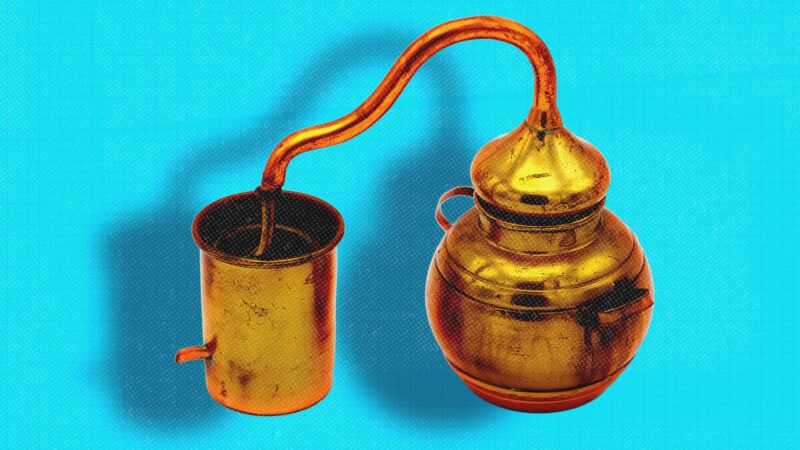
If you search for "home still" on Amazon, you will see a wide variety of contraptions designed to separate and concentrate a liquid mixture's most volatile components. Many of them are explicitly advertised as appliances designed to produce alcoholic beverages such as whiskey, brandy, gin, and vodka. But if you bought one of those products with the intent to use it for that purpose, you would be committing a federal felony.
The federal ban on home production of distilled spirits has been on the books since 1868, when Congress enacted it as part of a broader statute aimed at collecting taxes on booze. But two recent federal appeals court decisions raise the possibility that DIY distillers one day will no longer have to worry about this antiquated, widely flouted, and haphazardly enforced prohibition.
Last month in McNutt v. U.S. Department of Justice, the U.S. Court of Appeals for the 5th Circuit ruled that the ban on home distilling cannot be justified as a revenue measure. Eleven days later in Ream v. U.S. Department of Treasury, the U.S. Court of Appeals for the 6th Circuit disagreed, saying the federal government's tax power, combined with the authority that the Constitution gives Congress to "make all laws" that are "necessary and proper" for executing its enumerated powers, amply justified the ban. Those back-to-back decisions created a circuit split that the Supreme Court may be inclined to resolve, especially since it raises questions about the extent of federal power with potentially far-reaching implications.
Under 26 USC 5178(a)(1)(B), "no distilled spirits plant for the production of distilled spirits shall be located in any dwelling house, in any shed, yard, or inclosure connected with any dwelling house, or on board any vessel or boat." The penalty for violating that prohibition is spelled out in 26 USC 5601(a)(6): a fine up to $10,000, up to five years in prison, or both.
The 5th Circuit upheld a permanent injunction that U.S. District Judge Mark T. Pittman issued in 2024. That order barred the federal government from enforcing the home distilling ban against the lead plaintiff, Scott McNutt, and other members of the Hobby Distillers Association (HDA). In addition to concluding that the ban was not a valid exercise of the congressional taxing power, Pittman rejected the argument that it could be justified under the power to regulate interstate commerce.
The 5th Circuit did not consider the Commerce Clause rationale because the government abandoned it on appeal. But the appeals court agreed with Pittman that the home distilling ban did not qualify as a tax measure.
On their face, Judge Edith Jones noted in an opinion joined by the two other judges on the panel, the provisions that McNutt challenged have nothing to do with collecting taxes. "Neither provision raises revenue," Jones wrote. "Not only do they prohibit at-home distilleries, but in so doing, they amount to an anti-revenue provision that prevents distilled spirits from coming into existence. The provisions operate to reduce revenue instead of raising it."
That scheme, Jones said, "violates the Supreme Court's explanation of how the federal power of taxation works." In the 2012 case NFIB v. Sebelius, Chief Justice John Roberts noted that the imposition of a tax "leaves an individual with a lawful choice to do or not do a certain act, so long as he is willing to pay a tax levied on that choice." But in this case, Jones noted, the plaintiffs "have only the choice not to do as they wish or risk fines and imprisonment."
The government argued that the ban helps collect taxes by prohibiting a form of liquor production that is hard to detect. "But just as 'Congress cannot authorize a trade or business within a State in order to tax it,' it stands to reason that Congress cannot prohibit intrastate activity solely because it might produce products hard to tax," Jones wrote. "Congress's taxing power 'reaches only existing subjects,' not activity that may generate subjects of taxation. Put otherwise, preventing activity lest it give rise to tax evasion places no limit whatsoever on Congress's power under the taxation clause."
If the Taxing Clause is not enough, by itself, to justify the ban, the government said, surely the Necessary and Proper Clause does the trick. "That clause has been characterized as the 'last, best hope of those who defend ultra vires [i.e., illegal] congressional action,'" Jones noted, adding that the government's use of the clause in this case is inapt because the home distilling ban is not "necessary and proper" for collecting taxes.
"Prohibiting at-home distilleries is not 'plainly adapted' to effectuate Congress's taxation of spirits," Jones wrote, quoting the interpretation of "necessary" that the Supreme Court applied in the landmark 1819 case McCulloch v. Maryland. "The provisions challenged here do not tax the distilled spirits or the still; they flatly prohibit and penalize distillation inside a home or in any yard or shed connected to a home. Because these provisions tax nothing, and are distinct from the regulation of distilling alcoholic products that is permitted by federal tax law, they do not help Congress raise revenue. On the contrary, the statutes reduce revenue by preventing individuals from making distilled spirits."
Jones also agreed with the plaintiffs that "banning and criminalization of at-home distilling 'is not a proper means of exercising the tax power' because it 'takes away [their] choice to pay the tax' by engaging in otherwise legal, albeit licensed and regulated, activity." Under the government's logic, she noted, "Congress may criminalize nearly any at-home conduct only because it has the possibility of concealing taxable activity. Home-based businesses may be forbidden. Remote work may be deemed a crime." The Necessary and Proper Clause, she said, "cannot expand the reach of the taxing power to criminalize conduct that could produce taxable revenue under the pretext that generating revenue for the federal government will be enhanced."
The 6th Circuit saw it differently, noting that Congress in 1868 was keen to curtail rampant evasion of federal liquor taxes. "The 1868 Act was a monumental effort, running some 109 sections, to bring these 'stupendous frauds' to an end," Judge Raymond Kethledge wrote in an opinion joined by Judge Eugene E. Siler Jr. "The ban's inclusion was apparently uncontroversial, prompting not even a murmur of debate. Even now its rationale is almost self-evident: stills are more easily hidden in homes than in bonded premises dedicated to distilling spirits; and—as both a legal and practical matter—'dwelling houses' are much harder to search at 'all times, as well by night as by day,' than bonded premises are."
The lead plaintiff in the 6th Circuit case, would-be distiller John Ream, warned that upholding the ban on home liquor production would invite all manner of federal meddling in Americans' private lives. For example, he said, "the federal government could impose a nominal excise tax on baking bread or making clothing and [then] prohibit home bread-baking or home sewing on the theory that home-sewers or home-bakers are less likely to pay the tax."
Although Jones thought such possibilities were a good reason to deem the ban improper, Kethledge was not impressed. "Those 'theories' are merely that," he wrote, "and they would strip away nearly all the particular facts on which the judgment here is based."
Judge Andre Mathis dissented, but not because he disagreed with Kethledge's take on the home distilling ban. Rather, Mathis thought Ream did not have standing to sue. "Typically, a party challenging the constitutionality of a federal law must wait for the
government to enforce the law against him," Mathis wrote. Although there are exceptions, he said, Ream "has failed to show that his intention to distill spirits at home 'generates a certainly impending threat of prosecution.'"
Given the spotty enforcement of the ban (as reflected in the fact that vendors openly supply home distillers with the equipment they need), that test will often be hard to meet. But liquor hobbyists do sometimes face threats of federal prosecution. In 2014, for example, McNutt received a "Notice of Potential Civil and Criminal Liability" from the Treasury Department's Alcohol and Tobacco Tax and Trade Bureau (TTB).
The TTB said it had reason to believe McNutt "may have purchased a still capable of producing alcohol and/or equipment and materials that may be used in the manufacture of a still." It warned that "federal law provides no exemptions for the production of distilled spirits for personal or family use" at any location other than a government-approved distillery. The TTB added that "unlawful production of distilled spirits is a criminal offense," which it erroneously claimed was "punishable by a fine of up to $500,000" as well as "imprisonment for not more than 5 years." And it enclosed a document noting that the TTB collaborates with state authorities in "targeting illegal possession of stills and illegal production of distilled spirits."
The 6th Circuit's decision means home distillers in Kentucky, Michigan, Ohio, and Tennessee are still exposed to such threats. But thanks to the injunction upheld by the 5th Circuit, people who make liquor at home in Louisiana, Mississippi, and Texas cannot be arrested for doing that—provided they are members of the HDA and obtain a federal permit.
That second requirement may prove problematic. "The injunction does not mean that you cannot be charged for distilling at home!" the HDA warns. "The injunction simply means that you cannot be denied a DSP (Distilled Spirits Plant) permit simply because you wish to set up at home. You still must apply for the permit and abide by all rules that a regular DSP does."
In a recent interview with The Spill, Aaron Hyde, author of How to Distill:
That's a big deal, Harris says, because the taxing power otherwise would be a license for wide-ranging interference with people's habits and hobbies: "If Congress can prohibit an activity simply because it might complicate taxation, what can it not regulate? The government's theory had no limiting principle. It would allow federal authority to extend into virtually any aspect of private life—particularly activities occurring in the home—so long as some connection to revenue could be asserted. The Constitution does not permit that kind of open-ended power."