
America Is Losing Its Allure for the World's Migrants
The U.S. economy continues to outstrip the competition but takes a hit from declining immigration.
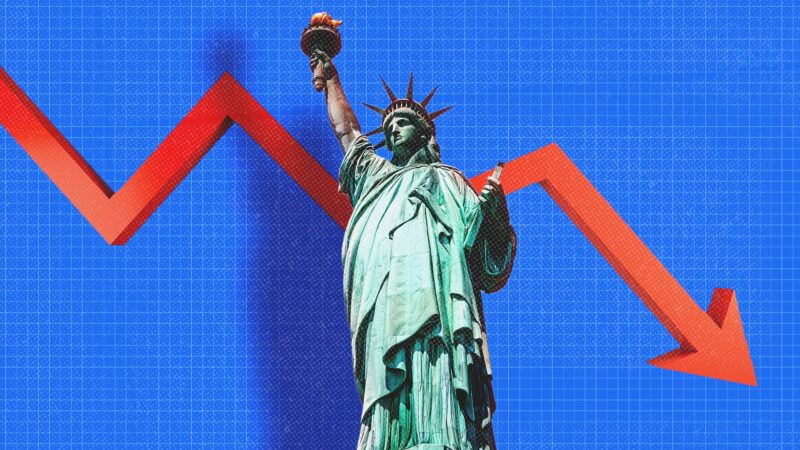
A plaque on the Statue of Liberty features Emma Lazarus's words urging the world to "give me your tired, your poor, your huddled masses yearning to breathe free." In his farewell address, then-President Ronald Reagan referred to the United States as a "shining city upon a hill" and added that in his vision, "if there had to be city walls, the walls had doors and the doors were open to anyone with the will and the heart to get here." But despite its continuing success, the U.S. is becoming a less attractive destination for people around the world. Currently-ascendant nativists want to close America's doors and turn away the huddled masses, and the message is being received loud and clear.
You are reading The Rattler from J.D. Tuccille and Reason. Get more of J.D.'s commentary on government overreach and threats to everyday liberty.
America's Declining Allure
According to Gallup polling published last week, "15% of adults worldwide who say they would like to move permanently to another country name the U.S. as their preferred destination." That's down from 24 percent from 2007–2009 and 20 percent in 2016. "Since 2017, it has been at or below 18%."
That still puts the U.S. as the top choice on a list of options including Canada (9 percent), Germany (5 percent), Australia, Spain, France, the U.K., Japan (all 4 percent), Italy, and Saudi Arabia (3 percent). For people around the world interested in permanently leaving their home countries, the U.S. steadily declined over the last two decades as a preferred destination while the other countries named largely remained steady.
What has changed, as Gallup, notes, is that the past year "coincides with a sharp slowdown in international migration into the U.S., amid changes in immigration policy and declining migration desire in several regions."
That is, in both his first and second stints in the White House, President Donald Trump has emphasized border enforcement and immigration restrictions—at least initially, with public support. The interregnum single-term Biden administration took a very different hands-off approach to migration and alienated voters as a result. "As public concern over border security grew, partly in response to Mr. Biden's own actions, his administration proved catastrophically slow to change course," Christopher Flavelle summarized for The New York Times after the 2024 election returned Trump to power.
The reinstalled president took his predecessor's failures as a reason to double down on border enforcement. That wasn't necessarily the right lesson to take from the election. High-profile and often brutal methods horrified many people who thought they were getting an administration that took the border seriously—not one that sent federal agents marching through city streets.
By December of last year, Pew Research found in polling about administration policies that "53% of Americans say it is doing 'too much' when it comes to deporting immigrants who are living in the United States illegally." That was up from 44 percent the previous March. The White House then shifted direction on immigration enforcement to emphasize arrests of migrants with criminal records.
But images of immigration and Border Patrol agents rounding up immigrants were broadcast and seen around the world. Those reports appeared while "global desire to migrate declined in 2025 to its lowest level in a decade," as reported by Gallup. Fewer people around the world want to move, and even fewer favor risking a potentially perilous transfer to the U.S.
Nothing Succeeds Like American Success
What's ironic—and troubling for the prospects of improving human prosperity—is that the U.S. remains a destination with better prospects than most other nations for building wealth.
As Gallup notes, the second-favorite choice for would-be migrants is Canada. Yet per capita GDP in Canada is $54,340 compared to $84,534 in the U.S., according to the World Bank—and the gap is widening. As recently as 2012, residents of the two countries were about equally prosperous.
From 2019 to 2024, "were Canada's ten provinces and three territories an American state, they would have gone from being slightly richer than Montana, America's ninth-poorest state, to being a bit worse off than Alabama, the fourth-poorest," reported The Economist.
Several of the other possible destinations mentioned by would-be migrants are in Europe. While the E.U. nations, taken together, have never matched U.S. prosperity, they too are falling behind. U.S. per capita income was $48,750 in 2008 compared to $37,169 in the E.U. It was $84,534 for the U.S. in the latest measure, compared to $43,305 in the E.U.
"In the period 2008-2023, EU GDP grew by 13.5% (from $16.37 trillion to $18.59 trillion) while U.S. GDP rose by 87% (from $14.77 to $27.72 trillion)," notes EconoFact. "The UK's GDP increased by 15.4%. In 2023, EU GDP was 67% of U.S. GDP — down from 110% in 2008."
Immigration skeptics will argue that strict border enforcement is a feature, not a bug, of an American economy that outstrips its competitors. But immigrants—at least the productive, peaceful variety—more than pull their weight in contributing to this country's prosperity.
Immigrants Contribute to American Prosperity
"For each year from 1994 to 2023, the US immigrant population generated more in taxes than they received in benefits from all levels of government," David J. Bier, Michael Howard, and Julián Salazar commented in a February Cato Institute report. They added that these revenues "do not account for any of immigration's indirect, tax-revenue-boosting effects on economic growth, represent the lower bound of the positive fiscal effects."
Last month, the Brookings Institution's Tara Watson wrote that "the decline in migration between 2024 and 2025 will reduce GDP growth by between 0.19 and 0.26 percentage points and lower consumer spending by $40 billion to $60 billion in 2025" because of the reduced ranks of workers and consumers.
That means the U.S. loses out by chasing away immigrants in general. Instead of benefiting, our economy suffers from indiscriminate border enforcement. Yes, that might make the country a less desirable destination for would-be migrants. But it does so by hurting Americans rather than by helping other countries shake off stupid policies that slow their own economic growth.
For somebody motivated only by nativism, America's declining attractions for the world is a win in itself. But people who really care about this country should want it to be so free and prosperous that it remains a shining city upon a hill that entices the world's huddled masses—while making us all richer.