
Unless People Support Me, Trump Habitually Warns, 'We Won't Have a Country Anymore'
The president's predictions of the nation's imminent demise reflect his narcissistic authoritarianism.
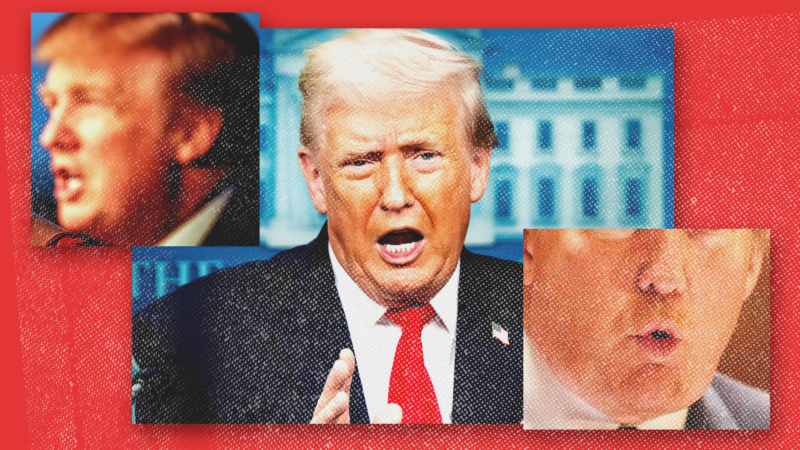
If Iran's leaders continue to resist U.S. demands, President Donald Trump warned on Sunday night, "they're not going to have a country." That remark was ominous in the context of a war that has included a huge military deployment, attacks on thousands of targets, threats to destroy civilian infrastructure, and the possibility of a ground invasion. But Trump frequently has deployed similar language much less credibly, warning Americans that they "won't have a country anymore" if certain things are allowed to happen.
Much like his notion of what constitutes a "national emergency," Trump's perception of existential threats to the republic is highly idiosyncratic. It includes concerns, such as crime and terrorism, that are plausible but fall far short of threatening to destroy the country. It includes illegal immigration, which Trump has long portrayed as inherently dangerous, regardless of whether unauthorized residents are committing crimes or making an honest, peaceful living. It includes Democratic electoral victories. It even includes constitutionally protected criticism of Trump.
If we don't "get tough and smart" on Islamic terrorism, Trump warned on Twitter in January 2016, "we won't have a country anymore!"
The threat to national security includes "anyone who has entered the United States illegally, who is subject to deportation," Trump emphasized at a rally in Phoenix that August. "That is what it means to have laws and to have a country. Otherwise we don't have a country."
Just as defeating Hillary Clinton in 2016 was essential to preserving the country, allowing Joe Biden to take office after he won the 2020 election would have cataclysmic consequences, Trump repeatedly warned. "We won't have a country if it happens," he told the crowd at the Ellipse during the "Save America" rally that preceded the Capitol riot on January 6, 2021. "We're going to have somebody in there that should not be in there, and our country will be destroyed, and we're not going to stand for that….If you don't fight like hell, you're not going to have a country anymore."
Trump portrayed the stakes in similarly dramatic terms when he ran for president in 2024. "We won't have a country anymore" unless I am elected, he declared at dozens of campaign rallies.
"The most important day in the history of our country is going to be November 5," Trump said in March 2024, when he was still expecting a rematch with Biden. "Our country is going bad. And it's going to be changed on November 5, and if it's not changed we're not going to have a country anymore."
After Biden left the race, Trump made it clear that Kamala Harris would be similarly disastrous as president. "We're not going to let this country be destroyed," he said at a Las Vegas rally in September 2024. "We got to get this border fixed. We got people coming in that have never even dreamed about being in this country, and they're coming in totally unchecked. Nobody has any idea where the hell they come from. Kamala would be the president of invasion."
Harris "will surrender our country," Trump warned. "She has already let in 21 million people. And if she gets four more years in America, our country will be obliterated. The 21 million people will be hundreds of millions of people who will come in from all over the world, which is where they're coming from now. You'll have 150 million more people. You won't have a country anymore. You're pretty close to not having one."
Trump's statistics may have been off a bit, since the estimated number of unauthorized U.S. residents, including people who entered the country prior to the Biden administration, was around 11 million at the time. And we never got a chance to see whether that population would grow by 1,300 percent under a Harris administration. But even after we dodged that bullet, the country still was not safe, according to Trump, who perceived another existential threat in a three-minute video that six Democratic members of Congress produced last November.
That video, which featured two senators and four representatives, reminded U.S. military personnel of their duty to "refuse illegal orders." The Trump administration is "pitting our uniformed military and intelligence community professionals against American citizens," the legislators said. "We know you are under enormous stress and pressure right now. Americans trust their military, but that trust is at risk." Although "we know this is hard," they added, "your vigilance is critical," and "we have your back."
Trump was irked by those words, which he said must be punished in the interest of national survival. "It's called SEDITIOUS BEHAVIOR AT THE HIGHEST LEVEL," he wrote on Truth Social. "Each one of these traitors to our Country should be ARRESTED AND PUT ON TRIAL. Their words cannot be allowed to stand—We won't have a Country anymore!!! An example MUST BE SET."
The Justice Department tried to deliver on Trump's threat. But a federal grand jury rejected a proposed indictment—a striking rebuke, since grand jurors, who hear only the government's side of a case, almost always approve charges recommended by federal prosecutors. Two days later, in a separate case involving the Defense Department's attempt to punish Sen. Mark Kelly (D–Ariz.) for participating in the video, U.S. District Judge Richard Leon, a George W. Bush appointee, ruled that the retired naval officer's criticism of Trump was "unquestionably protected" by the First Amendment.
The unifying theme in Trump's warnings about the nation's imminent demise is that America's continued existence depends on supporting him: electing him, praising him, and backing his policies. Americans who oppose Trump therefore are betraying their country, which helps explain his habitual accusation that his critics are guilty of treason.
Both rhetorical tics reflect the narcissistic authoritarianism that underlies much of what Trump says and does, whether it is declaring nonexistent crises, waging war without congressional approval, summarily executing suspected cocaine smugglers, asserting unlimited tariff authority, attempting to rewrite statutes or the Constitution by presidential decree, demanding impeachment of judges who rule against him, using the criminal justice system to punish his foes, or threatening people who say things he does not like with deportation, regulatory penalties, grant revocations, or other unpleasant consequences. As Trump sees it, extreme measures are necessary when the fate of the nation is at stake, which it always seems to be.