
Trump's Tariff Troubles
Plus: Minnesota Medicaid funds, AI vs. jobs, Taylor Lorenz's libertarian moment, and more...
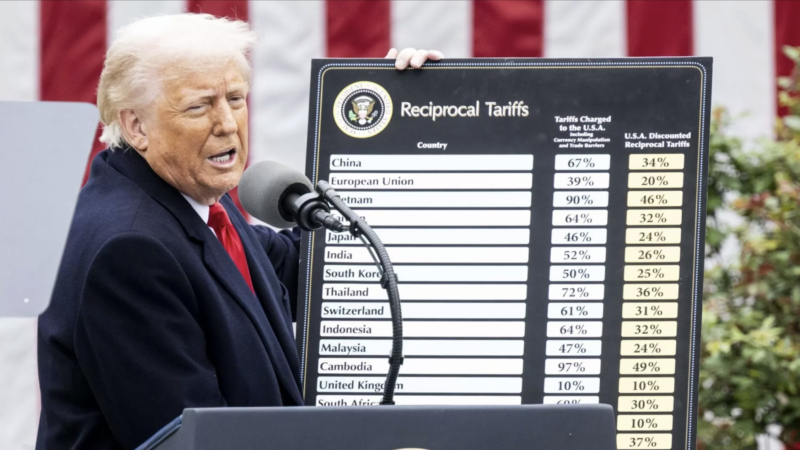
Tariff turmoil. Last week, the Supreme Court said President Donald Trump's tariffs were illegal. But it didn't say anything about the roughly $175 billion in tariffs that have already been collected—illegally—from businesses. Those businesses want refunds. Some 900 claims have already been filed, according to the Liberty Justice Center, which has advocated in court for businesses impacted by the tariffs. An analysis by The Wall Street Journal says the number is more like 1,800.
So will the businesses get their money back? We'll know soon enough. Late yesterday, the federal circuit ordered the administration to respond to the Liberty Justice Center's motion by Friday. If you don't have a calendar handy, that's tomorrow.
The Trump administration isn't exactly in a cooperative mood on this issue. As Reason's Eric Boehm wrote yesterday, the administration said in court last year that it would pay the refunds if ordered to do so. But in the wake of last week's Supreme Court ruling, it has backtracked, saying that doing so could take years.
The Reason Roundup Newsletter by Liz Wolfe Liz and Reason help you make sense of the day's news every morning.
In the meantime, a secondary market has sprung up around those refunds. Some businesses have sold the rights to any refunds they might eventually receive, The Wall Street Journal reports. Before the SCOTUS ruling, refunds sold for 20 cents on the dollar. Now the price is more like 40 cents.
For some companies, the refund is potentially massive. One company that has already filed suit for a refund is FedEx. The suit, filed Monday, doesn't specify the exact amount the shipping giant paid in tariffs. But last year, the company disclosed that it expected a hit on the order of $1 billion as a result of trade policies. The precise figure isn't clear, but at least some of that was a direct result of the tariff regime the Court struck down.
It's really a remarkable situation. American companies were forced to pay billions in duties that the highest court in the land says were unconstitutional. They deserve their money back, expeditiously.
Minnesota Medicaid mess. In Tuesday's State of the Union, Trump said that Minnesota had been ransacked by $19 billion in welfare fraud committed by Somalis. It's true that Minnesota has a serious welfare fraud problem, with billions in dubious claims, but Trump's figure was, at minimum, unproven.
Still, the state's Medicaid program is clearly a mess, with rampant waste and abuse. Part of the problem with Medicaid is that it's co-funded by the federal government on a matching basis. The formula is somewhat complicated and varies by state, but in general, the more a state spends, the more federal dollars it obtains. This gives states an incentive to drive up spending in order to reel in more dollars from Washington.
At a news conference yesterday, Vice President J.D. Vance announced that the administration would withhold $259 million in Medicaid payments from the state. And other blue states, like California, could follow.
I'm all for reducing federal spending on entitlements. But this is, in Vance's own words, a temporary halt. And it looks more like a selectively deployed political maneuver than a meaningful step towards a better system. Medicaid's entire funding structure needs permanent reform.
Scenes from Washington, D.C.: Last night, I attended a debate about whether AI will make work obsolete. The event, sponsored by Open to Debate and Johns Hopkins University and moderated by journalist John Donvan, featured Forward Party founder Andrew Yang and Massachusetts Institute of Technology economist Simon Johnson arguing that AI will make work obsolete and Facebook cofounder Chris Hughes and Rumman Chowdhury of Humane Intelligence arguing that it won't.
Hughes made the strongest points of the evening, arguing that even if AI displaced some job categories, the surplus would create opportunities for other, perhaps totally new, types of work that we can't yet imagine. There might be difficulties and disruptions. Work would change. But it would not be entirely displaced.
A surprising element of the debate was how much the two teams agreed: Yes, AI would be disruptive, but there would still be work after the disruptions. But at least for the foreseeable future, jobs like skilled construction will persist. As Yang, who was supposed to be arguing the case that AI would make work obsolete, said late in the debate, "I think everyone agrees that there's going to be jobs in this new era." That sounded an awful lot like a concession to me.
The audience voted before and after the debate to see how much the debate changed people's minds. In both cases, the "no" side represented by Hughes and Chowdhury garnered 62.7 percent of the vote. The audience was clearly on their side. In the second vote, however, Yang and Johnson's "yes" side, which started with 20 percent of the vote, improved their share by 1.8 percent, making them the "winners" in the sense that they moved more people to their position.
QUICK HITS
- U.S. and Iranian negotiators continue to meet. The best part of Trump's State of the Union was probably when he said he preferred a diplomatic solution with Iran. But there are also worrying signs, like this anonymous quote in Politico from someone familiar with administration discussion about the potential strike: "There's thinking in and around the administration that the politics are a lot better if the Israelis go first and alone and the Iranians retaliate against us, and give us more reason to take action." Meanwhile, the massive build-up of troops and equipment in the region has indicated that military conflict may be coming anyway. Hopefully, negotiations can head off a war.
- For months, there has been intrigue surrounding classified intelligence that led to a whistleblower complaint against Director of National Intelligence Tulsi Gabbard. The intelligence is said to revolve around an intercepted foreign communication that mentioned Jared Kushner, Trump's son-in-law. According to The Wall Street Journal, Gabbard has declined to share the full, unredacted complaint with Congress, "due to the assertion of executive privilege to portions."
- At a hearing yesterday, Trump's nominee for surgeon general, Casey Means, told Congress that "anti-vaccine rhetoric has never been part of my message." But as The New York Times notes, Means, who is critical of the mainstream medical establishment, danced around many questions about her views on health issues.
- Cuba says it killed four people and injured six others who approached the island on a speedboat. The people killed were apparently from Miami, and they reportedly opened fire on Cuban forces when approached. Maybe that's just how people from Miami say "hello"? (I kid, I kid.)
- Netflix chief Ted Sarandos is expected to visit the White House today to discuss the company's bid to buy Warner Bros. It remains immensely frustrating that large mergers and business deals like this now require the approval of the president.
- Tech journalist Taylor Lorenz says she's becoming more libertarian.
- Remember when someone with access to a Trump social media account posted a video that depicted the Obamas as apes? Sen. Tim Scott (R–S.C.) said it was the "most racist thing he'd seen" from the Trump White House. After initially defending the post, the White House took it down. But another popular anonymous right-wing account called it "a masterpiece." That account, according to Wired, appears to be run by a White House staffer. This is my surprised face.