
The World Has Turned and Left Me Here
Plus: Tariffs, tariffs, and even more news about tariffs! And George W. Bush has some interesting thoughts about George Washington.
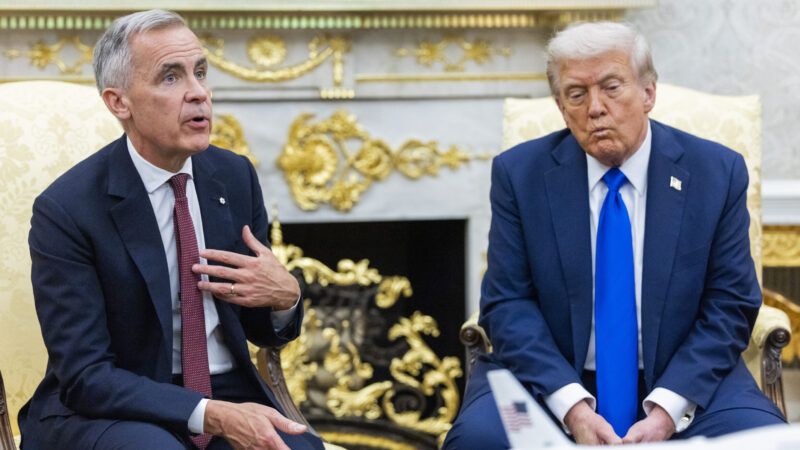
Much of President Donald Trump's economic policy rests on the idea that the United States doesn't need global trade in order to prosper.
A sizable portion of the rest of the world might be ready to put that sentiment to the test.
Canada, Mexico, the European Union, the United Kingdom, and 11 wealthy nations across the Indo-Pacific region are taking the first steps toward a globe-spanning trade deal that would encompass nearly 40 nations and over 1.5 billion people, Politico reported last week. The possible deal is being organized by Canadian Prime Minister Mark Carney, and it seeks to unite the E.U. with the Comprehensive and Progressive Agreement for Trans-Pacific Partnership (CPATPP), the 12-nation economic bloc created in 2018 and expanded in 2023.
The Reason Roundup Newsletter by Liz Wolfe Liz and Reason help you make sense of the day's news every morning.
If successfully negotiated, the deal would allow for supply chains that move parts and finished goods across dozens of nations without paying high tariffs.
Though it is a long way from a done deal, the attempt to link most of the world's largest non-U.S., non-China economies into a single economic bloc is perhaps the most significant sign that the rest of the world is preparing for a future where America is no longer pushing for open markets and free trade.
But it is not the only sign. The E.U. and India are close to signing what one ambassador calls the "mother of all trade deals." That comes after the E.U. signed a new deal with Indonesia, and India completed agreements with the U.K. and New Zealand, both of which are members of the CPATPP.
Meanwhile, Trump has signaled that he might rip up the United States-Canada-Mexico Agreement (USMCA), a deal he once hailed as "the fairest, most balanced, and beneficial trade agreement we have ever signed into law."
With friends like that, no wonder the Canadian and Mexican governments are looking elsewhere for stability.
"This diversification is likely good for non-US parties, especially given Trump's tariff threats and costlier domestic policy alternatives like subsidies," Cato Institute trade expert Scott Lincicome wrote last week. "The shift could also be good for the global economy, to the extent it dampens future trade shocks coming from North America. But it is decidedly not good for the US over the short and long term."
Of course, trade deals rarely guarantee full, free trade between signatories. Like all political agreements, there are inevitably carve-outs and protectionist details. On the whole, however, global trade deals have lowered tariff rates, boosted economic growth, and (most importantly) helped lift many human beings out of poverty by facilitating greater levels of free exchange.
And if the alternative is Trump's world of higher tariffs and less trade, then whatever Carney is cooking up seems pretty good.
Meanwhile, in the land of high tariffs, everything "from bluejeans and spices to housewares and industrial products" could be getting more expensive, The Wall Street Journal reports.
Why? It's not just tariffs, as higher health care costs, labor costs, and typical start-of-the-year pricing increases are part of the equation too. But the tariffs certainly aren't helping things. Prices on the most affordable imported goods are up by 2.3 percent since dipping at the end of November, the Journal reports, citing data from the Harvard Business School's tariff pricing tracker.
Tariffs are likely hitting your grocery bill too.
Even with exemptions, tariffs still apply to more than half of imported food products, and they will continue to push grocery prices higher for consumers.
See more: https://t.co/glzlD70IvI pic.twitter.com/JURggK7SOD
— Tax Foundation (@TaxFoundation) February 16, 2026
"President Trump has often defended tariffs on the grounds that they will boost domestic production and create jobs," reports the Tax Foundation. "However, in the case of food imports, it is often difficult or impossible to onshore production due to land scarcity and a lack of suitable climates for certain goods. Consumers also often prefer the foreign alternative to American-grown products, such as European wine and spirits."
Is Trump finally admitting he screwed up with the tariffs? Well, no. But the White House might be slowly (and quietly) planning to reduce some of them. The Financial Times reported on Friday that officials in the Commerce Department and the U.S. Trade Representative's office are worried that tariffs on aluminum and steel are raising prices for consumers. The White House denied that a tariff rollback is coming, but Trump has previously cut tariffs on goods like coffee and beef as part of an ongoing effort to ease prices.
I know what you're thinking: Doesn't cutting tariffs to reduce prices prove that raising tariffs was increasing prices in the first place?
Yes. Yes, it does.
Scenes from America's 250th Birthday Party: "George Washington's humility in giving up power willingly remains among the most consequential decisions and important examples in American politics," writes former President George W. Bush in the first of a series of essays examining the history of the U.S. presidency.
The essay series is being organized by Colleen Shogan, the former archivist of the United States who was fired by President Donald Trump last year. (The current head of the National Archives is, no joke, Marco Rubio.) I interviewed Shogan about the project last month.
The first essay, fittingly released on President's Day, contains an important message for contemporary politics. "Washington modeled what it means to put the good of the nation over self-interest and selfish ambition," Bush writes. "He embodied integrity and modeled why it's worth aspiring to. And he carried himself with dignity and self-restraint, honoring the office without allowing it to become invested with near-mythical powers."
QUICK LINKS
- It might take NINE MONTHS for the water utility in Washington, D.C., to fully repair a pipe that discharged 243 million gallons of raw sewage into the Potomac River last month. Nine months! To fix one (1) pipe. This is absurd.
- "I told [lawmakers] straight up: South Texas will never be red again" due to the economic damage being caused by workplace immigration raids, Mario Guerrero, CEO of the South Texas Builders Association, told Politico.
- President Donald Trump wanted dramatic cuts to some federal agencies, but Congress did not go along with the plan.
- Frederick Wiseman, who made acclaimed documentaries on everything from a boot camp to a welfare office, has passed away at age 96. His first film—Titicut Follies, about life in an institution for the criminally insane—was banned from release in the United States until 1991. Reason's Jesse Walker interviewed Wiseman in 2007 about his career and the First Amendment battle over that film.
- Elana Meyers Taylor, a 41-year-old Texas mom competing at her fifth Winter Olympics, finally won an elusive gold medal on Monday.
Elana Meyers Taylor.
Wins bronze/silver in 2010/14/18/22 Olympics.
In 2020 & 2022, she has kids. Both have special needs. She lives on the road with them, flying around the world for months at a time to compete in bobsled.
And THEN!
At 41!
She wins her first gold.
American hero. pic.twitter.com/ksVLkBXY8H— Rodger Sherman (@rodger) February 16, 2026