
The Feds Who Killed Alex Pretti Are Heavily Shielded From Being Sued. Blame the Supreme Court for That.
It is nearly impossible to sue a rights-violating federal agent under current caselaw.
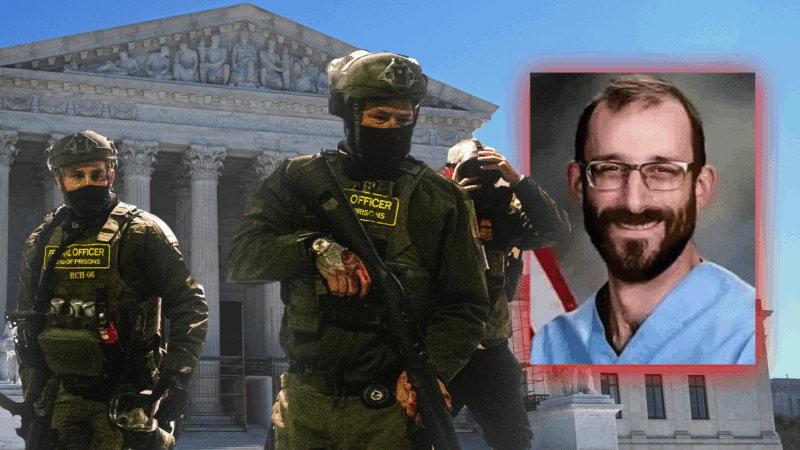
If Alex Pretti had been pepper-sprayed, thrown to the ground, disarmed, and repeatedly shot by Minnesota police after exercising his First Amendment right to record law enforcement and his Second Amendment right to keep and bear arms as a lawful conceal-carry permit holder, Pretti's family would be able to sue the officers involved under Section 1983 of Title 42 of the U.S. Code, which says that state officials may be sued in federal court when they allegedly violate someone's constitutional rights. Such a lawsuit would be at least one way for the grieving family to seek justice in the wake of Pretti's horrific and seemingly lawless killing.
But Pretti was not killed by state or local police. He was killed by agents of the U.S. Border Patrol. And thanks to a series of flawed rulings by the U.S. Supreme Court, such federal agents are heavily shielded from facing any civil liability for conduct that violates constitutional rights.
You’re reading Injustice System from Damon Root and Reason. Get more of Damon’s commentary on constitutional law and American history.
It did not have to be this way. In Bivens v. Six Unknown Named Agents of the Federal Bureau of Narcotics (1971), the Supreme Court allowed federal officers to be sued in federal court for alleged Fourth Amendment violations. "That damages may be obtained for injuries consequent upon a violation of the Fourth Amendment by federal officials should hardly seem a surprising proposition," noted the majority opinion of Justice William Brennan. "Historically, damages have been regarded as the ordinary remedy for an invasion of personal interests in liberty."
But a majority of the Supreme Court has taken a different view in more recent years. They see Bivens as a case of judicial activism, in which the "liberal" Court of the 1970s overstepped its proper bounds. The late conservative Justice Antonin Scalia was a prominent proponent of this complaint. He once denounced Bivens as "a relic of the heady days in which this Court assumed common-law powers to create causes of action."
One problem with the Scalia view is that federal judges were already imposing damages against rogue federal officers well before the heady days of 1971. In fact, none other than Chief Justice John Marshall was doing it back in the even headier days of the early American republic. In Little v. Barreme (1804), for example, Marshall found a U.S. naval officer liable for trespass after he seized a ship based on an illegitimate presidential order. "The law must take its course," Marshall's ruling declared, "and he must pay such damages as are legally awarded against him."
In other words, there is nothing in American legal history that requires the Supreme Court—in either Scalia's day or our own—to render Bivens a dead letter. Just as Webster Bivens was permitted to sue the federal agents who allegedly violated his constitutional rights, so too should the family of Alex Pretti be able to sue the federal agents who allegedly violated Pretti's constitutional rights.
Regrettably, the current Supreme Court seems unlikely to correct its course. As matters currently stand, Bivens has basically been overruled in all but name.
What about Congress? Can the legislative branch of government do anything about it?
One relatively straightforward way for Congress to fix the problem created by SCOTUS would be for Congress to amend the language of Section 1983 so that it covered the constitutional malfeasance of both state and federal officials. Congress could simply codify a Bivens-like cause of action in federal law.
Granted, the idea of the current Congress passing any legislation that might even slightly inconvenience the executive branch does seem hard to imagine. But the balance of power in Congress may change. And perhaps that change will bring with it a greater willingness to counteract the president's agenda. If that happens, codifying Bivens in federal law might not seem like such a long shot.
Until then, we are left in the grips of a dreadful legal regime in which, as Judge Don Willett of the U.S. Court of Appeals for the 5th Circuit once protested, "redress for a federal officer's unconstitutional acts is either extremely limited or wholly nonexistent, allowing federal officials to operate in something resembling a Constitution-free zone."