
The New Dietary Guidelines Are a Warning About State-Run Grocery Stores
If progressives distrust Robert F. Kennedy Jr.’s vision of healthy eating, they should rethink giving the government control over grocery aisles.
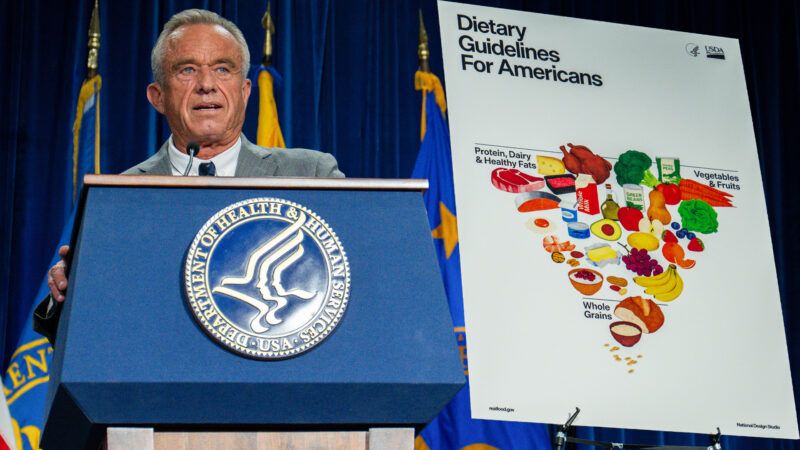
The Department of Health and Human Services (HHS), under Secretary Robert F. Kennedy Jr., recently released its long-awaited dietary guideline revisions for 2025–2030. The 10-page document has drawn both praise and fire from dietitians and public health experts.
While lauding the emphasis on eating real, whole foods, some experts argue that Kennedy's prioritization of dairy and meat does not reflect nutritional science. Progressives have claimed Kennedy's focus on red meat is creating a "funnel of performative masculinity" and a culture of "protein-maxxing." But those on the political left should also see a warning sign about one of their favored policy ideas: government-run grocery stores.
During his election campaign, New York City Mayor Zohran Mamdani mainstreamed the idea of government grocery stores as a potential solution to alleged "food deserts" and affordability problems in the Big Apple. Commentators and economists across the political spectrum were quick to condemn Mamdani's idea, citing past debacles and the lack of evidence that corporate grocery chains are hoarding excess profits and extorting customers.
Despite this, many progressives remain defiantly in favor of state-run stores. But the handwringing over the new HHS dietary guidelines revisions should provide a moment of pause.
What Americans should or should not eat has been a matter of controversy for decades. Perhaps most notably, the federal government in the 1980s urged Americans to eschew saturated fats in favor of carbs and low-fat (often highly processed) foods. Unsurprisingly, encouraging Americans to eat products like Kellogg's Frosted Flakes—with their zero grams of saturated fat—every day for breakfast merely accelerated the already skyrocketing obesity rate.
In other words, the government has not proven to be a very reliable nutritionist. But when it comes to government-run grocery stores, it would be the same government that determines what gets stocked in them. In some progressive circles, this is seen as a virtue—lauded as a way to ensure "dignity" over the food supply chain while focusing on "providing healthy food" for the citizenry.
But therein lies the rub. As the new dietary guidelines prove, what constitutes "healthy" is in the eye of the beholder, and it's unlikely Mamdani and Kennedy—not to mention President Donald Trump—would agree as to which direction their preferred food pyramid should be turned. Presumably, Kennedy's treasured beef tallow would not be prioritized in Mamdani's borough stores.
While partisans trust folks on their ideological team to make these calls, that doesn't mean the next mayor or HHS secretary will act in kind. These decisions inevitably become political, not only over what constitutes healthy eating, but also based on the current administration's political interests. Progressives are already alleging that the new guidelines were tainted by financial influence from the meat and dairy industry, a fight that would unavoidably become more virulent once it spilled over into the grocery aisle.
If more evidence is needed, one need look no further than government-run alcohol stores, which still exist in a handful of states. In these "control states," selection committees are in charge of which spirits get carried in the statewide system. Those that don't make the cut are locked out of liquor stores entirely within the state.
Progressives may dislike the new Kennedy-led dietary guidelines. But then why would they empower a future Kennedy-like official to decide what makes it into their local grocery store aisle?