
Video Shows Border Patrol Threaten Legal Observer in Key Largo for Following Him
Every federal circuit court that has considered the issue, including the one covering Florida, has upheld a First Amendment right to monitor and record the police.
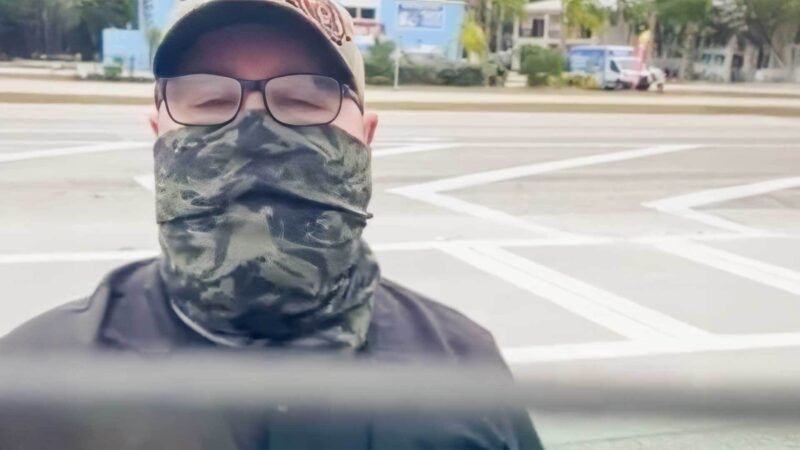
A U.S. Border Patrol officer threatened to arrest a legal observer in Key Largo, Florida, today for following the officer, video of the encounter posted on Instagram shows.
The video is another instance of federal immigration officers threatening and harassing legal observers for conduct that civil liberties groups and multiple federal circuit courts say is firmly protected First Amendment activity.
The observer and activist, a 64-year-old Key Largo man who requested that his name not be printed to avoid retaliation, tells Reason he is part of a local group that tracks federal immigration enforcement activity in the Upper Florida Keys. Key Largo was the scene of a Border Patrol stop in December that generated national headlines after officers dragged a U.S. citizen out of her car.
The observer says he was following an unmarked Customs and Border Protection (CBP) vehicle from a safe distance when the car turned into a restaurant parking lot. The observer says he parked well over 25 feet away from the CBP vehicle, at which point the Border Patrol officer got out of his car, put on a mask, and approached the observer's car. That is where the observer's cell phone video picks up:
View this post on Instagram
"This is your one warning, do you understand this?" the officer says in the video. "One warning. You've been following us around."
"I'm just driving around," the man replies.
"You're following me around. If I continue to see you following me around, I'm gonna pull you over and arrest you," the officer says.
"For what?" the man asks. "What law am I breaking?"
"You're impeding an investigation, OK?"
"What are you going to do, shoot me?" the observer asks, referencing the recent killing of Renee Good by a CBP officer in Minneapolis.
After a short back-and-forth, the officer says, "Oh, you mean that woman that was trying to run them over?" The officer warns the observer again before declaring he's not going to argue about it and returning to his car.
The Department of Homeland Security (DHS) has made it clear through official statements and a long list of similar encounters that it considers following, filming, and warning others of federal immigration agents to be illegal under a rather tortured interpretation of a federal statute that criminalizes physically impeding, resisting, or assaulting federal law enforcement officers.
Although the Supreme Court has declined to address the issue, seven federal circuit courts have firmly upheld the right to record and monitor the police, as long as one doesn't physically interfere with them.
The U.S. Court of Appeals for the 11th Circuit, which covers Florida, ruled in 2000 that there was "a First Amendment right, subject to reasonable time, manner and place restrictions, to photograph or videotape police conduct."
"The First Amendment protects the right to gather information about what public officials do on public property, and specifically, a right to record matters of public interest," the 11th Circuit wrote.
Civil libertarians say the DHS' policy is unconstitutional.
"The right to record publicly visible law enforcement activity is a core First Amendment right," Scarlet Kim, a senior staff attorney with the American Civil Liberties Union's Speech, Privacy, and Technology Project, told Reason last month. "It creates an independent record of what officers are doing, and it is no accident that some of the most high-profile cases of misconduct have involved video recordings. The burning question is why ICE officers feel the need to hide who they are and what they do from the public—masking their faces, lacking visible ID, driving unmarked vehicles, and now attacking those who document their activities."
The incident was actually the second time the observer says he's been harassed. In December, a CBP agent shoved him away from the scene of a traffic stop, even though he was complying with the officer's orders to step back.
"I walked backward as fast as I could, but I'm practically a senior citizen, so I can't move that quickly," the observer says. "And even though I was moving backward, he still decided to shove me and get in my face and also threaten me."
Last October, ICE officers broke out the window of a U.S. citizen's car in Oregon and detained her for seven hours after she followed and photographed their unmarked vehicles. The DHS accused her of reckless driving, attempting to block in officers with her car, and resisting arrest—all claims that she and her lawyer deny. In cell phone video footage, the first question that the ICE officer asks when he approaches the woman's car is, "why are you taking photos?"
In the wake of Good's killing, the Trump administration and Republican lawmakers have continued to paint anti-ICE protesters and monitors as radical extremists. DHS Secretary Kristi Noem said Good had been "stalking and impeding" agents all day prior to her killing.
"Honking your horns, following people is something that absolutely must not be tolerated," Rep. Pete Sessions (R–Texas) said in a TV news interview today. "And I stand completely with the administration on this effort."
However, the arrests, threats, and violence have not kept protesters and legal observers out of the streets since the killing of Good. In fact, it has galvanized some of them.
"My voice was probably shaking a little bit in the video, but now that I'm calmed down and looking back at it, I would do it all over again," the observer says. "I would do it all over again because we just can't let this go. We need to keep track of what these people are doing, and we can't let 'em treat our neighbors like this, and people from other countries, and U.S. citizens. They're literally killing them, and I can't abide by it."
CBP did not immediately respond to a request for comment.