
Hegseth Mulls Releasing a Video That Illustrates the Brutality of Trump's Murderous Anti-Drug Strategy
The footage shows what happened to the survivors of the September 2 attack that inaugurated the president's deadly campaign against suspected drug boats.
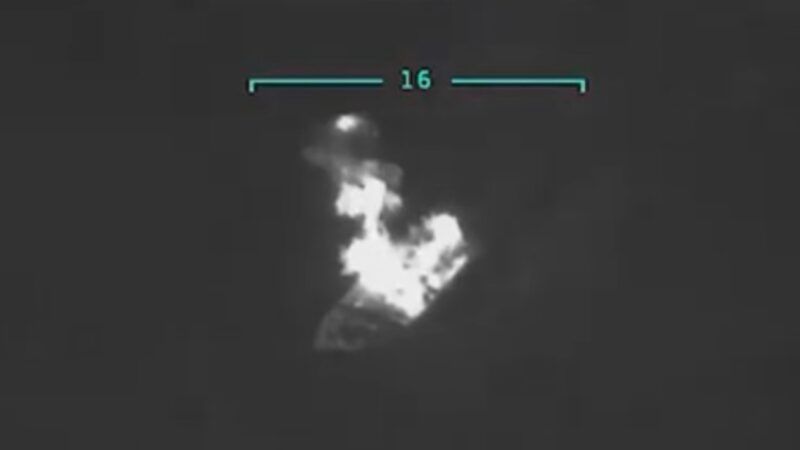
During a Cabinet meeting last Tuesday, Defense Secretary Pete Hegseth invoked "the fog of war" while discussing the newly controversial September 2 attack that inaugurated President Donald Trump's deadly military campaign against suspected drug boats in the Caribbean and the eastern Pacific. The implication was that Adm. Frank M. Bradley, who commanded that SEAL Team 6 operation, ordered a second strike, which blew up two survivors as they clung to the smoldering wreckage, in conditions of uncertainty. Yet Hegseth also said he was convinced Bradley "made the correct decision to ultimately sink the boat and eliminate the threat."
To back up that assessment, Bradley and other Pentagon officials showed lawmakers the full video of the attack, which was executed in the Caribbean near Venezuela, during closed-door briefings on Thursday. Unlike the snippet that Trump and Hegseth posted while bragging about the attack, this video shows what happened after the first missile strike, and it provoked sharply different reactions that broke along partisan lines. Democrats such as Rep. Jim Himes (D–Conn.), the ranking minority member of the House Intelligence Committee, said the video reinforced the impression that the second strike amounted to a war crime. Sen. Tom Cotton (R–Ark.), chairman of Senate Intelligence Committee, told reporters he did not see "anything disturbing" in the video, which he said confirmed that the second strike was "highly lawful."
Americans could judge for themselves which view is more accurate if they were allowed to see the video. On Wednesday, Trump said he saw "no problem" with that. During a Meet the Press interview on Sunday, Cotton likewise said "I personally don't have any problem with" releasing the video, assuming Hegseth decides to declassify it. But on Saturday, Hegseth said he had not yet decided whether to release the video, which he suggested could compromise ongoing U.S. attacks on suspected drug smugglers by revealing information about "sources and methods."
It seems more likely that the video would compromise the Trump administration's defense of the president's bloodthirsty anti-drug strategy, which so far has killed 87 people in 22 attacks. Trump conflates drug smuggling with violent aggression, saying it amounts to "an armed attack against the United States" that justifies a lethal military response. According to that reality-defying theory, suspected cocaine smugglers are "combatants" who can be killed at will, and their unarmed vessels pose a "threat" to U.S. national security that can be neutralized only by completely destroying them. By showing what those positions mean in practice, the video of the September 2 attack would underline the immorality and lawlessness of Trump's policy.
Bradley maintains that the second strike was necessary because the two survivors might have been able to salvage whatever cocaine may have remained on the boat after the first strike. Cotton amplified that argument during his Meet the Press interview on NBC, although he also repeatedly said it does not matter whether that concern was realistic.
The men killed in the second strike were not "helpless survivors," Cotton said. "They were not floating in the ocean on a wooden plank or in life jackets. They were on a capsized vessel. They were not incapacitated in any way. It was entirely appropriate to strike the boat again to make sure that its cargo was destroyed. It is in no way a violation of the law of war."
Himes, who watched the same video, disagrees. "Any American who sees the video that I saw will see the United States military attacking shipwrecked sailors," he told reporters on Thursday. According to the Defense Department's Law of War Manual, "orders to fire upon the shipwrecked would be clearly illegal." The manual says individuals are deemed "shipwrecked" when they are "in distress at sea," "helpless," and "in need of care and assistance," provided they "refrain from any hostile act."
As Bradley and Cotton tell it, the survivors of the initial attack did not fall into that category. "They were not in the water surviving only because they had a life jacket or [were] hanging [onto] a plank of wood," Cotton said on Meet the Press. "They were sitting on that boat. They were clearly moving around on it."
That is rather different from the description that The New York Times offered based on information from people who saw the video. The first strike "destroyed most of the boat," the Times reported. "When the smoke finally cleared about 30 minutes later, the front portion of the boat was overturned but still afloat, according to lawmakers and congressional staff who viewed the video or were briefed on it. Two survivors, shirtless, clung to the hull, tried unsuccessfully to flip it back over, then climbed on it and slipped off into the water, over and over."
The crucial point, according to Cotton, is that the men "weren't floating helplessly in the water." Although "I don't think it matters all that much what they were trying to do," he said, "they looked at one point like they were trying to flip the boat back over, presumably to rescue its cargo and continue their mission."
Perhaps, interviewer Kristen Welker suggested, the men were simply trying to "stay afloat." But "maybe they were signaling to other airplanes or drug cartel boats, because they're in waters that are just off drug cartel areas," Cotton said. "At one point the guy takes off his T-shirt. Maybe he's trying to get a suntan. It doesn't really matter what they were trying to do. What matters is they were not in a shipwrecked state, distressed, dog-paddling in the water at all. And therefore, that boat, its cargo, and those drug traffickers remained valid targets."
According to some lawmakers who watched the video, Welker noted, the men "were waving their arms around." She suggested that "the act of taking off a T-shirt could have been part of an attempt to get attention for help." Cotton replied that "it could have been an attempt to signal to another cartel boat to come pick them up and pick up the cargo." But he reiterated that "it doesn't really matter what they were doing" because "they were on that boat" and "that boat was still a valid target."
Cotton's insistence that "it doesn't really matter" whether the two survivors were trying to "continue their mission," or even whether it is plausible that they could have done so, is striking given that Bradley reportedly emphasized that point in defending the second strike. And there is another problem with Cotton's gloss that also raises questions about the decision to target this boat in the first place.
Citing an NBC report, Welker noted that Bradley "told the lawmakers the drugs were heading first to Suriname"—i.e., away from the United States—and "then ultimately to Europe or Africa." She wondered how "a boat that's not heading to the United States" could reasonably be viewed as "an imminent threat to this country."
Cotton did not have a plausible response to that question. "What we know is that these drug cartels, which are designated foreign terrorist organizations, are trafficking drugs to our shores," he said. "And when we have an opportunity to strike one of these boats, or the intelligence gives us high confidence that everyone on the boat is a valid target because they are associated with these cartels, then I think we need to strike it."
Rep. Adam Smith (D–Wash.), the top Democrat on the House Armed Services Committee, offered a dramatically different take during an interview on ABC's This Week. "Sen. Cotton's description of [the video] is simply not accurate," he said. "The boat was adrift. It was going where the current was going to take it, and these two were trying to figure out how to survive."
When the men "were finally taken out, they weren't trying to flip the boat over," Smith said. "The boat was clearly incapacitated. A tiny portion of it remained, capsized, the bow of the boat. They had no communications device. Certainly they were unarmed." He added that "any claim that the drugs had somehow survived that attack is hard to really square with what we saw."
The Defense Department "ought to release the video," Smith said. "It seems pretty clear they don't want to release this video because they don't want people to see it….If they release the video, then everything that the Republicans are saying will clearly be [seen] to be completely false."
While Cotton said "there's nothing remarkable on that video," Smith found it "deeply disturbing" because "it did not appear that these two survivors were in any position to continue the fight." He also raised a point that goes to the heart of the case for Trump's general policy of summarily executing suspected drug smugglers: "What is the fight exactly?"
The men Bradley killed, Smith noted, were not engaged in combat with U.S. forces or attempting an attack on American targets. They "were trying to bring drugs, and not even to the United States." And although Trump has asserted a "non-international armed conflict" with drug cartels, Smith added, there is "no congressional authorization for this."
The idea that "if maybe there were still drugs somewhere on that boat," it would justify "the use of deadly force" represents "an incredible expansion of presidential power," Smith warned. "If you say anyone who has drugs that they're intending to illegally transit to the U.S. is a legitimate target for deadly force, the amount of power that gives the president and the U.S. military is unprecedented and something that ought to be concerning to all of the American people."
Sen. Adam Schiff (D–Calif.), who appeared on Meet the Press after Cotton, elaborated on that point. "All of these strikes are unlawful," he said. "They're a form of extrajudicial killing. These boats are not invading the United States in an armed assault. They're thousands of miles away. Some of them—maybe even this vessel, if reports are accurate—[weren't] even heading to the United States."
In addition to asserting a nonexistent "armed conflict," Trump and Hegseth routinely call their targets "narcoterrorists." As Schiff noted, that label also does not justify Trump's policy.
Although the government has not publicly identified any of the people whose deaths the president has ordered, Trump said the 11 men killed on September 2 were all members of the Venezuelan gang Tren de Aragua, which the State Department considers a "foreign terrorist organization" (FTO). That description is counterintuitive as applied to a profit-motivated criminal organization, as opposed to a religious or ideological group that uses violence for political ends. In any event, an FTO designation, which authorizes the Treasury Department to block transactions involving a listed group's assets and triggers criminal penalties for providing it with "material support or resources," is not a license to kill anyone said to be associated with an FTO.
"The fact that the administration may put a group of organizations…on a list," Schiff noted, "doesn't confer on a president the ability to kill them at sea. You could put anyone you want on a list. It doesn't make it lawful to say, 'I can now kill them.'"
All the talk of an "armed conflict" with "narcoterrorists," in short, is an attempt to disguise what is really happening. Instead of intercepting and arresting suspected drug smugglers, which was the practice until September 2, Trump has unilaterally decided to kill them from a distance without legal authorization or any semblance of due process, simultaneously abandoning longstanding principles of criminal justice and obliterating the traditional military distinction between civilians and combatants. The video that Hegseth isn't sure he wants to release would vividly illustrate that policy's implications.
On Sunday, Himes noted the Pentagon's "shifting explanations" for the second strike. Immediately after the attack, he said during an interview on the CBS show Face the Nation, members of Congress were told "we needed to clear the wreckage so that there wasn't a danger to navigation." Then "right before we watched the video," Himes said, the explanation was that the survivors "might have had a radio," "might have been radioing a boat," and "might have been trying to recover the cocaine." But "when you actually watch the video," he noted, "you realize they don't have a radio," and "they're barely hanging on" to what remains of the boat. Then the claim became that they were "trying to right the boat," even though "the conflagration" from the first missile strike "probably destroyed everything in that boat."
What about "the fog of war"? "There was no fog," Himes said. The military "watched the wreckage of the boat very carefully for a long period of time before they took the second strike." He argued that "what Pete Hegseth says about this strike has zero credibility at this point," which is why "it's really important that this video be made public."
The two survivors "were barely alive, much less engaging in hostilities," Himes said. "There's a certain amount of sympathy out there for going after drug runners, but I think it's really important that people see what it looks like when the full force of the United States military is turned on two guys who are clinging to a piece of wood and about to go under, just so that they have sort of a visceral feel for what it is that we're doing."