
Court Ordered Social Media Personality to Stop Posting About Teenagers He Accused as to Nolan Wells' Death
The temporary restraining order was issued without giving the defendant, who posts as BoogieLowdown, a chance to respond.
The order was issued by a Mississippi state court Oct. 12; the case has just been removed to federal court, which will now consider the defendant's First Arguments arguments against the injunction. Here's the key passage from the injunction, a temporary restraining order that was issued before the defendant could respond:
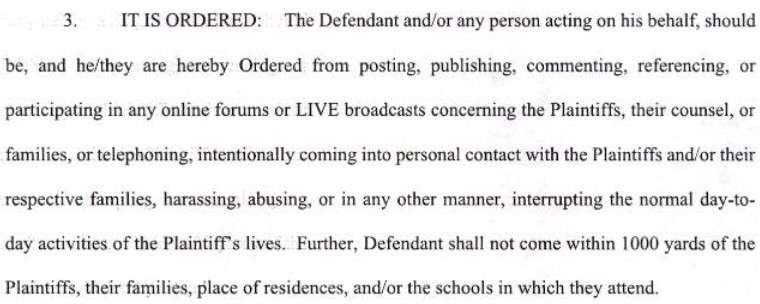
Here's the heart of plaintiffs' argument:
- As shown in the Complaint, Hughes has used two Facebook accounts with a combined audience of more than thirty thousand followers to accuse Plaintiffs of murdering Nolan Xavier Wells, and he has continued to do so after the Jackson County Grand Jury returned a No True Bill. He has stated publicly that he will not stop.
- Hughes has continued since this action was filed. On or about October 11, 2026, he has even resorted to publishing a post accusing Plaintiffs' counsel of having a felony domestic battery charge. When counsel responded, Hughes wrote, "I do not know if this is true or not, which is why I said, allegedly." The accusation is obviously false. Further, on the date of this Emergency Motion, the Defendant has sunk so low as to post pictures of Plaintiff's [perhaps meaning Plaintiffs' counsel's? -EV] wife and children.
- Hughes used the same method against Plaintiffs. On July 9, 2026, he published that they deleted text messages from Nolan's phone, "allegedly." No Plaintiff did so.
- The Plaintiffs and their families have received threats and harassment following Hughes's publications. Should the Court not grant this Emergency Motion, further publications by the Defendant will be posted before Hughes can be served and heard, and the resulting injury to Plaintiffs is immediate and irreparable.
Defendants argue that the order isn't authorized by the Mississippi's Protection from Domestic Abuse Law or by the Mississippi rules governing ordinary temporary restraining orders. But it also argues (I think correctly) that is an overbroad prior restraint that violates the First Amendment:
The order does not merely prohibit threats or harassment. It prohibits speech about the Plaintiffs, their families, and their lawyers—whether truthful or false, threatening or harmless, harassing or not. And it does so before that speech occurs. The Supreme Court has repeatedly condemned such prior restraints, particularly when imposed without notice or an opportunity to be heard.
The Court need not decide whether Mr. Hughes's commentary was fair, tasteful, or justified. The question is whether the law permits this order. It does not. The order should be dissolved, and the motion for a preliminary injunction denied….
A judicial order "forbidding certain communications when issued in advance of the time that such communications are to occur" is a prior restraint…. "Any system of prior restraints on communication bears a heavy presumption against its constitutional validity." Such restraints are unconstitutional "except in exceptional circumstances." .As the Supreme Court held in Organization for a Better Austin v. Keefe (1971), {the party seeking to suppress speech} "carries a heavy burden of showing justification for the imposition of such a restraint." …
The remedy for false or injurious statements lies in "actions under libel laws providing for redress and punishment, and not in proceedings to restrain the publication." [But t]he October 12 Order … does not impose consequences for particular statements adjudicated unlawful. It prohibits Mr. Hughes from speaking about entire categories of people in the future. That is a prior restraint in its most direct form which is presumed unconstitutional….
Test Masters Educ. Servs., Inc. v. Singh (5th Cir. 2005) … recognized that a court may enjoin "harassing communication" and "repeated invasions of privacy." But an injunction prohibiting all communication, rather than limiting itself to "threatening or harassing conduct," "swept too broadly" and constituted an unconstitutional restraint. Id.…
Plaintiffs cannot justify the restraint merely by characterizing Mr. Hughes's commentary as malicious, coercive, or injurious. The Supreme Court rejected that reasoning in Keefe. There, the Court held that an individual's "interest in being free from public criticism of his business practices" did not justify an injunction against speech…. Plaintiffs may have remedies for unlawful conduct. But those remedies do not include an order forbidding Mr. Hughes from speaking about them at all….
Defendant also argues (again correctly, I think) that the order was unconstitutional because defendant wasn't given an opportunity to be heard before the order was entered:
The absence of notice presents a separate constitutional defect. In Carroll v. President & Commissioners of Princess Anne (1968), the Supreme Court set aside a short ex parte order restraining expression because of "a basic infirmity in the procedure by which it was obtained." The order "was issued ex parte, without notice to petitioners and without any effort, however informal, to invite or permit their participation in the proceedings."
The Supreme Court held:
There is a place in our jurisprudence for ex parte issuance, without notice, of temporary restraining orders of short duration; There is no place within the area of basic freedoms guaranteed by the First Amendment for such orders where no showing is made that it is impossible to serve or to notify the opposing parties and to give them an opportunity to participate.
The Court also rejected the suggestion that a later hearing could cure the problem. The availability of a subsequent opportunity to be heard "does not overcome the infirmity in the absence of a showing of justification for the ex parte nature of the proceedings."
The reason is straightforward. "The value of judicial decision-making … is substantially diluted where the process is ex parte, because the Court does not have available the fundamental instrument for judicial judgment: "an adversary proceeding in which both parties may participate." And where First Amendment freedoms are at stake, any order must be "couched in the narrowest terms that will accomplish the pin-pointed objective."
The October 12 Order fails both principles. It was entered without notice or an adversary hearing. It contains no finding that notifying Mr. Hughes was impossible. And far from identifying a narrow category of unlawful speech, it prohibits virtually any online commentary concerning the Plaintiffs, their families, or their counsel.
Carroll is directly controlling on the constitutional defect. An ex parte order restraining expression cannot stand without a showing that notice and participation were impossible. No such showing appears here….