
Kafka's The Trial "Was Not Supposed to Be an Instruction Manual"
In a Fifth Circuit case (which the court just declined to rehear en banc), a woman had faced potential prosecution for publishing a photo of a transgender politician washing hands in a women's restroom.
From Fifth Circuit Judge Priscilla Richman, concurring in the 10-7 vote to deny rehearing en banc in Evans v. Garza (for more on last year's panel opinion, see here):
The statute under scrutiny made it a crime to disseminate a photograph of a person in a restroom under certain circumstances. The photo that Michelle Evans tweeted undoubtedly punctuated her political speech that accompanied the photo. But Michelle Evans could have conveyed her political views without publishing the photo. The Texas statute did not impinge at all on Evans's ability to broadcast to the world that she saw a biological male who is transgender, and who was also a political candidate, use a women's public restroom at the Texas Capitol complex, and to express her strong political views that this should not be permitted.
The question is whether it is likely (since we are at the preliminary injunction stage) that a state has a compelling interest in protecting a person's expectation of privacy in a restroom that is sufficient to outweigh First Amendment free speech rights under the facts of this case. I submit that the answer is "yes."
Evans attended a debate in the Texas House of Representatives at the Texas Capitol about gender reassignment treatment for children. When she visited the women's restroom, she encountered a biological male who is a transgender female, and who was at the time running for election to the Texas House of Representatives. Texas law did not prohibit a biological male who identifies as a female from using a women's restroom….
Evans then returned to her seat in the Capitol gallery, where one of her seatmates showed her that someone else from their group had posted on Facebook a photo of the candidate washing their hands in the women's restroom. Evans posted the photo on Twitter with a caption:
Evans's tweet generated a controversy, and the Travis County District Attorney, José Garza, investigated whether Evans had violated Texas Penal Code § 21.15(b). This statute criminalized—as a state jail felony—transmitting "a visual image of another in a bathroom or changing room" or promoting such a transmission if the action is done without consent and "with intent to invade the privacy of the other person."
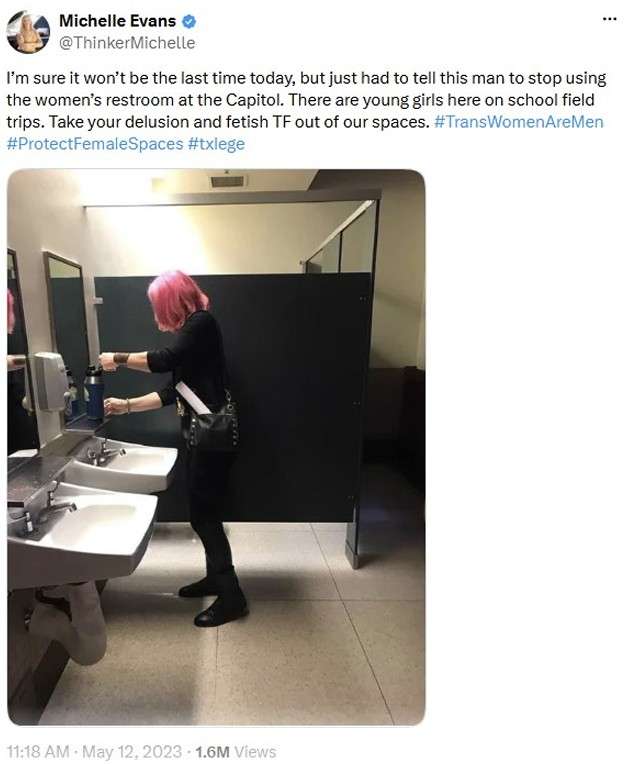
Evans has not been prosecuted, but she sought a temporary restraining order and preliminary injunction in federal court prohibiting Garza from investigating or prosecuting her based on her dissemination of the photograph…. Evans maintains that when the subject of the photograph is "not in a private area of the bathroom and knows they are subject to public view," specifically, when they are "fully clothed, at a sink, washing their hands," others in the restroom have a First Amendment right to photograph the subject, and Evans has a First Amendment right to distribute that photograph. The question is whether the State has an interest in protecting the privacy of those using public restrooms that is sufficient to survive strict scrutiny when the person is photographed fully clothed washing their hands.
No one disputes that a person has a privacy interest not to be photographed in their own home without their permission, certainly not when the intent is to use the photograph to invade the person's privacy. But what happens when a person leaves their home and enters public spaces in a government building? When nature calls, it is unrealistic to think that the person can make it back home to use their own bathroom (which may be in another city or state) or find some other private restroom.
A public restroom has been considered as a practical matter "off limits" to the press once someone crosses its threshold. Traditionally, neither a private citizen nor the press follows a person into a restroom to pursue questioning or to obtain photographs. That is considered, as a matter of tradition, "beyond the pale."
Evans argues, though, that in the case before us, the person who was photographed had left the privacy of a stall to use the sink and therefore should be fair game. This would allow people engaged in a number of activities outside restroom stalls to be photographed without their consent. Outside the confines of a stall, people attend to all sorts of personal needs. Mothers change babies' diapers or nurse them. People adjust clothing or undergarments or change outfits entirely. They dab water on spills on their clothing, perhaps taking off a blouse or shirt or trousers, or hiking up a skirt. Some public bathrooms have sitting areas with couches or other lounge furniture in case a person feels the need to lie down.
Do these activities outside a stall subject people to being photographed without their consent, including surreptitiously, as long as certain body parts are not visible? Is there no constitutional protection when the photograph is taken or disseminated with the intent to invade the privacy of the person?
Does the constitution draw the line at the door to a stall in a women's or men's restroom for purposes of photographing someone? Does the First Amendment require that, once a person exits a stall, mobile phones and cameras may come out? As to urinals, does the First Amendment say cameras can click once the pants or trousers are zipped? Can the press or anyone seeking to photograph celebrities or public figures or other persons of interest enter or even crowd the restrooms of public buildings waiting for the chance to capture the moment the targeted person enters or exits a stall or turns away from a urinal? What of the ordinary person who is also in the restroom and of no interest to the press or to a private citizen on a politically motivated mission? Must the non-targeted individual navigate the press or other photo seekers?
The Texas Legislature reached the considered judgment that everyone, be it the Governor, a member of the Texas House or Senate, a state or federal judge, a political activist, a tourist, or a child, should have protection from being photographed without their consent when in a restroom, when the intent is to invade their privacy. This is a substantial, legitimate state interest.
Evans is not likely to succeed on her claim that strict scrutiny requires states to draw the line at the point when a person has left a stall or finished using a urinal or might otherwise have ceased to be in a position in which their genitalia would be visible. A public restroom in a government building is analogous to a bathroom in one's home. It is a place that sometimes must be frequented to attend to bodily functions that cannot be ignored and to attend to other personal matters normally addressed in a restroom. To say that a person has an expectation of freedom from being photographed only when that person's genitalia might be exposed would confine the right to privacy and seclusion too narrowly.
Some excerpts from Judge James Ho's dissenting opinion:
In [publishing the photo] …, the concurrence only dramatizes the First Amendment violation in this case…. [T]he concurrence invites Evans to "convey[ ] her political views without publishing the photo." But not only is that contrary to bedrock First Amendment law—which protects images as well as words. It's also contrary to the concurrence itself. After all, the concurrence (like Michelle Evans!) chose to publish the photo—presumably because the concurrence agrees with Evans that adding images to words does indeed help to "punctuate[ ]" their message….
The photo [also] confirms that there's no actual violation of privacy here.
After all, the photo depicts the individual in question in precisely the same way that that person chooses to present himself in public. So if that's a violation of privacy, then we have truly lost all understanding of the word.
And we have indeed lost all understanding of privacy. For let us not miss the profound irony here: A man enters a women's bathroom—and it's the man's privacy that is violated?
To borrow from the concurrence: Mothers must "nurse [their babies]," and women must "adjust [their] undergarments," "tak[e] off a blouse," or "hik[e] up a skirt," in the presence of any man who claims he is a woman—and if a woman objects, she's the one who is violating his rights?
The entire point of Evans's message, of course, is that it's a violation of women's privacy for a man to be present in a women's bathroom. So we're turning the law upside down to suggest that men have a privacy right to enter a women's restroom—and women have no First Amendment right to object….
Justice Thomas has observed that "[m]en … are not women …, even if they believe that they are." And to claim otherwise is to "show indifference regarding the truth." If the First Amendment protects nothing else, it protects the right of every American to express the truth. So I'm grateful to have this opportunity to dissent. I only regret that we could not extend that same privilege to Michelle Evans.
And from a concurrence by Judge Andrew Oldham, joined by Judges Edith Jones, Don Willett, James Ho, Stuart Kyle Duncan, and Kurt Engelhardt:
Travis County District Attorney Garza wanted to prosecute Michelle Evans over a tweet. Cf. Rhys Groen, Pakistan Human Rights Lawyers Imaan Mazari and Hadi Chattha Sentenced to 17 Years Over Social Media Posts, Jurist NewsNEWS (Jan. 25, 2026), https://perma.cc/Z4VY-33EC; Hanson v. Faruqi [2026] FCAFC 96 (27 July 2026) (Austl.). Never mind that the tweet constituted political speech. And never mind that criminally charging social-media users for core political speech is tragicomically unconstitutional in this country. DA Garza waged a years-long battle over his right to do so anyway.
Then on the eve of possible en banc rehearing, Garza waved the white flag. With all the tact of a Kafkaesque bureaucrat, Garza blithely informed the court that "previously gathered evidence was not retained," that the limitations period has now run, and that "the office will make arrangements for releas[ing]" Evans's confiscated phone. That assurance of mootness apparently sufficed to defeat the en banc poll.
But it did not vacate the panel opinion in this case. Nor did it give future would-be speakers in Austin any assurance that they can participate freely in public policy debates without worrying about ham-fisted local prosecutors who'll abuse state law to suppress conservative speech. Kafka's Inspector said, "I can't even confirm that you are charged with an offense, or rather I don't know whether you are. You are under arrest certainly, more than that I do not know." Franz Kafka, The Trial. That was not supposed to be an instruction manual.
Judge Cory Wilson also voted for en banc rehearing, but didn't join either of the concurrences.