
Just a 10% Gender Gap in Attitudes on Lindsay Clancy Verdict
From a YouGov Sept. 4-8 survey:
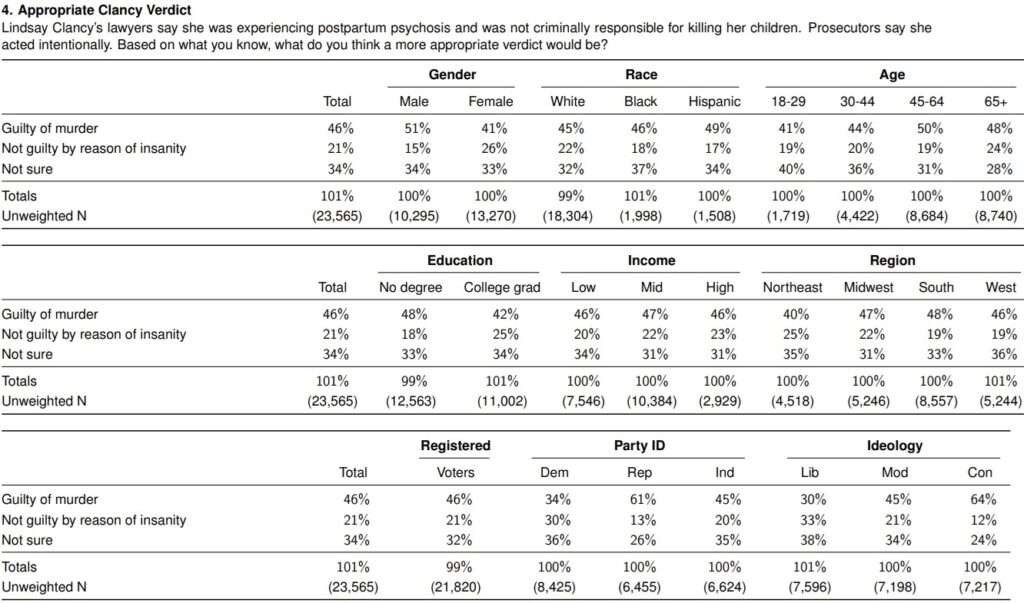
Thus, there's
- a 10-point gender gap, with women being less likely to vote guilty;
- a 4-point gap between Hispanics and whites, with whites being less likely to vote guilty;
- a 6-point gender gap by education, with college graduates being less likely to vote guilty;
- virtually no black-white gap or income gap;
- a 5-to-7-point regional gap between the Northeast and other regions, with Northeasterners being less likely to vote guilty;
- a 3-to-5-point gap between 45-to-64-year-olds and other age ranges, with the other ranges being less likely to vote guilty;
- a huge gap by ideology, which is unsurprising because "ideology" generally captures the sorts of value judgments that underlie these sorts of opinions;
- a huge gap by party identification, which is likewise unsurprising because party identification is closely linked to ideology.
So the gender gap is real, and much of it also persists even controlling for ideology: My Hoover colleague and Stanford political science professor Doug Rivers, who is the chief scientist (and former CEO) of YouGov, tells me that "Among Democrats, 33% of men and 27% of women would find her guilty; among Republicans, 68% of men and 60% of women would find her guilty."
But at the same time the gap is not vast: Again, it's just 10%; only ¼ of women supported a not guilty by reason of insanity verdict. Indeed, even among Democratic women, Doug tells me that only 41% supported a not guilty by reason of insanity verdict, though it was the top response of the three options in that particular subcategory.
Of course, none of this tells us who is right as a general matter, or who is right under the specific jury instructions Massachusetts law provides for such matters. But it is a reminder that gender gaps do exist but are often overstated.