
How Often Are Articles in Top Law Reviews Written In Part By AI?
A guest post from Julian Nyarko.
[Orin Kerr writes: My colleague Julian Nyarko reached out to me with an interesting guest post looking into whether AI is being used to write parts of law review articles published in top journals, using estimates from Pangram's AI detection software. Professor Nyarko's basic finding, as I understand it: Most law review articles published in top journals this year have no AI writing at all, although some have a small amount of AI writing, a handful have a substantial amount, and one article was more than 50% AI-written. I reprint Professor Nyarko's post below. All that follows was written by Professor Nyarko.]
Over the last few weeks, there has been some interesting discussion around the use of AI in the writing of law review articles, with views among legal scholars varying quite widely. To me, the question of whether AI use ought to be prohibited or even just frowned upon is genuinely hard.
In my area of empirical legal studies, I believe most scholars would agree that the process of *thinking* through a project and the process of *writing* the paper, while not unrelated, are largely separate undertakings. This is because empirical analyses are often planned and executed in meticulous detail, and the main figures and tables are created before a single word of the article's narrative prose is drafted. Indeed, the increasingly prevalent practice of preregistration disincentivizes scholars from changing what is thought to be the core contribution--the empirical analysis--during the final stages of writing the paper. Granted, the originally intended framing and the interpretation of the results may undergo some changes during the drafting process. But those are also the parts of a paper that empiricists tend to read most skeptically. In fact, when reading a research article, many empirical scholars make it a point to first examine the tables, figures, and the method section, precisely because they want to get a chance to form their own views on what the data says before looking at the authors' interpretation of it.
That said, I also understand that this sentiment about AI in writing is not necessarily shared within many other legal subfields. When a doctrinal or non-formal theoretical argument is the main contribution, the process of writing it down can infuse precision and rigor, laying bare limitations and nuances that the thinker-writer is then forced to reconcile. The discussion is further complicated by the fact that not all AI use is the same. Among others, AI could be used to write from scratch, to rephrase, to edit, to polish--and to the extent that there is a AI writing displaces thinking, this effect would likely differ across these specific use cases.
But whatever one's preferred normative position is, I thought it would be helpful to get a descriptive sense of how prevalent AI use actually is in legal research. So this is what I want to report on here. Since I personally am not convinced that AI writing should be stigmatized (although I remain open to persuasion), I'm not going to name any articles or authors and will only report a few aggregate results.
The Data & Method
Here is my AI disclosure: Throughout the data collection and analysis, I relied on Codex 5.6 Sol with extra high effort. When I say "I did xyz," it usually means that I had Codex do it. Now let me briefly describe the dataset and methodology, just so it is clear what's being measured. I collected all articles published since January 1 2025 from flagship law reviews of the T14, as measured by the 2026-27 U.S. News ranking.
Because of a three-way tie, this set contains fifteen law reviews. In addition to the 2025 and 2026 articles, I also collected articles published between January 1 and May 28 of 2020. GPT-3 was released on May 29, so this latter set serves as a historical benchmark. In total, the set comprises 571 articles containing 17.3 million words, with the following breakdown:
- 2020 (before May 29): 133 articles
- 2025: 273 articles
- 2026: 165 articles
Using Claude Sonnet 5, I split each article into abstract or opening summary, main body, footnotes, and other material not to be analyzed, like the Table of Contents, headers and appendices. I then fed every article into Pangram 3.3.2, in chunks of approximately 4,000 words each.
Pangram is a highly accurate detection tool for AI-written text. Its own model card suggests that the false positive rate, i.e. the rate at which text is incorrectly flagged as AI-generated, is 0.02% for academic writing. The false negative rate, i.e. the rate of flagging AI-written academic text as human-authored, is 0.00%. An independent study by Brian Jabarian and Alex Imas confirmed the quality of the tool.
To be sure, I am not claiming Pangram is perfect. In fact, I myself found that the tool is often unable to detect AI-written complex contracts, like stock purchase agreements or definitive merger agreements. I suspect this is because the language models generating these contracts are largely reproducing human-written language from publicly available contracts word-for-word. It is at least conceivable that Pangram also performs less-than-ideal on law review articles. Hence the inclusion of the 2020 benchmark.
Pangram estimates the fraction of the chunk that is AI written and the fraction that is written with the assistance of AI. Together, I define these fractions as the "AI signal." If Pangram detected a chunk with any AI signal, my coding agent inspected and--if necessary--cleaned up the chunk to ensure that there are no artifacts that could cause a false positive, such as incorrectly OCR'd characters. Finally, I again inspected every chunk with AI signal to ensure the absence of artifacts. (In this last instance, "I" does refer to me, Julian, as opposed to my coding agent.)
The Findings
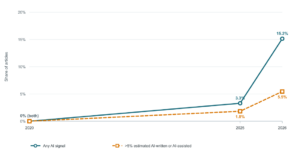
There is no AI signal in the 2020 benchmark set, suggesting that false positives should be very uncommon or nonexistent in this analysis. In 2025, AI use was rare: 9 out of 273 articles (3.3%) have any AI signal, with 5 articles (1.8%) containing an estimated share of AI-generated words exceeding 5%. The estimated share of AI written words across all articles is 0.20% in 2025. By 2026, AI signals became much more prevalent. Pangram identifies 25 out of 165 articles (15.2%) as containing AI-written content. At the article level, this is an increase of approximately 4.6 times over the 2025 rate. A two-sided Fisher exact test yields a p-value of 0.000012, suggesting this increase is statistically significant. 9 articles (5.5%) in 2026 appear to contain more than 5% of AI-generated words, with an overall share of 1.10% words among all articles published this year.
Next, to get a sense of the intensity of current AI use in writing, we can break down the 2026 articles by the estimated proportion of words affected by AI.
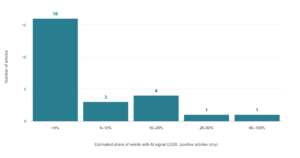
9 of 25 articles contain more than 5% AI generated words, with one article appearing to be predominantly AI-written (the exact share is 64.6%).
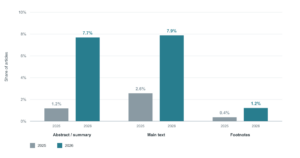
The AI signal is predominantly contained in the main text and the abstract / summary of the articles. Footnotes contain relatively little AI signal. To me, this was somewhat surprising. I would have expected that adding footnotes and parentheticals--often viewed as tedious--might be one of the primary tasks ripe for AI use. Four articles contain signal only in the abstract / summary, nine only in the main text, and the other twelve in multiple parts.
So What?
The results suggest that AI use is widely distributed across articles in T14 flagship law reviews, with a clear increase compared to last year. This suggests that *someone* is using AI more in their writing. The analysis cannot fully trace who that someone is. For minor instances, it could well be the case that law student editors are revising an author's language with the help of AI, which the author then accepts. But although I haven't published in law reviews in a while, my distant memory suggests this mechanism--even if prevalent--would rarely explain AI signal affecting more than 5% of words in any given article.
The analysis also does not identify *how* AI has been used in the writing process. The general patterns do not and cannot differentiate between workflows such as polishing, editing or writing from scratch. For the normative discourse, I suspect these differences should matter, at least to some extent.
More generally, while I'm providing evidence of increased AI use in law review writing, as mentioned at the outset, I don't mean to adjudicate whether this phenomenon is good or bad. The one caveat to that statement concerns Claude-slop. Because while I remain somewhat agnostic about AI-assisted writing, I am less agnostic about having to read load-bearing honest takes that surface the key distinction, do the real work, and explain that the problem is not the prose but the epistemics. That much seems worth stating plainly.
—Julian Nyarko