
"Trendy Eateries May Keep a Secret Menu; the United States Code Does Not"
Some excerpts from the long opinion in R.J. Reynolds Tobacco v. FDA, written by Judge Don Willett and joined in relevant part by Judges Leslie Southwick and James Ho:
When Congress legislates in broad strokes, constitutional trouble sometimes follows. This case presents the opposite problem: Congress legislated with precision, and an agency treated that precision as optional. In the Family Smoking Prevention and Tobacco Control Act (TCA), Congress provided a detailed framework with nine prescribed warning statements that must appear on cigarette packages and advertising, while granting the Food and Drug Administration (FDA) only limited, conditional authority to adjust it. The FDA's rule, however, requires the display of eleven warnings, prompting multiple cigarette manufacturers and retailers (Plaintiffs) to challenge it.
At this preliminary stage, the statutory text points one way: the FDA may require the nine warnings Congress prescribed—no more. The district court agreed and temporarily postponed the Rule's effective date after finding that Plaintiffs had shown a substantial likelihood of success on their claim that the FDA exceeded its statutory authority. Because that interim relief was no abuse of discretion, we AFFIRM….
Relevant here, the TCA made it "unlawful for any person to manufacture, package, sell, offer to sell, distribute, or import for sale or distribution" cigarettes if the package "fails to bear … one of the following labels[.]" The statute then enumerates nine warning labels addressing specific health risks associated with smoking:
- WARNING: Cigarettes are addictive.
- WARNING: Tobacco smoke can harm your children.
- WARNING: Cigarettes cause fatal lung disease.
- WARNING: Cigarettes cause cancer.
- WARNING: Cigarettes cause strokes and heart disease.
- WARNING: Smoking during pregnancy can harm your baby.
- WARNING: Smoking can kill you.
- WARNING: Tobacco smoke causes fatal lung disease in nonsmokers.
- WARNING: Quitting smoking now greatly reduces serious risks to your health….
Congress further directed the FDA to "issue regulations that require color graphics depicting the negative health consequences of smoking to accompany the label statements specified in subsection (a)(1)." These text-and-graphic pairings must appear on the top 50 percent of the front and rear panels of cigarette packages and at least 20 percent of cigarette advertisements. The warning statements must also comply with detailed placement, rotation, and formatting requirements. Despite the TCA's intricate specifications, it grants the FDA modest authority to adjust the warnings in two limited ways….
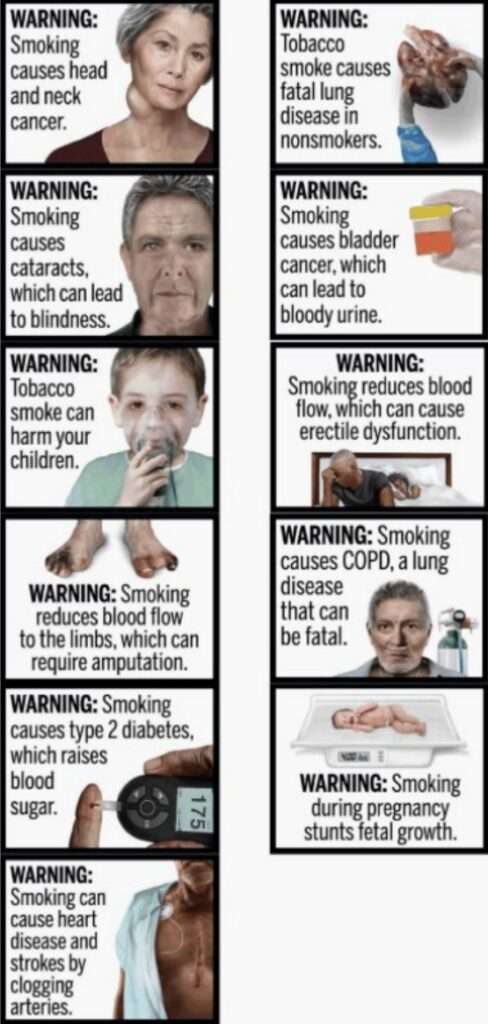
[A later FDA Rule] discarded all but two of Congress's nine statutory warnings and substituted statements of the FDA's own drafting. As a result, the Rule requires cigarette manufacturers and retailers to display a rotating total of eleven warning statements—rather than the nine enumerated in § 1333(a)(1)—each paired with a graphic image depicting a smoking-related health harm … [:]
… As always, we begin with the statutory text—"the alpha and the omega of the interpretive process." The operative provision here, § 1333(a)(1), makes it unlawful to sell or distribute cigarettes whose package "fails to bear, in accordance with the requirements of this section, one of the following labels." It then immediately prescribes the labels to use. Rarely is statutory text this crisp. The command requires a package to bear "one of the following labels," and then lists nine of them—yet the FDA would read nine as eleven. Nine is not a placeholder for eleven….
Consider a familiar analogy: If a restaurant menu says a customer may choose "one of the following sides" followed by a list of nine choices, no ordinary diner reads that as license to order an unlisted tenth. Trendy eateries may keep a secret menu; the United States Code does not. Congress supplied a list of nine labels and required sellers and manufacturers to use one of them on rotation. But the Rule departs from that command. It instead requires packages and advertisements to rotate among eleven warnings—two more than Congress listed. A package bearing one of the extra labels is thus not bearing "one of the following labels" Congress enumerated. That straightforward reading suffices here….
Congress sometimes speaks in gauzy generalities. But Congress steered clear of any concerns attendant to doing so in the TCA. And when Congress opts for precision, agencies must respect that choice, not revise it. Precision in legislation leaves no room for improvisation in execution….
Amelia DeGory, Christian George Vergonis, and Ryan Jeffrey Watson (Jones Day) represent plaintiffs.