
Bernie Sanders' Dangerous and Unconstitutional Plan to Expropriate AI Firms
The plan to seize 50% of AI firms' stock violates the Takings Clause of the Fifth Amendment. It would also create dangerous government control over a vital industry, in ways similar to Trump's policies.
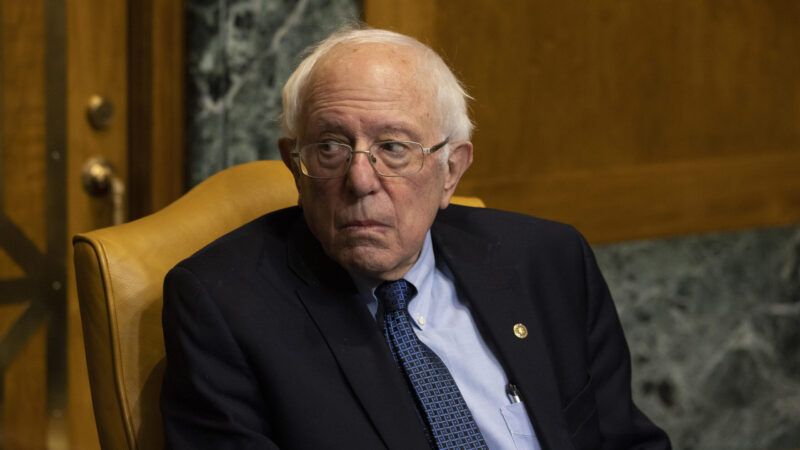

In a recent New York Times article, socialist Sen. Bernie Sanders presented a proposal to have the federal government expropriate 50% of the stock of major AI producers. If enacted by Congress, the plan would violate the Takings Clause of the Fifth Amendment.
Sanders justifies this expropriation by claiming that AI was produced through the "collective knowledge of humanity":
Artificial intelligence was not created out of thin air. The data and language used by generative A.I. tools didn't just pop into Sam Altman's head or Elon Musk's imagination. A.I. is built on our collective intelligence: our books, songs, artwork, journalism, computer code, scientific research, videos, conversations, images and ideas spanning generations. That is not just the opinion of Bernie Sanders.
For the most part, tech oligarchs have fed this knowledge into their A.I. models without permission, without acknowledgment, without compensation. In other words, the creative work of millions of people — writers, artists, musicians, journalists, teachers, scientists and ordinary citizens — has essentially been stolen by some of the wealthiest people in the world. It's time for us to reclaim it.
Since A.I. is built on the collective knowledge of humanity, the wealth it generates must benefit humanity.
The Takings Clause of the Fifth Amendment states that the government may not take "private property" without paying "just compensation."As Richard Epstein and Eduardo Penalver – leading takings scholars with widely divergent views on most political and legal issues – explain in a joint essay on the Takings Clause for the National Constitution Center, "the guarantee of just compensation must apply at the very least to cases in which the government engages in the outright confiscation of property." Stock is private property, and seizing 50% of the stock value of major firms is a pretty obvious case of confiscation.
And it does not matter that Sanders proposes to take "only" 50% of the stock, rather than 100%. If the government seizes half your house or half of your business, that's still a taking. Indeed, the Supreme Court has held that seizing a much smaller proportion of a property is a taking, as in the famous case of Loretto v. Teleprompter, where New York City required the owner of a building to give up a small portion of the roof to put a cable box there. The same principle applies here.
Sanders refers to the seizure as a "one-time 50 percent tax." But that labeling doesn't matter. It's still obviously an expropriation of property, and not simply a tax on the income it generates or even a property tax. One of the key elements of property rights is control over its use. Sanders makes clear that seizing control for the government is a major objective of the proposal. There can be situations where the boundary between a tax and a taking is fuzzy. But this proposal is very obviously on the taking side of the line.
If merely labeling an expropriation like this a tax could immunize the government from takings liability, they could use the same trick to expropriate virtually any property without compensation. Thus, they could take over your house by claiming that it's merely an in-kind tax payable in the form of land-use rights. They could take over any business or charitable organization by claiming that it's a one-time tax payable by turning over the right to control all the organization's activities. And so on.
Sanders could potentially get around Takings Clause constraints by abandoning outright confiscation, and instead having the government pressure firms into giving up control by using regulatory pressure, offering subsidies, or imposing unconstitutional export taxes on those that refuse to comply. Donald Trump has actually used tools like these to acquire stakes in various firms, such as Intel. The Trump administration has recently been considering using such shenanigans to acquire stakes in major AI firms.
The Trump-like approach is, I believe, also subject to a variety of legal objections. But it's less obviously unconstitutional than Sanders' plan for outright confiscation.
In addition to being unconstitutional, the Sanders plan - like Trump's similar policies (which I have forcefully criticized) - is awful on moral and policy grounds. Sanders justifies it on the basis that AI has been "built on the collective knowledge of humanity." That "reasoning" could justify confiscating virtually any property. Pretty much every productive activity relies, in part, on knowledge accumulated by other people previously. Your house, your cellphone, your car, and your refrigerator, are all based on previously developed scientific and other knowledge. Anyone who writes a book or an article is likely building accumulated knowledge, some of it accumulated over many centuries. My writings on democratic theory rely, in part on, ideas that go all the way to the origins of democracy in ancient Greece.
AI producers, like almost everyone else, are building on accumulated knowledge. But they nonetheless make important new contributions, and the government has no right to expropriate them. Consumer choice and competition, not the government, should determine how much value to assign to the AI producers' products, not the state.
To the extent that AI producers may have illegally used others' intellectual property (by using "stolen" creative work, as Sanders puts it), the proper solution is not confiscation by the government, but lawsuits seeking damages. There are, in fact, a number of such cases currently ongoing. Expropriation of AI firms by the federal government would do nothing to compensate people whose intellectual property may have been used without proper authorization. It would just transfer the illegal profit from AI firms to the feds.
Sanders also argues that AI should be under the control of the government because it's an important technology that should not be left to the control of a few billionaires. But a century of experience with socialism shows that government control of major industries leads to horrific results: poverty, oppression, and even mass murder. And for reasons I outlined in detail in this piece, Sanders' brand of "democratic socialism" is unlikely to be much better than the authoritarian kind - nor is it likely to remain democratic for long.
Similar problems arise when right-wing nationalists like Trump seek to impose government control over major industries. On that point, see my 2024 article "The Case Against Nationalism," coauthored with my Cato Institute colleague Alex Nowrasteh. Indeed, the similarity between Trump's policies and Sanders' ideas is an example of how socialists and nationalists advocate similarly awful ideas. It's "Horseshoe theory" at work!
Sanders' progressive supporters would do well to consider whether they want the AI industry - or any major industry - to be controlled by the likes of Trump. Trump isn't the first right-wing demagogue to win an election, and he's unlikely to be the last. Don't give government powers that you are unwilling to have wielded by your political opponents.
It is not true that the only alternative is a few billionaires dominating everything. The AI market is in fact very competitive. Claude, ChatGPT, Grok, Perplexity, and others are rival products competing in this space, produced by different firms. New firms enter the market on a regular basis. And the firms' owners - including billionaires - know they can only make money by meeting consumer demand better than their rivals or at lower cost. That is, so long as they cannot instead rely on government handouts and cronyism of the kind likely to proliferate with greater state control.
AI does pose some risks, and there are legitimate arguments for constraining some types of uses, particularly when it comes to warfare and government surveillance. But the right approach there is restricting dangerous uses, not wholesale expropriation by the government. To the extent that AI is potentially dangerous, government monopoly control over that industry actually exacerbates that danger, by concentrating power in the hands of politicians and their cronies and henchmen.
In sum, Sanders' plan to expropriate a large part of the AI industry is unconstitutional. And it's terrible policy, to boot. On that score, it has much in common with Trump's economic policy agenda.