
How Grand Theft Auto Became the New Monoculture
Once derided as dangerous trash, the violent crime games now aspire to artistic merit.
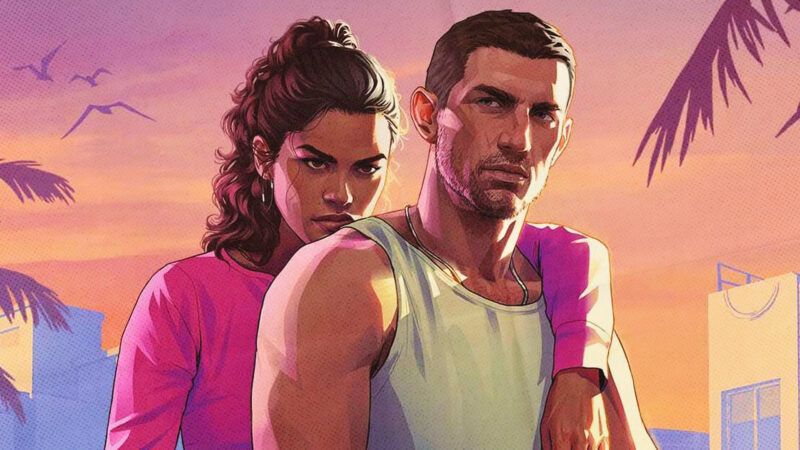
If you have heard anything about the Grand Theft Auto games, it's that they are dangerous to our culture and poisonous to the character of our youth. The games are scuzzy crime-spree simulators, wantonly violent and outrageously vulgar pulp entertainments meant to titillate and thrill, while appealing to the basest impulses of a mostly young, mostly male audience. The gameplay is built around car theft, violence, and general mayhem-making, with storylines that frequently take a back seat to the chaotic pleasures of simply tearing things up while the in-game police try to hunt you down. The games traffic in a glamorous fantasy of outlaw life in which the ultimate freedom is the ability to steal someone's car and run them down without paying a price. Grand Theft Auto offers Dostoyevsky in negative: crime, without punishment.
The series' indulgence of anarchic, destructive impulses has never sat well with the nation's scolds, who tend not to like video games generally and consider these particular video games the apotheosis of all that's degrading and disreputable about the form. Since GTA's debut in the 1990s, activist lawyers such as Jack Thompson have tried to sue the game makers for encouraging violence, conservative pundits have blamed the games for a coarsening of the culture, and politicians, including Hillary Clinton, have called for literal federal investigations. Grand Theft Auto was a scourge, a threat, a national cultural emergency.
This week's long-awaited release of the Grand Theft Auto VI, after 13 years in development and multiple delays, has occasioned some familiar grumbling, with Fox News hosts insisting that the game shouldn't be played by middle-aged men (hard disagree), Atlanta cops telling teens not to try to replicate the game's crimes in real life, and old foes like Thompson emerging from the woodwork to warn that the new game could cause a massacre. Doubtful, at least as long as the servers don't go down.
But what's notable about this release is how muted the criticisms have become. The tut-tutting from the scolds feels more like the cadaveric spasms of the dead than some meaningful going concern. Grand Theft Auto is a broadly accepted part of the culture now, like professional sports. As with sports, there's deep cultural saturation, bordering on inescapability. Even as war rages, major election results continue to come in, and artificial intelligence sits poised to take over the economy, awe-struck reviews and thinky articles about how the game captures the American zeitgeist topped some of the nation's biggest news sites this week.
Grand Theft Auto is the new monoculture, the final vindication of video games as a mass cultural art form. Even former Fox News host Glenn Beck is giving it a chance.
Given this shift in attitudes, it's not hard to imagine a future in which the conservative curmudgeons of Fox (or whatever plays their role in the culture) embrace a warm-and-fuzzy GTA nostalgia, remembering it fondly for its immersive depth and oddball wit, its satirical commentary on youthful amorality, its willingness in a world of distraction to demand that players to commit their full focus and attention on a project that can easily take dozens, even hundreds of hours to complete.
I haven't started playing yet—the game has only been available to the public for a few hours as I write this—but by all accounts, Grand Theft Auto VI is packed with comic character and tragic incident. Set in a sprawling, fictionalized version of South Florida, it's built around a love story positioned against the backdrop of a complex but rapidly fraying society defined by class, desperation, and economic discontent. There are literary references and allusions that span the range of high and low culture, and the game grapples, in its gleefully grotesque way, with all sorts of discourse-friendly hot-button topics, from Nick Fuentes to illegal furries to animal rights activism.
GTA VI invites players to take a break from doomscrolling to experience an elaborate virtual simulation of the culture war—or not. (The truly attention-challenged can scroll social media apps on your in-game phone.) The game's male protagonist also has to repair his front steps, paint the interior of his house, and run errands and go on dates with his girlfriend to keep her happy with their relationship. This is a game about the banality of modernity; it gamifies the mundane. Critics used to warn that GTA trained young men to be antisocial and violent; this one appears more intent on training them for the pro-social drudgery of normie adulthood.
Yes, you can still rob and kill and steal cars and blow things up and indulge in cartoon mayhem. But you can also just…watch birds. (There are reportedly 62 different species to be found.) Perhaps the game is going soft, even woke. Or maybe this is just a more advanced version of what it's been up to the entire time, and the scolds didn't notice.
Grand Theft Auto isn't an escape from the real world so much as a twisted mirror of it, a pulpy, grandiose, and ambitious attempt to capture the entirety of a society that cannot be reduced into a single story or a linear experience.
Once derided as trash, the franchise has taken on literary heft. Writing in The New York Times, Joseph Bernstein analogized the game to a Jorge Luis Borges story about an empire that designs a map as large as the empire itself; Bernstein tried to explain the meaning of its expansiveness through the lens of Baudrillard. GTA VI is the video game equivalent of Anna Karenina or War and Peace, except it will take you even longer to get through it.
The franchise's journey from crude object of political panic and elite scorn to artful cultural totem will be familiar to anyone who has watched the many freakouts over pop provocations over the last century. Elvis. Rap. Comic books. Quentin Tarantino. Violent video games. Pinball. Even reading novels. The scolds have almost always been wrong, and eventually the culture has left them behind. Today's crass, crude, youth culture emergency is tomorrow's masterpiece.