
China Has Become an Excuse To Crack Down on AI Freedom
A coalition of foreign policy hawks and safety activists wants to stop companies from running open-weight AI on their own computers.
For decades, there has been a struggle between open and closed software. In the early 1990s, the U.S. government tried to classify encryption as a military technology and ban Americans from "exporting" encryption software on the internet. In 2001, a Microsoft executive called the open-source movement—which wanted to keep software code open for users to read and modify—an "intellectual-property destroyer."
The same struggle has been playing out with the artificial intelligence boom. Some AI labs release what are called "open-weight" models, which anyone can download, run, and retrain on any computer capable of it. (All the commercial Chinese models, and some models from Google and Meta, are open-weight.) Other labs, including the American "frontier" labs OpenAI and Anthropic, run proprietary models on their own servers and charge users for access. Anthropic began selling its first shares to the public on Thursday.
Open-weight models have some pretty obvious advantages for businesses and computers. Despite being slightly less capable than their frontier competitors, these models make up around 80 percent of traffic on the AI marketplace OpenRouter, which automatically matches users to the best AI model for their request. But a coalition ranging from right-leaning China hawks to the left-leaning "AI safety" movement is banding together to stamp out the freedom to choose.
After the Chinese startup Moonshot AI released the Kimi model in July 2026, creating an open-weight alternative that could compete with the frontier labs, the Trump administration considered banning American companies from running Chinese-made models. Although Anthropic founder Dario Amodei denied rumors that he was pushing for the ban, Amodei wrote that open-weight models "do potentially present a higher risk than closed models, because it is very difficult to apply guardrails to them or monitor their usage, and once weights are released they cannot be withdrawn." He called for "mandatory safety testing" before any model could be released.
During that debate, the chipmaker Nvidia pushed hard to keep open-weight AI legal, against Anthropic's objections. "Our AI leadership will be judged not by one frontier AI model, but by whether the United States builds a strong, open ecosystem that diffuses into every sector," Nvidia founder Jensen Huang wrote at the time. Now that piece is off the chessboard. Huang resigned last week after the exposure of his extramarital affairs.
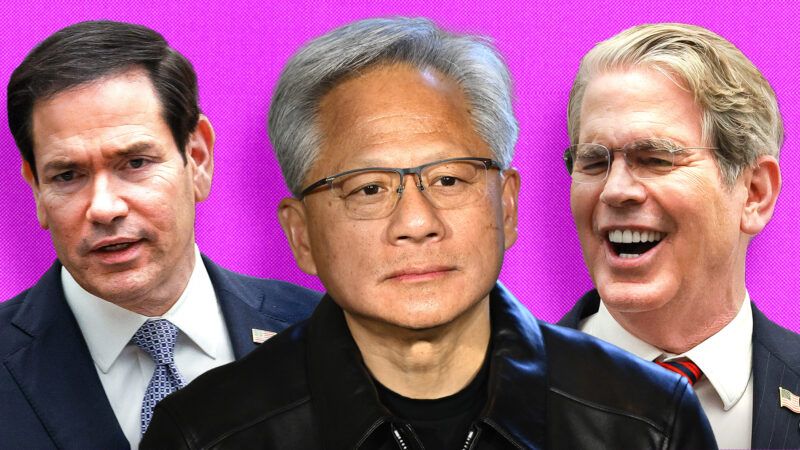
China hawks were quick to portray Huang, a citizen of both the U.S. and Taiwan, as part of a Beijing plot. Secretary of State Marco Rubio wrote a memo, later leaked to the media, portraying one of Huang's alleged mistresses as a Chinese spy. Treasury Secretary Scott Bessent accused Huang of fostering a "culture" of "seemingly illicit" business with China because of his willingness to sell high-end chips to anyone.
The U.S. Department of Commerce announced new export restrictions on Monday, ostensibly meant to stop Chinese models from being trained in data centers outside the country. (About 75 percent of Chinese computing power for AI is hosted in Southeast Asia.) Data centers in Indonesia, Malaysia, Singapore, Thailand, and Brazil are now required to get an extra license to import certain American computer chips, or even to sell these chips inside their own country.
Reuters reports that the U.S. Treasury and the White House Office of Science and Technology Policy are planning a "name and shame" campaign against American companies that run Chinese-made open-weight models; this would include mandatory labeling. House Select Committee on China Chairman John Moolenaar (R–Mich.) has publicly backed the proposal. "Even if a user downloads these models and runs it on their own infrastructure, risks remain," he argued. "Chinese models may have embedded security risks the CCP [Chinese Communist Party] can exploit, and they are trained on censorship regimes that tow the CCP's party line."
Of course, part of the advantage of open-weight models is users' ability to audit and tinker with them. Qwen, an open-weight model released by the Chinese company Alibaba, has been a particularly popular lab rat for AI researchers. Nous Research, an AI lab in Texas, recently released a version of Qwen that was retrained "to reinforce Western values." The lab claims to have demonstrated that "the bias layer in a Chinese-aligned model is shallow" and easy to remove.
In September, researchers at Anthropic published a paper claiming that GLM-5.3, an open-weight model by the Chinese lab DeepSeek, has "lax safeguards" on cybersecurity compared to Anthropic's own models. Their claim was the opposite of Moolenaar's complaint: Rather than being subject to the Chinese government's whims, GLM-5.3 is under no one's control and so hackers can freely use it for cybercrimes. "Attackers can't readily access those [high-end] versions of US models, but anyone can download GLM-5.3," the researchers wrote.
As the tech magazine TNW points out, "openness cut both ways there, since those tests were only possible because the weights were public."
Despite the obvious disadvantages for short-term profitability and control, both the AI industry and the government in China have consciously chosen to favor open weights. For businesses, offering open-weight models is an opportunity to sell computing infrastructure, especially since the best models are too big for a consumer to run at home. For the government, offering open-weight AI has won China a lot of international good will. Still, China's open-weight industry is not entirely lockstep with the government. Last month, Chinese regulators proposed export controls on the highest-end AI capabilities.
Amodei, the Anthropic founder, has tried to tie together his political and safety objections to Chinese AI. He wrote in July that cybercrime and other AI-enabled threats are a "secondary concern" to him, compared to the possibility that "authoritarian governments" use AI "to achieve permanent military superiority or perpetrate incredibly deep repression of their own people." Therefore, Amodei argued, the U.S. government should stop chip exports to China.
Yet Amodei's own vision of AI doesn't leave much room for individual freedom. In "Machines of Loving Grace," an October 2024 essay outlining the benefits of AI, he wrote that "most or all humans may not be able to contribute meaningfully to a sufficiently advanced AI-driven economy." Instead, Amodei proposed an AI-assisted government to "make decisions and processes more impartial" and an "economy of AI systems, which then give out resources…to humans based on some secondary economy of what the AI systems think makes sense to reward in humans."
Huang, the ousted chipmaker, gave a very different vision of advanced AI a week before his ouster from Nvidia. "We love closed models. There's a solid place in the world for closed frontier models. But the world has so many good ideas," he told an audience at the Fireworks Force conference in San Francisco. "By taking an open frontier model, adapting it, and providing it with your domain knowledge, your access to your specialized tools, and the proper evaluation, you should be able to create essentially a superintelligence."