
The Feds Own a $1 Billion Stake in the Military Contractor Being Blamed for the Air Traffic Meltdown
The Pentagon invested $1 billion in L3Harris in January, and the federal government now holds stock in the company. That may complicate the calls for accountability.
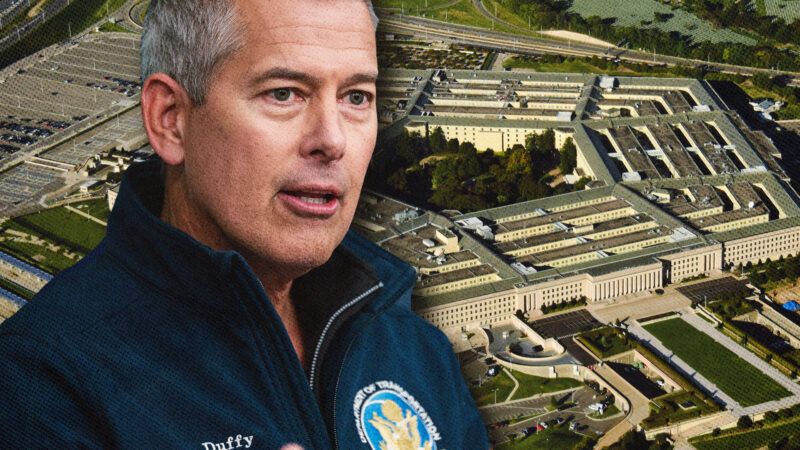
The Trump administration has been blaming a contractor for Friday's air traffic control outage. That accusation should raise new questions about the administration's habit of buying shares in American companies—including that very contractor.
That company is L3Harris Technologies, which among other things operates communication infrastructure for the Federal Aviation Administration (FAA). It was selected to retrofit the Boeing 747 that the government of Qatar gifted to President Donald Trump. About 75 percent of the company's revenue comes from the government, according to The New York Times.
At a press conference on Saturday, Transportation Secretary Sean Duffy said L3Harris "didn't meet the moment." He promised to investigate whether "incompetence" was to blame. "And frankly, we're going to hold people accountable," Duffy said.
Meanwhile, Pentagon officials have already invested $1 billion in L3Harris and taken an equity stake in the company.
That investment, announced in January, was connected to L3Harris's work on rocket motor technology rather than anything directly related to the FAA's communications problems. Still, it makes L3Harris part of the federal government's growing portfolio of theoretically private companies.
An arrangement like that also gives L3Harris an advantage over its competitors. As CNBC noted when the deal was announced, the equity stake "creates a potentially significant conflict of interest for the U.S. government. The Pentagon will have an ownership stake in a company that regularly bids on major defense and other government contracts."
That may complicate Duffy's quest for accountability.
One of the major problems with America's air traffic control system is that the FAA both runs and regulates it, as Reason's Liz Wolfe noted this morning. Privatizing air traffic control—something the Trump administration has sometimes talked about doing—would likely make the system more efficient and accountable.
Getting the government more intimately intertwined with contractors is a decisive step in the opposite direction. The Trump administration's habit of seizing parts of key contractors means the government is not only the customer and regulator for entities like L3Harris, but an investor too.
That will increase the conflicts of interest that already exist within government contracting, and it will reduce the likelihood that anyone is held seriously accountable for Friday's outage. Now, before the government can do anything to punish L3Harris—such as pulling contracts, or taking steps that might limit the company's ability to win contracts in the future—those regulators will have to consider how the move might affect the company's stock price. That's a consideration that should not enter into the equation.
L3Harris has announced that it is "supporting the FAA in its investigation to understand the conditions that led to the Nov. 13 ground stop of our nation's air travel."
That's fine, but that's not all that needs to happen. The federal government should divest from L3Harris—and the dozens of other companies the Trump administration has acquired a piece of—as soon as possible.