
Quaaludes Might Be Back. The Iron Law of Prohibition Never Left.
This counts as progress in the war on drugs?
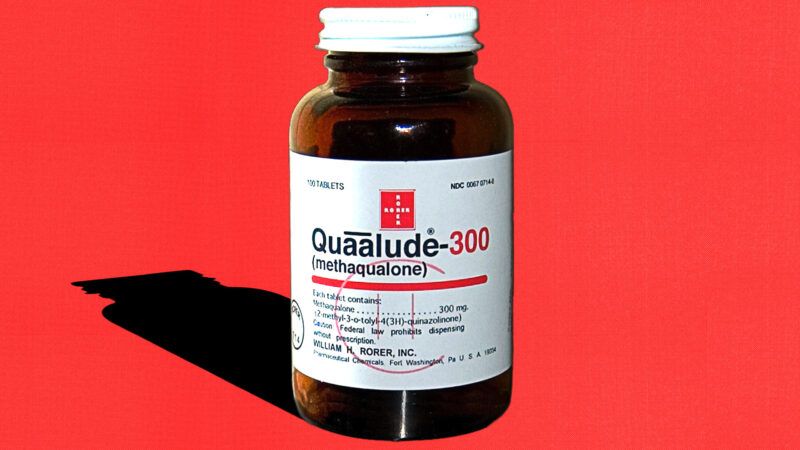
For a drug that has been essentially dead in the United States for four decades, the Quaalude has maintained an impressive cultural presence.
Quaaludes were a staple of the leisure suit/disco era. Anyone who lived through the 1970s probably remembers them. Anyone who didn't may remember Leonardo DiCaprio's extraordinary performance in The Wolf of Wall Street: After swallowing several 15-year-old, supposedly ineffective Quaaludes, his character discovers that the pills aren't quite as ineffective as he thought. Unable to walk, he crawls to the top of a flight of stairs at a country club, curls himself into a ball, and tumbles down them in an attempt to reach his Lamborghini.
The scene is hilarious. The pharmacology behind it isn't.
Quaalude was the trade name for methaqualone, a sedative-hypnotic that became one of America's favorite recreational drugs before virtually disappearing from the U.S. market in the 1980s. Now reports suggest it may be making a comeback—though this seems, for the moment at least, to be a niche phenomenon rather than widespread use.
A Safer Sleeping Pill—What Could Possibly Go Wrong?
First synthesized in India in 1951, methaqualone belongs to a class of drugs called quinazolinones. It entered the American pharmaceutical market in the 1960s as a non-barbiturate treatment for insomnia. Physicians at the time were seeking alternatives to barbiturates, which were effective but notoriously dangerous in overdose.
Methaqualone worked well as a sleeping pill. It also produced euphoria, relaxation, disinhibition, and other effects that made it immensely popular for recreational use. By the 1970s, Quaaludes, particularly the famous 300 mg tablets stamped 714, had become fixtures of American drug culture.
Methaqualone works much like other sedatives, including barbiturates and benzodiazepines, by enhancing the effects of gamma-aminobutyric acid, a neurotransmitter that suppresses activity in the brain. The result is a combination of relaxation and sedation—and at higher doses, impaired judgment and loss of muscular coordination. Combined with alcohol, things get worse fast: Respiratory depression, coma, and death can result.
The supposedly safer alternative to barbiturates had developed a rather barbiturate-like résumé.
Congress Stumbles In
Concerns about misuse, dependence, diversion, and overdoses prompted federal regulators to place methaqualone in Schedule II of the Controlled Substances Act in 1973. Physicians could still prescribe it, but under tighter restrictions.
By the early 1980s, state lawmakers were increasingly targeting methaqualone. Nine states had enacted bans on its sale, and the Drug Enforcement Administration (DEA) slashed the manufacturer's production quota from 58 million tablets in 1978 to just 7.5 million in 1983. Facing shrinking sales, hostile legislation, and adverse publicity, Lemmon, the drug's last American manufacturer, announced in November 1983 that it would stop producing Quaaludes.
But Congress wasn't satisfied. In 1984, lawmakers passed legislation ordering methaqualone moved to Schedule I, the category reserved for drugs deemed to have "no currently accepted medical use and a high potential for abuse." Congress bypassed the Controlled Substances Act's normal scheduling procedures and ordered the Food and Drug Administration (FDA) to withdraw its approval.
FDA officials, you see, had acknowledged that methaqualone had legitimate medical uses and posed no unique risks compared with other marketed sedative-hypnotics. Even DEA officials questioned the need for legislation. Nevertheless, politicians, many lacking medical or pharmacological expertise, decided they knew better. With the stroke of a pen, Congress effectively declared that an FDA-approved medicine had no accepted medical use. In a 1987 decision concerning the DEA's scheduling of MDMA (a.k.a. "ecstasy" or "molly"), a federal appeals court highlighted the contradiction: Congress had placed methaqualone in Schedule I despite its recognized therapeutic value and FDA approval. The court noted that the DEA itself could not have taken that action under the ordinary scheduling rules.
Methaqualone's risks, benefits, and pharmacological properties hadn't changed. Congress had simply changed its legal status.
The Return of the 'Lude?
Although methaqualone virtually disappeared from the American market, it remained a recreational drug in South Africa, where it was commonly sold under the name Mandrax.
Reports of renewed interest in methaqualone are now accompanied by another development: the emergence of methaqualone analogs, chemical cousins that may differ in potency and toxicity. The pattern resembles what we're seeing today with fentanyl analogs. A 2026 review reported that some methaqualone derivatives were roughly 100 times as potent as the original drug, while researchers still know little about their risk in human beings.
In April 2026, the Center for Forensic Science Research and Education reported detecting 2-methoxyqualone, a structural analog of methaqualone, in illicit drug material collected in Pennsylvania and California.
Small changes to a drug's chemical structure can profoundly alter its pharmacological properties. In the case of 2-methoxyqualone, essentially nothing is known about its effects, potency, or toxicity in humans, as is the case with many illicit fentanyl analogs. From a synthetic chemistry standpoint, producing a virtually unlimited variety of methaqualone analogs is trivial, requiring relatively simple chemistry and readily available starting materials.
A 2026 scientific review identified five newer methaqualone analogs reportedly 100 times more potent than the original drug, although those potency estimates remain preliminary. Meanwhile, Australian drug-checking researchers identified a pill submitted as a Quaalude that actually contained methylmethaqualone. An earlier American clinical case report documented a patient who believed he had ingested methaqualone but had actually taken another analog, SL-164.
The Iron Law of Prohibition
This emerging market offers another example of what drug policy analysts call the iron law of prohibition. As enforcement raises the risks and costs of supplying prohibited drugs, illicit suppliers have incentives to favor more potent substances that are easier to conceal and transport. Prohibition also encourages underground chemists to develop more potent chemical substitutes or to adulterate existing drugs with other substances to intensify their effects, exposing consumers to products of uncertain composition, potency, or toxicity.
The appearance of methaqualone analogs is consistent with that pattern. Although it is too early to establish that prohibition caused their development or that they are widely used, it's a pretty sure bet.
What we do know is that Congress removed a medically useful drug from the regulated pharmaceutical market, even though its own committee acknowledged methaqualone's accepted medical use. Lawmakers simply decided that the risks of diversion outweighed its therapeutic benefits.
Four decades later, people trying black-market Quaaludes will encounter products of uncertain composition, potency, and purity, lacking the quality controls that accompanied pharmaceutical manufacturing.
Whether Quaaludes will ever regain their former popularity is anyone's guess. Congress banned a drug in the name of protecting the public, and the market that may now be emerging offers consumers chemicals about which scientists know considerably less.
Apparently, that counts as progress in the war on drugs.