
Federal Judge Dismisses DOJ Lawsuit Over Alaska Senate Race, Calling Proposed Remedy 'Infeasible'
Democrats almost certainly engaged in dirty tricks, but to most any politician's relief, being underhanded is not illegal.
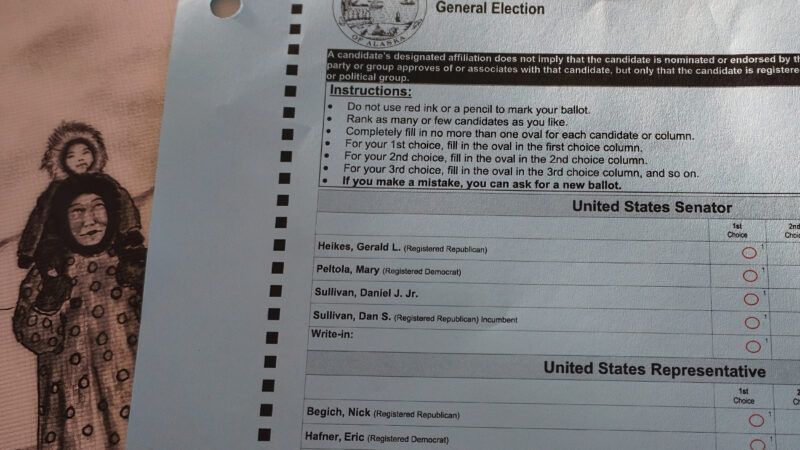
On the eve of the midterms, it may be a bit of a surprise that the Alaska Senate race would be a focus of national attention.
But along with Republican Sen. Dan Sullivan and Democratic challenger Mary Peltola, the ballot will include two other candidates, including a second Dan Sullivan—retired schoolteacher Daniel J. Sullivan.
For months, the latter Sullivan insisted he was a sincere candidate running for a seat in Congress' upper chamber, and sharing a name with the sitting senator was simply a coincidence and not an intentional attempt to siphon votes.
That story fell apart last week, when The New York Times reported that the Peltola campaign and Democratic Party strategists had actively recruited candidates, including Daniel J. Sullivan, to stack the ballot against the Republican senator.
After the Times report, President Donald Trump said Peltola and Daniel J. Sullivan "should be prosecuted." Gov. Mike Dunleavy wrote on X that he had directed state authorities "to investigate whether this scheme violated Alaska's laws and whether criminal charges or civil action are warranted."
The U.S. Department of Justice (DOJ) had already sued, asking the state not to certify the results of the election if the senator lost by a narrow enough margin that it could conceivably have stemmed from confusion over two Dan Sullivans. After the Times piece appeared, the DOJ amended its complaint to include the new revelations.
The Peltola campaign's dirty tricks are certainly disreputable. But to most any politician's relief, being underhanded is not illegal, nor is misleading or even outright lying to voters.
Besides, the government's lawsuit had a number of problems, leading a federal judge to throw it out over the weekend.
"Should Alaska certify any electoral results tainted by the inclusion on the
ballot of Daniel J. Sullivan," the Justice Department's filing warned, "the State and its officers will fail in their obligations to protect the integrity of its election and obstruct Congress's purposes and objectives in enacting various election integrity laws."
For the remedy, it requested that the court "enjoin Defendants from certifying any result" in which Sullivan lost by too narrow a margin, "pending an investigation to determine whether votes cast for Daniel J. Sullivan were meant to be cast for Senator Sullivan."
The DOJ had to contend with Purcell v. Gonzalez, a 2006 decision in which the U.S. Supreme Court cautioned against issuing "court orders affecting elections" too close to Election Day. Whatever remedy the government sought, it would have to get around that proscription.
"The requested relief here would not change the rules of the election," the government explained in an amended complaint. "It would merely require preservation and segregation of potentially tainted ballots, and only if the result may have been impacted by the scheme to confuse voters, pending an investigation."
In other words, if Sullivan (or, presumably, Peltola) did not win by a wide enough margin, the DOJ said the state should set aside all ballots that voted for the other Sullivan and conduct some sort of (unspecified) investigation into whether those voters actually intended to vote for the senator.
"Delaying certification of Alaska's election results—but only if a particular candidate does not win—would interfere with state election administration and threaten election integrity," Alaska officials replied in a motion to dismiss. "Worse, the United States contemplates an open-ended 'investigation' that would violate ballot secrecy."
The DOJ's purported investigation, the Alaskan filing added, "would require segregating ballots cast for Daniel J. and identifying them with the voters who cast them, so that those voters could later be interrogated about their intent. But that is not possible. Like every state in the union, Alaska protects the secrecy of the ballot by law, and such an investigation would require violating that secrecy."
In an opinion issued Sunday, Judge Sharon L. Gleason of the U.S. District Court of Alaska agreed.
"Requiring the segregation of ballots cast by voters for Daniel J. Sullivan so that these voters can be further investigated by law enforcement is not a remedy that this Court can or should order as it clearly violate Alaskans' right to a secret ballot," Gleason wrote. "This Court lacks the authority to order that certain ballots cast by Alaskans be segregated so that federal law enforcement officials can conduct an unspecified investigation of the voters who cast them."
"The relief requested here by the United States is 'infeasible,'" Gleason concluded.
For those reasons, as well as the government's inability to give a justification strong enough to get past the Purcell principle, Gleason dismissed the lawsuit, finding that the courts did not have the authority to grant the DOJ's request.
Even if the lawsuit had gotten past those hurdles, it still would have faced an uphill climb.
For one thing, the DOJ explained its authority on the issue by citing the National Voter Registration Act of 1993 (NVRA), noting that "Congress has tasked state officials with 'protect[ing] the integrity of the electoral process.'"
But as the UCLA law professor Richard L. Hasen notes, that clause appears in the act's preamble and does not contain any operative phrases that actually grant rights or authorities.
"If Congress intended to give the federal government these breathtaking powers over states—contrary to American history and tradition—it would not hide such an intent in the preamble of a statute about voter registration," Hasen wrote in an amicus brief. "The plain meaning of the NVRA's preamble gives the United States executive branch no powers over state and local election processes."
All evidence suggests that Daniel J. Sullivan—with the assistance of Democrats—did in fact jump into the race solely to draw votes away from Dan Sullivan, the sitting senator. But that doesn't mean it's illegal to do so. If we could keep people from running for office based solely on the worthiness of their intentions, that would essentially let those in power pick who is allowed to run against them.