
Abdul El-Sayed Would Freeze the Bill of Rights in the 18th Century
The Second Amendment is not confined to 1780s technology.
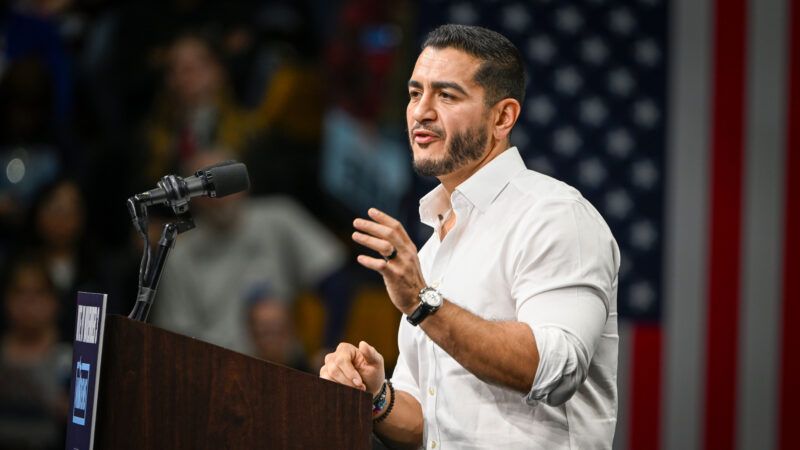
Abdul El-Sayed, Michigan's Democratic U.S. Senate candidate, is the latest politician to suggest that the Second Amendment might shield the right to bear arms, but only those that existed at the time that it was adopted: namely, flintlock muskets. It's a not-so-clever way of trimming back the Constitution's protections. The argument's flaws should be clear: the U.S. Supreme Court has already dismissed that line of reasoning, and a world in which the Bill of Rights applies only to 18th century technology would be one where freedom exists only in museum exhibits.
You are reading The Rattler from J.D. Tuccille and Reason. Get more of J.D.'s commentary on government overreach and threats to everyday liberty.
"Everyone Should Have Equal Rights to a Musket"
"I'm gonna swear an oath to the Constitution. The Constitution has a Second Amendment in it, but the Second Amendment, just so we all are clear, even the most conservative folks, they hew to this idea called originalism, and originalism is the idea that you should interpret the Constitution in the context in which the Constitution was written," El-Sayed insisted at a campaign rally. "When they promised the right to bear arms, they had muskets. So, yeah, everyone should have equal rights to a musket."
So clever. The Bill of Rights passed in the 1780s, so it must only apply to 1780s things. Except that the courts have thoroughly dismissed that ridiculous line of reasoning.
"Some have made the argument, bordering on the frivolous, that only those arms in existence in the 18th century are protected by the Second Amendment," Justice Antonin Scalia wrote for the majority in District of Columbia v. Heller (2008). "We do not interpret constitutional rights that way. Just as the First Amendment protects modern forms of communications…and the Fourth Amendment applies to modern forms of search…the Second Amendment extends, prima facie, to all instruments that constitute bearable arms, even those that were not in existence at the time of the founding."
The Founders Lived in a Time of Rapid Innovation
The reason for this should be obvious. The founders were not unaware of progress. Many of them were scholars and innovators. They were certainly aware of (and enthusiastic about) continuing advancements in technology. During the then-recent revolution, American troops had faced off against a small unit of redcoats armed with Ferguson breech-loading rifles. A decade before the Bill of Rights was adopted, the 22-shot Girandoni repeating air rifle was introduced, one of which was later sent along on the Lewis and Clark expedition. And Kalthoff and Lorenzoni repeating flintlock firearms had existed for well over a century.
Not to mention, the founders made extensive use of printing presses to distribute pamphlets and official government documents, including the new Constitution, rather than having them hand-copied as they would have been a few centuries earlier. Technology marches on.
That last point illustrates the foolishness of the only-1780s-tech argument, as Scalia pointed out. What use is a First Amendment that applies only to hand-cranked printing presses and unamplified voices? That would leave the internet, television, radio, telephones, and all post-revolutionary means of communications unprotected from government censorship.
By the same token, a Fourth Amendment stuck in the 18th century might shield us from government agents kicking in the door and rifling through our papers. But it would have nothing to say about wiretaps, computer searches, surveillance cameras, thermal imaging, and the like.
The Founders Sought To Limit Government, Not Create Small Carve-Outs for People
Founders who were well aware of innovation and often contributed to it themselves (think Benjamin Franklin and Thomas Jefferson) knew that science and technology constantly advance—because they helped it do exactly that—as would the government's intrusive capabilities. And they believed they were creating protections for broad natural rights against limited government, not small carve-outs from the authority of an all-powerful state.
"Rightful liberty is unobstructed action according to our will, within the limits drawn around us by the equal rights of others," Jefferson wrote in 1819. "I do not add 'within the limits of the law'; because law is often but the tyrant's will, and always so when it violates the right of an individual."
The Bill of Rights isn't an ancient artifact to be applied only to a snapshot of life as it existed around 1789. Its amendments are intended to protect timeless individual rights, however those rights might be expressed in an always-evolving world.
El Sayed: "To Protect People From Government Tyranny"
El-Sayed went on, in his increasingly incoherent monologue, to acknowledge that the Bill of Rights was intended "to protect people from government tyranny," and "the idea was that you had the right to bear arms against your government should they become tyrannous." He floated the idea, for some reason, that "the Coast Guard, and state militias" are how this idea was implemented. I don't want to delve too deeply into whatever argument is being presented here, because I've sacrificed enough brain cells by listening to him speak.
But kudos to El Sayed for admitting the Bill of Rights is intended to protect us from government. The only way that can possibly work is if, as government's capabilities become increasingly sophisticated, the protections of the Constitution's first 10 amendments extend to safeguarding our rights from ever more advanced potential intrusions.
The Second Amendment and the rest of the Bill of Rights don't preserve a snapshot of life in the 1780s. They were written to protect eternal principles of individual liberty. And they're certainly not limited to muskets.