
Nuclear Power Now Has Bipartisan Support
Majorities of both major parties now recognize its potential as a more clean and stable energy source.
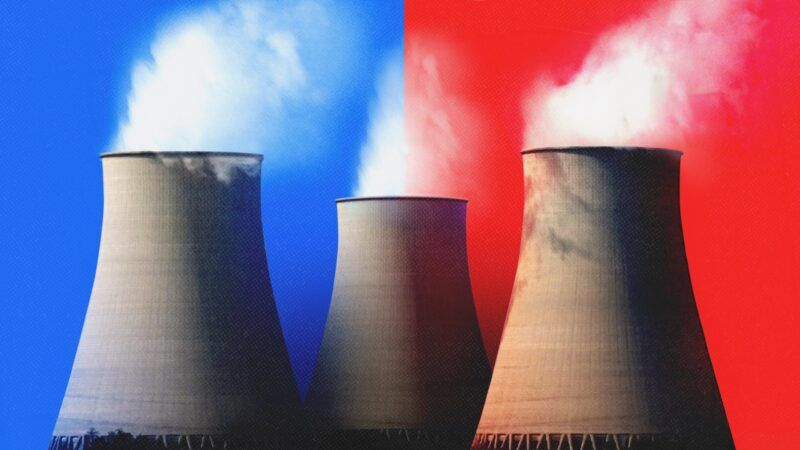
Nuclear power has historically been a divisive issue: During the Cold War, an entire generation feared annihilation at the hands of the same basic technology that some want to use to power their homes.
That's unfortunate, because nuclear energy has considerable benefits—a reliable source of power with very few greenhouse gas emissions—with increasingly lower risks.
Thankfully, it seems that message is catching on with people from both major political parties.
"About six-in-ten U.S. adults now say they favor more nuclear power plants to generate electricity," Pew Research reported in October 2025. "That's up from 43% in 2020, driven by increasing support among both Republicans and Democrats." The authors noted that "Republicans are more likely than Democrats" to favor the policy, with "roughly seven-in-ten Republicans and Republican-leaning independents" expressing support, but it still included 52 percent of Democrats and independents who lean in that direction.
Gallup found similar results earlier this year. The pollster "asked whether the U.S. should put more emphasis, less emphasis or about the same emphasis as it does now on producing domestic energy from each of six sources," wrote Megan Brenan. The six sources were solar, wind, nuclear, natural gas, oil, and coal.
"Nuclear energy is the only one of the six sources to see support grow since 2021, rising seven points to 46%," Brenan added. "This shift is notable given that preferences for nuclear energy had historically been more evenly divided among responses of more, less and the same." Instead, those favoring more emphasis on nuclear power outranked both those who want less and those who wish for it to stay the same, by about 20 points each.
It seems the consensus has been building: In 2024, a poll of first-time voters in The Wall Street Journal found overwhelming support for nuclear energy as a means of fighting climate change.
The trend is welcome, and it marks a major reversal of anti-nuclear sentiment that goes back decades.
The China Syndrome, a film about a possible meltdown at a fictional California nuclear plant, premiered in the U.S. in March 1979. One character in the film warns that a meltdown could "render an area the size of Pennsylvania permanently uninhabitable, not to mention the cancer that would show up later."
Less than two weeks later, in a disastrous bit of timing, a malfunction caused a partial meltdown at the Three Mile Island nuclear power plant near Harrisburg, Pennsylvania.
Thankfully, Three Mile Island was not a disaster. "Some radioactive gas was released a couple of days after the accident, but not enough to cause any dose above background levels to local residents," according to the World Nuclear Association. "There were no injuries or adverse health effects."
But those details were lost on the public. Several recording artists formed Musicians United for Safe Energy (MUSE), an activist group that opposed nuclear power. Just six months after Three Mile Island, MUSE held a series of "No Nukes" concerts at Madison Square Garden, plus a rally in Central Park that drew nearly 200,000 attendees.
That populist support spilled over into politics, particularly among Democrats. Running for president in 1980, Sen. Ted Kennedy (D–Mass.) called for a two-year moratorium on new nuclear plants. In its national platform, the Democratic Party pledged to "retire nuclear power plants in an orderly manner."
After the Three Mile Island incident, 39 planned nuclear plants were canceled.
That's a shame, for many reasons. As Reason's Ronald Bailey wrote in 2018, in a theoretical world where the development of U.S. nuclear power continued at its previous pace, "by 2015 it would have replaced all coal-burning and three-quarters of gas-fired electric power generation….Cumulative global carbon dioxide emissions would be about 18 percent lower, and annual global carbon dioxide emissions would be one-third less."
Yet even decades later, plenty of people—again, particularly Democrats—still opposed nuclear energy.
"Of all the Democratic divides on climate," Politico wrote in 2019, "the role of nuclear power may be the biggest. Progressives and some environmental groups have long lumped it into a category with fossil fuels, and some have spent decades opposing it."
At the time, a number of people were running to be the Democratic Party's presidential candidate, and many of them had strong opinions on nuclear energy. Sen. Elizabeth Warren (D–Mass.) said that she would not license any new nuclear reactors; Sen. Bernie Sanders (I–Vt.) pledged to go one step further and not renew the licenses of any existing reactors.
But things have changed in just a few short years, and nuclear energy is now an issue with potential bipartisan support. When did this pivot take place, and why?
"It was really around 2021, 2022, I would say that things really began to shift," James Walker, CEO of Nano Nuclear Energy, tells Reason. "A lot of the popular support looks like it's coming from younger people….It is a zero-carbon-emission power, and they have been raised to [be] more climate goal-focused" than older generations.
It's not just Gen Z either: Lawmakers are more keen on nuclear power now too. Earlier this month, the MORE American Fuel Act, sponsored by Sens. Cynthia Lummis (R–Wyo.) and Mark Kelly (D–Ariz.), passed the Senate unanimously. The bill "modernizes outdated Nuclear Regulatory Commission (NRC) licensing requirements for uranium enrichment facilities and aligns them with the process already used for other nuclear facilities and reactors," according to a press release from Lummis. It also "lets enrichment companies begin construction at their own risk instead of waiting years for a construction license before breaking ground, while preserving public participation and the NRC's rigorous safety standards."
"What we've seen up in Washington is that there is a nervousness around keeping pace with AI development," Walker adds. "There is a concern that rivals that are also investing very heavily into AI, such as China, are building nuclear reactors like crazy, and one of the reasons they're doing that is just so they have baseload power that allows them to scale up their systems. They are building two gigawatt-scale nuclear power plants every year at the moment, and a lot of it is to try and catch up with the U.S. tech industry."